Results by title
22 books match the query 'Phonology'
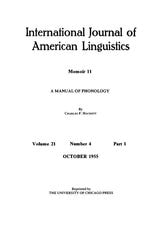
A Manual of Phonology
Edited by Charles F. Hockett
University of Chicago Press, 1988
An Introduction to the Shoshoni Language
Dammen DaigwapeDrusilla Gould
University of Utah Press, 2003
Listen to the open source audio companion to this book:
An Introduction to the Shoshoni Language Chapter 1
An Introduction to the Shoshoni Language Chapter 2
An Introduction to the Shoshoni Language Chapter 3
An Introduction to the Shoshoni Language Chapter 4
An Introduction to the Shoshoni Language Chapter 5
An Introduction to the Shoshoni Language Chapter 6
An Introduction to the Shoshoni Language Chapter 7
An Introduction to the Shoshoni Language Chapter 8
Arabic Sounds and Letters
A Beginning Programmed Course. Textbook and ManualRaji M. Rammuny
University of Michigan Press, 2006
The textbook includes twenty lessons aimed at introducing Arabic sounds and writing system in a programmed method of instruction, supported by images and audio tapes*. The Manual consists of two parts. Part One includes a suggested methodology to guide teachers and students and Part Two contains basic communication needs in both Arabic script and transliteration to create a climate of enjoyable learning while students are acquiring the sounds and letters.
Raji M. Rammuny is Professor of Arabic Studies, Department of Near Eastern Studies, University of Michigan. He is the author of numerous books, including Advanced Standard Arabic through Authentic Texts and Audiovisual Materials, Parts 1 and 2, also published by the University of Michigan Press.
*The CD accompanying Arabic Sounds and Letters can be obtained from the UM Language Resource Center. Contact them by email at flacs@umich.edu or by phone at 734-764-3521.
Bantu Historical Linguistics
Theoretical and Empirical PerspectivesEdited by Jean-Marie Hombert and Larry M. Hyman
CSLI, 1999
Cilungu Phonology
Lee Bickmore
CSLI, 2007
Featuring a reference grammar and formal analysis of Cilungu, this volume will be a major contribution to our understanding of tonology, since several of the forty-four processes analyzed appear to be unique to the language. It also includes a discussion of morphology, both nominal and verbal.

Elements of German
Phonology and MorphologyElmer H. Antonsen
University of Alabama Press, 2007
Elements of German fills a gap in advanced undergraduate and beginning graduate levels of German language study by presenting more advanced concepts of the language in a light intended for practical use rather than theoretical discourse. This text provides a means to improve knowledge and command of grammatically correct German as it is spoken and written. It also introduces methods and tools of linguistic analysis in the areas of phonology and morphology. Unlike books that treat phonology in a cursory way, this text delves into the problems of word formation and the intricacies of inflection and derivation. Exercises are included throughout to help better absorb the rules for real-world language use. This volume provides an in-depth look at the German language from the ground up. Its detailed approach makes this book an excellent complement to the work of less specific grammar textbooks and reviews.

Elements, Government and Licensing
Developments in PhonologyEdited by Florian Breit, Yuko Yoshida, and Connor Youngberg
University College London, 2023
Elements, Government and Licensing covers three principal domains of phonological representation: melody and segmental structure; tone, prosody, and prosodic structure; and phonological relations, empty categories, and vowel-zero alternations. Theoretical topics covered include the formalization of Element Theory, the hotly debated topic of structural recursion in phonology, and the empirical status of government.
In addition, a wealth of new analyses and empirical evidence sheds new light on empty categories in phonology, the analysis of certain consonantal sequences, phonological and non-phonological alternation, the elemental composition of segments, and many more. Taking up long-standing empirical and theoretical issues informed by the Government Phonology and Element Theory, this book provides theoretical advances while also bringing to light new empirical evidence and analysis challenging previous generalizations.
The insights offered here will be equally exciting for phonologists working on related issues inside and outside the Principles and Parameters program, such as researchers working in Optimality Theory or classical rule-based phonology.
Intermediate Biblical Hebrew Grammar
A Student's Guide to Phonology and MorphologyEric D. Reymond
SBL Press, 2018
A unique grammar for intermediate or advanced students of Hebrew
This grammar is intended for students of Hebrew who wish to learn more about the history of the Hebrew language, specifically its phonology and morphology. Reymond focuses on aspects of Hebrew that will encourage a student to better remember the words and their inflection as well as those that will reinforce general principles of the language. Specific examples for memorization are outlined at the end of each chapter. The book also serves as a resource for students wishing to remind themselves of the relative frequency of certain phenomena. The book provides students with a full picture of the language's morphology.
Features:
- Tables of nouns and adjectives illustrating the absolute and construct, singular and plural forms, as well as all the forms with suffixes
- Tables include forms not found in the Masoretic Text
- Additional tables that set similar verbal inflections side by side

Linguistics Of Maya Writing
Soren Wichmann
University of Utah Press, 2004
Morphology and its Relation to Phonology and Syntax
Patrick Farrell
CSLI, 1998
Perspectives in Phonology
Edited by Jennifer S. Cole and Charles Kisseberth
CSLI, 1997

Phonology as Human Behavior
Theoretical Implications and Clinical ApplicationsYishai Tobin
Duke University Press, 1997
Tobin describes the methodological connection between phonological theory and phonetics by way of a comprehensive and insightful survey of phonology’s controversial role in twentieth-century linguistics. He reviews the work of Saussure, Jakobson, Troubetzkoy, Martinet, Zipf, and Diver, among others, and discusses issues in distributional phonology through analyses of English, Italian, Latin, Hebrew, and Yiddish. Using his theory to explain various functional and pathological speech disorders, Tobin examines a wide range of deviant speech processes in aphasia, the speech of the hearing-impaired, and other syndromes of organic origin. Phonology as Human Behavior provides a unique set of principles connecting the phylogeny, ontogeny, and pathology of sound systems in human language.
Phonology in the Twentieth Century
Theories of Rules and Theories of RepresentationsStephen R. Anderson
University of Chicago Press, 1985

Qumran Hebrew
An Overview of Orthography, Phonology, and MorphologyEric D. Reymond
SBL Press, 2014
A unique study of the Hebrew of the Dead Sea Scrolls
In Qumran Hebrew, Reymond examines the orthography, phonology, and morphology of the Dead Sea Scrolls. Short sections treat specific linguistic phenomena and present a synopsis and critique of previous research. Reymond’s approach emphasizes problems posed by scribal errors and argues that guttural letters had not all “weakened” but instead were “weak” in specific linguistic environments, texts, or dialects. Reymond illustrates that certain phonetic shifts (such as the shift of yodh > aleph and the opposite shift of aleph > yodh) occur in discernible linguistic contexts that suggest this was a real phonetic phenomenon.
Features:
- Summary and critique of previous research
- Discussion of the most recently published scrolls
- Examination of scribal errors, guttural letters, and phonetic shifts
Shaping Phonology
Edited by Diane Brentari and Jackson L. Lee
University of Chicago Press, 2018
Divided into two parts, Shaping Phonology first explores the elaboration of abstract domains (or units of analysis) that fall under the purview of phonology. These chapters reveal the increasing multidimensionality of phonological representation through such analytical approaches as autosegmental phonology and feature geometry. The second part looks at how the advent of machine learning and computational technologies has allowed for the analysis of larger and larger phonological data sets, prompting a shift from using key examples to demonstrate that a particular generalization is universal to striving for statistical generalizations across large corpora of relevant data. Now fundamental components of the phonologist’s tool kit, these two shifts have inspired a rethinking of just what it means to do linguistics.

Studies in General Linguistics and Language Structure
N.S. Trubetzkoy
Duke University Press, 2001
Translated by Marvin Taylor and Anatoly Liberman
N. S. Trubetzkoy (1890–1939) is generally celebrated today as the creator of the science of phonology. While his monumental Grundzüge der Phonologie was published posthumously and contains a summary of Trubetzkoy’s late views on the linguistic function of speech sounds, there has, until now, been no practical way to trace the development of his thought or to clarify the conclusions appearing in that later work. With the publication of Studies in General Linguistics and Language Structure, not only will linguists have that opportunity, but a collection of Trubetzkoy’s work will appear in English for the first time.
Translated from the French, German, and Russian originals, these articles and letters present Trubetzkoy’s work in general and on Indo-European linguistics. The correspondence reprinted here, also for the first time in English, is between Trubetzkoy and Roman Jakobson. The resulting collection offers a view of the evolution of Trubetzkoy’s ideas on phonology, the logic in laws of linguistic geography and relative chronology, and the breadth of his involvement with Caucasian phonology and the Finno-Ugric languages.
A valuable resource, this volume will make Trubetzkoy’s work available to a larger audience as it sheds light on problems that remain at the center of contemporary linguistics.
The Geometry of Visual Phonology
Linda Ann N. Uyechi
CSLI, 1996
The Interaction of Tone with Voicing and Foot Structure
Evidence from Kera Phonetics and PhonologyMary D. Pearce
CSLI, 2013
This book investigates the topics of tone, vowel harmony, and metrical structure, with special reference to Kera, a Chadic language spoken in Chad and Cameroon. Kera is a tone language where a change in the pitch of the word can make a difference to its meaning. Drawing on a decade of experience living and working with the Kera, Mary D. Pearce looks at both the phonetics and phonology to examine how tone interacts with the vowel quality and rhythm of the language. The implications arising from this research are relevant for phonologists and Africanists far beyond the boundaries of Chad and should be useful to anyone working on languages with interesting tonal and rhythmic properties.
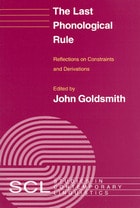
The Last Phonological Rule
Reflections on Constraints and DerivationsEdited by John A. Goldsmith
University of Chicago Press, 1993
In this provocative book, leading linguists and computer scientists consider the challenges that computational innovations pose to current rule-based phonological theories and speculate about the advantages of phonological models based on artificial neural networks and other computer designs. The authors offer new conceptions of phonological theory for the 1990s, the most radical of which proposes that phonological processes cannot be characterized by rules at all, but arise from the dynamics of a system of phonological representations in a high-dimensional vector space of the sort that a neural network embodies. This new view of phonology is becoming increasingly attractive to linguists and others in the cognitive sciences because it answers some difficult questions about learning while drawing on recent results in philosophy, psychology, artificial intelligence, and neuroscience.
The contributors are John A. Goldsmith, Larry M. Hyman, George Lakoff, K. P. Mohanan, David S. Touretzky, and Deirdre W. Wheeler.
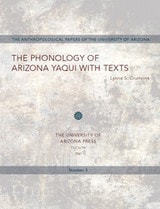
The Phonology of Arizona Yaqui with Texts
Lynne S. Crumrine
University of Arizona Press, 1961

The Phonology-Syntax Connection
Edited by Sharon Inkelas and Draga Zec
University of Chicago Press, 1990

Word Structure in Ngalakgan
Brett Baker
CSLI, 2008