Results by title
14 books match the query 'Photograph collections'

A Curious and Ingenious Art
Reflections on Daguerreotypes at HarvardMelissa Banta
University of Iowa Press, 2000
Around the time Louis Jacques Mandé Daguerre perfected his method for fixing images on polished metal plates in 1839, Harvard was emerging as a modern research institution. Accordingly, the college began amassing vast collections for teaching and research. Among these collections in the university's libraries, museums, archives, and academic departments are some of the earliest photographic documents of American life: daguerreotypes.
A Curious and Ingenious Art brings together a representative sampling of Harvard's internationally significant but relatively unknown collection of daguerreotypes. Many of these images were made for, by, and of members of the university's community and have been in its holdings for more than 150 years. The collection includes the work of some of America's pioneering daguerreotypists, such as Mathew Brady, Southworth and Hawes, and John Adams Whipple. Most notably, the Harvard collection preserved for posterity such faces of the era as Oliver Wendell Holmes, Ralph Waldo Emerson, Harriet Beecher Stowe, Henry James, James McNeill Whistler, Dorothea Dix, Jenny Lind, and even Tom Thumb.
The university also seized upon photography as a tool of scientific research, stunningly exemplified in one of the first detailed daguerreotypes of the moon taken in 1851 as well as in images capturing the emergence of modern anesthesia. An unfortunate misuse of photography is recalled in the now famous slave daguerreotypes commissioned by natural historian Louis Agassiz, who believed in the theory of separate human species.
The Harvard collection represents the early history of photography and its social meaning. The accompanying essays explore the personal, telling histories behind the images, stories that unveil the reflections of individuals who searched for purpose and promise in the new medium.

Beyond Memory
Soviet Nonconformist Photography and Photo-Related Works of ArtEdited by Diane Neumaier
Rutgers University Press, 2004
Photography possesses a powerful ability to bear witness, aid remembrance, shape, and even alter recollection. In Beyond Memory: Soviet Nonconformist Photography and Photo-Related Works of Art, the general editor, Diane Neumaier, and twenty-three contributors offer a rigorous examination of the medium's role in late Soviet unofficial art. Focusing on the period between the mid-1950s and the late 1980s, they explore artists' unusually inventive and resourceful uses of photography within a highly developed Soviet dissident culture.
During this time, lack of high-quality photographic materials, complimented by tremendous creative impulses, prompted artists to explore experimental photo-processes such as camera and darkroom manipulations, photomontage, and hand-coloring. Photography also took on a provocative array of forms including photo installation, artist-made samizdat (self-published) books, photo-realist painting, and many other surprising applications of the flexible medium.
Beyond Memory shows how innovative conceptual moves and approaches to form and content-echoes of Soviet society's coded communication and a Russian sense of absurdity-were common in the Soviet cultural underground. Collectively, the works in this anthology demonstrate how late-Soviet artists employed irony and invention to make positive use of difficult circumstances. In the process, the volume illuminates the multiple characters of photography itself and highlights the leading role that the medium has come to play in the international art world today.
Beyond Memory stands on its own as a rigorous examination of photography's place in late Soviet unofficial art, while also serving as a supplement to the traveling exhibition of the same title.
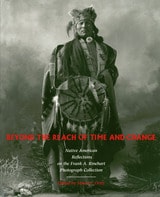
Beyond the Reach of Time and Change
Native American Reflections on the Frank A. Rinehart Photograph CollectionEdited by Simon J. Ortiz
University of Arizona Press, 2004
This book provides an unusual perspective on the Rinehart collection. It features one hundred outstanding images printed from the original negatives made by Rinehart and Muhr at the Congress and over the course of the next two years. It also includes 14 essays by modern Native American writers, artists, and educators—some of them descendants of the individuals photographed—reflecting on the place of these images in their heritage.
Beyond the Reach of Time and Change is not another coffee-table book of historical Indian photographs but rather a conversation between Indian people of a century ago and today. Just as the Rinehart collection offers today's Native Americans a unique connection to the past, this book offers all readers a positive understanding of continuity and endurance within the American Indian community.

French Daguerreotypes
Janet E. Buerger
University of Chicago Press, 1989
Lavishly illustrated, this volume is the first complete catalog of the French daguerreotype collection of the International Museum of Photography at George Eastman House. Janet E. Buerger uses this remarkable collection of images to produce a cultural history of the daguerreotype's most learned following—an elite group of mid-nineteenth-century intellectuals who sought to understand and develop the usefulness, potential, and beauty of this camera image. This varied group, including entrepreneurs, painters, scientists, and historians, enables Buerger to trace the influence of photography into virtually every area of nineteenth-century European intellectual life.
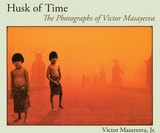
Husk of Time
The Photographs of Victor MasayesvaVictor Masayesva, Jr.; Introduction by Beverly R. Singer
University of Arizona Press, 2006
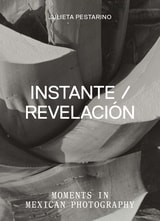
Instante/revelacion
Moments in Mexican PhotographyJulieta Pestarino
J. Paul Getty Trust, The, 2026
Presenting nearly 150 pictures made between 1920 and 2017, Instante/revelación highlights the work of thirteen renowned photographers who feature prominently in the history of the medium in Mexico, including Lola and Manuel Álvarez Bravo, Graciela Iturbide, and Pablo Ortiz Monasterio.
Through a dynamic selection of images, the publication explores some of the intertwined sociocultural forces that shape life and art in Mexico. Among the photographs are stunning presentations of landscapes, architecture, and flora and fauna from across the country; depictions of daily life; and portraits of esteemed Mexican artists and writers such as Diego Rivera, Frida Kahlo, and Octavio Paz. An illustrated essay examines the significant role photobooks and periodicals played in disseminating these images.
The photographers featured in this volume are linked by friendship, influence, and collaboration. Their works, when viewed together as a collective narrative, reveal the spirit of fruitful exchange that characterizes this exciting chapter in Mexico's photographic history.
This volume is published to accompany an exhibition on view at the J. Paul Getty Museum at the Getty Center from September 1, 2026, to January 3, 2027.
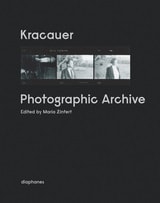
Kracauer. Photographic Archive
Edited by Maria Zinfert
Diaphanes, 2014
Kracauer.Photographic Archive, a companion volume to The Past’s Threshold: Essays on Photography, collects previously unpublished photographs by Siegfried and Elisabeth, “Lili,” Kracauer. With its remarkably rich material, the book tells the story of the Kracauer’s close working relationship, from their marriage in Germany to their escape to Paris and the war and postwar years in the United States. While neither Kracauer nor his wife trained in photography, their portraits, city views, and landscapes evince impressive aesthetic and technical skill, while simultaneously shedding light on their lives marked by exile and flight.
Margaret Mead, Gregory Bateson, and Highland Bali
Fieldwork Photographs of Bayung Gede, 1936-1939Gerald Sullivan
University of Chicago Press, 1999
Margaret Mead, Gregory Bateson, and Highland Bali includes 200 photographs that the couple took between 1936 and 1939, the vast majority of which have never before been published. They vividly capture the everyday lives of the men, women, and children of Bayung Gedé, their homes and their temples, and many other fascinating details of village life not featured in Mead and Bateson's publications.
In a substantial introductory essay, Gerald Sullivan, who selected the photographs, uses excerpts from fieldnotes and correspondence to illuminate Mead and Bateson's ethnographic work. Tracing the project from its inception in their proposals to the publication of their work, Sullivan shows how they used the photographs both as fieldnotes and as elements in their theoretical argument. Finally, he explores what the photographs reveal—independently of Mead and Bateson's project—about the Balinese character to the contemporary viewer.
The result is a both a substantial contribution to visual anthropology and an invaluable supplement to the published works of Margaret Mead and Gregory Bateson.
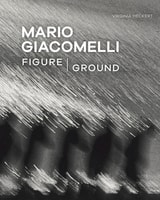
Mario Giacomelli
Figure/GroundVirginia Heckert
J. Paul Getty Trust, The, 2021
Mario Giacomelli (1925–2000) was born into poverty and lived his entire life in Senigallia, a seaside town along the Adriatic coast in Italy’s Marche region. He purchased his first camera in 1953 and quickly gained recognition for the raw expressiveness of his images. His preference for grainy, high-contrast film and paper produced bold, geometric compositions with glowing whites and deep blacks. Giacomelli most frequently focused his camera on the people, landscapes, and seascapes of the Marche, and he often spent several years expanding and reinterpreting a single body of work or repurposing an image made for one series for inclusion in another. By applying titles derived from poetry and literature to his photographs, he transformed ordinary subjects into meditations on time, memory, and existence.
Spanning the photographer’s earliest pictures to those made in the final years of his life, this publication celebrates the J. Paul Getty Museum’s extensive Giacomelli holdings, formed in large part through a significant gift from Daniel Greenberg and Susan Steinhauser.
This volume is published to accompany an exhibition on view at the J. Paul Getty Museum at the Getty Center from June 29 to October 10, 2021.
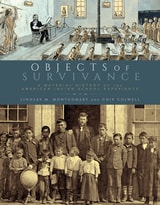
Objects of Survivance
A Material History of the American Indian School ExperienceLindsay M. Montgomery
University Press of Colorado, 2019
This visual and material archive serves as a lens through which to view a key moment in US history—when Native Americans were sequestered onto reservation lands, forced into unfamiliar labor economies, and attacked for their religious practices. Education, the government hoped, would be the final tool to permanently transform Indigenous bodies through moral instruction in Western dress, foodways, and living habits. Yet Lindsay Montgomery and Chip Colwell posit that Bratley’s collection constitutes “objects of survivance”—things and images that testify not to destruction and loss but to resistance and survival. Interwoven with documents and interviews, Objects of Survivance illuminates how the US government sought to control Native Americans and how Indigenous peoples endured in the face of such oppression.
Rejecting the narrative that such objects preserve dying Native cultures, Objects of Survivance reframes the Bratley Collection, showing how tribal members have reconnected to these items, embracing them as part of their past and reclaiming them as part of their contemporary identities. This unique visual and material record of the early American Indian school experience and story of tribal perseverance will be of value to anyone interested in US history, Native American studies, and social justice.
Co-published with the Denver Museum of Nature & Science
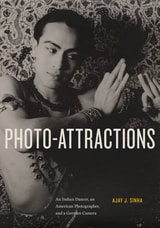
Photo-Attractions
An Indian Dancer, an American Photographer, and a German CameraAjay Sinha
Rutgers University Press, 2022
Art historian Ajay Sinha uses these hitherto unpublished photographs and archival research to raise provocative and important questions about photographic technology, colonial histories, race, sexuality and transcultural desires. Challenging the assumption that Gopal was merely objectified by Van Vechten’s Orientalist gaze, he explores the ways in which the Indian dancer co-authored the photos. In Sinha’s reading, Van Vechten’s New York studio becomes a promiscuous contact zone between world cultures, where a “photo-erotic” triangle is formed between the American photographer, Indian dancer, and German camera.
A groundbreaking study of global modernity, Photo-Attractions brings scholarship on American photography, literature, race and sexual economies into conversation with work on South Asian visual culture, dance, and gender. In these remarkable historical documents, it locates the pleasure taken in cultural difference that still resonates today.

Photographs
Archival Care and ManagementMary Lynn Ritzenthaler
Society of American Archivists, 2006
Proof
Photographs from Four Generations of a Texas FamilyByrd M. Williams IV
University of North Texas Press, 2016
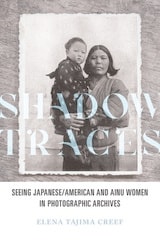
Shadow Traces
Seeing Japanese/American and Ainu Women in Photographic ArchivesElena Tajima Creef
University of Illinois Press, 2022
Innovative and engaging, Shadow Traces illuminates how photographs shape the history of marginalized people and outlines a method for using such materials in interdisciplinary research.