Results by title
3 books match the query 'Photographer'
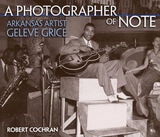
A Photographer of Note
Arkansas Artist Geleve GriceGeleve Grice
University of Arkansas Press, 2003
In a selection of more than one hundred black and white images taken over a period of sixty years, this book bears witness to the life of a remarkable photographer and to small-town African American life in the middle of the twentieth century. Geleve Grice was born and raised near Pine Bluff, and he has documented the ordinary life of his community: parades, graduations, weddings, club events, and whatever else brought people together. In the process he has created a remarkable historical portrait of an African American community. Through his lens we glimpse the daily patterns of segregated Pine Bluff, and we also participate in the excitement of greeting extraordinary visitors. Martin Luther King Jr., Mary McLeod Bethune, Harry S. Truman, and others all came through town.
Folklorist Robert Cochran worked with Grice to select these photographs from the thousands he has taken across a lifetime. They organized the work chronologically, reflecting Grice’s early years in small-town Arkansas, his travel as a serviceman in World War II, and his long career in Pine Bluff. Cochran’s accompanying chapters link Grice to the great tradition of American community photographers. He also shows how work for pay-at the Arkansas Agricultural, Mechanical and Normal College in Pine Bluff; at the Arkansas State Press daily newspaper; through his own studio-shaped Grice’s work. Cochran shows that Grice not only made his living taking photographs for jobs, but that he also made his own life by making photographs for himself-and now for history.

Anna Atkins
Photographer, Naturalist, InnovatorCorey Keller
J. Paul Getty Trust, The, 0
Step into the world of Anna Atkins (1799–1871), perhaps the world’s first female photographer and a pioneer of the medium. She lived an existence full of heartache and triumph, from her mother’s death when Atkins was an infant to her publication of multiple photographic books as an adult. After the passing of her mother, Atkins was raised primarily by her father and grandfather, who placed an emphasis on both her emotional and intellectual growth. As a result, she spent her life surrounded by some of the brightest minds of Victorian England during the Industrial Revolution.
Despite societal gender norms of the time, which typically limited women to a life within the home, Atkins gained the respect of the scientific community with her ambitious multivolume album Photographs of British Algae: Cyanotype Impressions, now recognized as the world’s first photographically illustrated book. Her cyanotypes, in addition to their scientific accuracy, lent artistic beauty to her publications, setting the stage for new uses of this experimental technology. In an era replete with state-of-the-art inventions and innovative ideas, Atkins pushed photography forward in its earliest days with courage, creativity, and brilliance.
Ages thirteen and up.
Please note that this title is sold and distributed in North America by ABRAMS, New York.
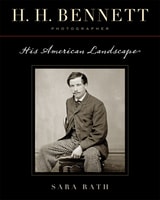
H. H. Bennett, Photographer
His American LandscapeSara Rath
University of Wisconsin Press, 2010
"My energies for near a lifetime have been used almost entirely to win such prominence as I could in outdoor photography."—H. H. Bennett
Henry Hamilton Bennett (1843–1908) became a celebrated photographer in the half-century following the American Civil War. Bennett is admired for his superb depictions of dramatic landscapes of the Dells of the Wisconsin River and also for his many technical innovations in photography, including a stop-action shutter and a revolving solar printing house that is now housed at the Smithsonian Institution. With his instantaneous shutter, he gained recognition for his striking images of moving subjects, such as lumber raftsmen shooting the river rapids and his son Ashley leaping in midair from a bluff to the craggy pillar of Stand Rock. Less well-known are Bennett’s splendid urban photographs of nineteenth-century Chicago, Milwaukee, and St. Paul.
This engaging biography of H. H. Bennett tells his life story, illustrated throughout with his remarkable photographs, some of them rarely viewed before. It draws on the photographer’s own letters and journals, along with other family documents, to portray the sweep of his career and personal life. An important figure in the history of photography, he also contributed to the growth of American tourism: his nationally distributed stereoscopic views of Dells rock formations and his portraits of local Ho-Chunk Indians played a significant role in creating the Wisconsin Dells as the popular tourist destination it is today. Despite personal challenges—a crippling Civil War injury, the death of his first wife, and continual financial worries—Bennett produced an extensive portfolio that captures the midwestern culture of his time. He accepted commissions in the 1890s to document Chicago’s modern skyscrapers, grand residences of Milwaukee’s entrepreneurs and sailing ships in its harbor, enormous scenic panoramas along the routes of Wisconsin railroads, and sparkling ice palaces lit by fireworks at the St. Paul Winter Carnival.
Finalist, Midwest Regional Interest, Midwest Book Awards