Results by title
4 books match the query 'Photographic criticism'
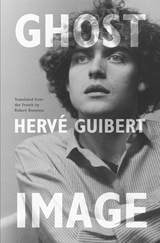
Ghost Image
Hervé Guibert
University of Chicago Press, 2014
Both a memoir and an exploration of the artistic process, Ghost Image not only reveals Guibert’s particular experience as a gay artist captivated by the transience and physicality of his media and his life, but also his thoughts on the more technical aspects of his vocation. In one essay, Guibert searches through a cardboard box of family portraits for clues—answers, or even questions—about the lives of his parents and more distant relatives. Rifling through vacation snapshots and the autographed images of long-forgotten film stars, Guibert muses, “I don’t even recognize the faces, except occasionally that of an aunt or great-aunt, or the thin, fair face of my mother as a young girl.” In other essays, he explains how he composes his photographs, and how—in writing—he seeks to escape and correct the inherent limits of his technique, to preserve those images lost to his technical failings as a photographer.
With strains of Jean Genet and recurring themes that speak to the work of contemporary artists across a range of media, Guibert’s Ghost Image is a beautifully written, melancholic ode to existence and art forms both fleeting and powerful—a unique memoir at the nexus of family, memory, desire, and photography.

Illuminations
Women Writing on Photography From the 1850s to the PresentLiz Heron and Val Williams, eds.
Duke University Press, 1996
Extraordinarily wide-ranging in its scope, this collection chronicles the role of women in photography as critics, historians, and practitioners. Readers will find Julia Margaret Cameron’s bold description of her photographic method, Rosalind Krauss’s exploration of what the camera means for Surrealism, Margaret Bourke-White and Carol Squiers with differing perspectives on Life magazine, as well as essays by Eudora Welty, Susan Sontag, Lucy Lippard, Berenice Abbott, Dorthea Lange, and many others. Illuminations begins with a short piece on the daguerreotype by Elizabeth Barrett Browning then moves through the avant-garde influence of Dada, Bauhaus, and surrealism, to fashion and portrait photography, continuing with documentary and reportage, the emergence of feminist analysis, and postmodern and postcolonial criticism. Encompassing many varied points of view, this volume offers pieces on individual photographers such as Diane Arbus, Ansel Adams, Barbara Kruger, Edward Weston, and Cindy Sherman along with theoretical work by contemporary writers including Jane Gallop, Coco Fusco, and Laura Mulvey.
An historic anthology, Illuminations shows that women have been writing about photography from its beginnings and have intervened in the key debates of the past century and a half. It will welcomed by those interested in photography, gender studies, and women and the arts.
Contributors. Berenice Abbott, Dawn Ades, Susan H. Aiken, Jan Avgikos, Elizabeth Barrett Browning, Margaret Bourke-White, Deborah Bright, Susan Butler, Julia Margaret Cameron, Cynthia Chris, Louise Dahl-Wolfe, Gen Doy, Olive Edis, Ute Eskildsen, Andrea Fisher, Gisèle Freund, Coco Fusco, Jane Gallop, Nan Goldin, Jewelle Gomez, Jan Zita Grover, Judith Mara Gutman, Maria Morris Hambourg, Liz Heron, Alice Hughes, Karen Knorr, Rosalind Krauss, Annette Kuhn, Dorothea Lange, Therese Lichtenstein, Lucy Lippard, Catherine Lord, Mary Warner Marien, Elizabeth McCausland, Roberta McGrath, Lee Miller, Tina Modotti, Lucia Moholy, Laura Mulvey, Carole Naggar, Nancy Newhall, Amy Rule, Lauren Sedofsky, Ingrid Sischy, Abigail Solomon-Godeau, Susan Sontag, Jo Spence, Carol Squiers, Varvara Stepanova, Anne Tucker, Eudora Welty, Dorothy Wilding, Val Wiliams, Anne-Marie Willis, Madame Yevonde
The Cruel Radiance
Photography and Political ViolenceSusie Linfield
University of Chicago Press, 2010
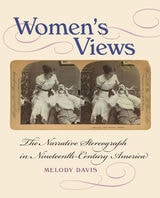
Women's Views
The Narrative Stereograph in Nineteenth-Century AmericaMelody Davis
University of Massachusetts Press, 2015
In this remarkable book, Melody Davis analyzes the underexamined genre of narrative stereoviews and their audiences. Because stereoviews were created for and marketed primarily to middle-class women in domestic settings, Davis argues that they represent one of the best sources for addressing the flow of historical change in women's lives. By analyzing dozens of stereoviews—including depictions of gender stereotypes, power dynamics, comical or sentimental situations, and scenes of both serious and playful innuendo—Davis energetically spins a broad history of the real social, sexual, and economic changes in the lives of American women. Her close reading and rich contextualization of these compelling vernacular objects bridge the gaps between the private viewing that took place within the home and the outside world of consumption and power that women were gradually entering.
Illustrated with more than one hundred stereographs and including a three-dimensional viewer, this book will appeal to readers with an interest in U.S. women's history, the history of photography, visual and cultural studies, and American studies.