Results by title
2 books match the query 'Photography of families'
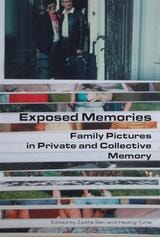
Exposed Memories
Family Pictures in Private and Collective MemoryHedvig Turai
Central European University Press, 2010
Within the larger context of cultural memory, family pictures have become one of the most intriguing multi- and interdisciplinary fields of investigation in the past decade. This field brings together artists working in different media (e.g. documentary photography and film, photo-based painting and installations, digital art, collage, montage, comics, etc.) as well as academics, critics, theorists and writers working in a wide range of disciplines including literature, history, art history, sociology, anthropology, psychoanalysis, film and media studies, visual culture studies, gender studies, postcolonial studies, and word and image studies. This volume intends to offer a broad, panoramic view of the topic combining West and East European as well as American perspectives.
[more]
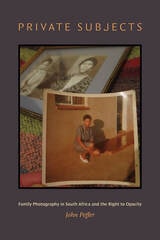
Private Subjects
Family Photography in South Africa and the Right to OpacityJohn Peffer
Duke University Press, 2026
In Private Subjects, John Peffer presents perspectives about everyday uses of photography in predominantly Black South African communities during apartheid to give insight into how these images are seen through the eyes of those who own them today. In South Africa, portrait photography was used to create positive self-images during times of hardship and subjection. Peffer shows how owners limited the distribution of their photographs to close networks of family and friends as a means of establishing control over their own image. He develops an intersubjective method for writing about vernacular photographic experience that keeps the people that appear in those photographs at the center of the story, creating a space to converse about race and history in their own ways rather than be explained from outside the frame. He then considers cultural and legal histories of the ownership of the self-image, theorizes an ethics for looking at others’ private family photographs, and argues for a model of writing and scholarship that protects people’s desires for opacity.
[more]