Results by title
12 books match the query 'Photojournalists'
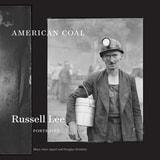
American Coal
Russell Lee PortraitsMary Jane Appel and Douglas Brinkley
University of Texas Press, 2024
More than 100 powerful images by noted photographer Russell Lee that document the working conditions and lives of coal mining communities in the postwar United States; publication coincides with an exhibition at the National Archives in Washington, DC.
In 1946 the Truman administration made a promise to striking coal miners: as part of a deal to resume work, the government would sponsor a nationwide survey of health and labor conditions in mining camps. One instrumental member of the survey team was photographer Russell Lee. Lee had made his name during the Depression, when, alongside Dorothea Lange and Walker Evans, he used his camera to document agrarian life for the Farm Security Administration (FSA). Now he trained his lens on miners and their families to show their difficult circumstances despite their essential contributions to the nation's first wave of postwar growth.
American Coal draws from the thousands of photographs that Lee made for the survey—also on view in the US National Archives and Records Administration’s exhibition Power & Light—and includes his original, detailed captions as well as an essay by biographer Mary Jane Appel and historian Douglas Brinkley. They place his work in context and illuminate how Lee helped win improved conditions for his subjects through vivid images that captured an array of miners and their communities at work and at play, at church and in school, in moments of joy and struggle, ultimately revealing to their fellow Americans the humanity and resilience of these underrecognized workers.
Corner of the Dead
Lynn Lurie
University of Massachusetts Press, 2008
"I use the camera to block my view," says Lisette. This is the start of her double vision—trying to forget and trying to recall—and her struggle to come to terms with the human capacity for cruelty. But the grim reality in Peru is so overpowering that she carries it with her back to New York and through the rest of her life. Having abandoned a lover along with the fight, she desperately tries to find meaning beyond that of mere survival.
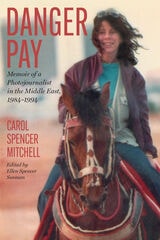
Danger Pay
Memoir of a Photojournalist in the Middle East, 1984-1994By Carol Spencer Mitchell
University of Texas Press, 2008
An engrossing memoir in which a photojournalist records both the precursors to today’s conflicts in the Middle East and her own deeply felt conviction that news coverage of the region actually increases the conflicts there.
"You're going where?" Carol Spencer Mitchell's father demanded as she set off in 1984 to cover the Middle East as a photojournalist for Newsweek and other publications. In this intensely thoughtful memoir, Spencer Mitchell probes the motivations that impelled her—a single Jewish woman—to document the turmoil roiling the Arab world in the 1980s and 1990s, as well as how her experiences as a photojournalist compelled her to set aside her cameras and reexamine the way images are created, scenes are framed, and "real life" is packaged for specific news stories.
In Danger Pay, Spencer Mitchell takes us on a harrowing journey to PLO military training camps for Palestinian children and to refugee camps in the Gaza Strip before, during, and after the first intifada. Through her eyes, we experience the media frenzy surrounding the 1985 hijackings of TWA Flight #847 and the Italian cruise liner Achille Lauro. We meet Middle Eastern leaders, in particular Yasser Arafat and King Hussein of Jordan, with whom Spencer Mitchell developed close working relationships. And we witness Spencer Mitchell's growing conviction that the Western media's portrayal of conflicts in the Middle East actually helps to fuel those conflicts—a conviction that eventually, as she says, "shattered [her] career."
Although the events that Spencer Mitchell records took place decades ago, their repercussions reverberate in the MIddle Eastern conflicts of today. Likewise, her concern about "the triumph of image over reality" takes on greater urgency as our knowledge of the world becomes ever more filtered by virtual media.
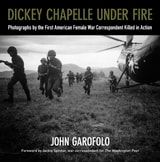
Dickey Chapelle Under Fire
Photographs by the First American Female War Correspondent Killed in ActionJohn Garofolo
Wisconsin Historical Society Press, 2026
Striking photographs and stories from more than two decades on the frontlines by a groundbreaking photojournalist—and the first female American war correspondent to be killed in action.
In 1941, twenty-two-year-old Georgette "Dickey" Chapelle sold her first photo essay to Look magazine. A year later, with World War II underway, she was photographing American soldiers in combat training in Panama. By the end of the war, she had captured the devastation at Iwo Jima and Okinawa, and in the ensuing decades, Dickey and her camera were on the scene at many of the world’s hotspots—from Cuba and the Dominican Republic to Algeria and Lebanon to Vietnam and Laos. Dickey Chapelle Under Fire exposes her remarkable story and shares over 150 stunning images from her extraordinary career as a photojournalist.
In the male-dominated world of war journalism, Chapelle fought to be taken seriously. She eventually earned the respect of many of her male colleagues and broke down barriers for future generations of female journalists. She embedded herself with military units on frontlines around the globe, capturing not only the horrors of war but also the camaraderie and everyday routines of service men and women.
Always one to follow the action, Chapelle traveled with Algerian rebels across the North African desert and with Fidel Castro through the jungles of Cuba. She spent two months in a Hungarian prison after being caught smuggling aid to refugees fleeing a Soviet invasion. Beginning in 1961, Chapelle set her lens and viewfinder on Southeast Asia, capturing the growing conflict there, until she was killed while on patrol with marines in Vietnam in April 1965—making her the first female American war correspondent to be killed in action.
For twenty-five years, Chapelle's photographs graced the pages of National Geographic, the National Observer, Life, and other major publications. Despite her tragic end, Chapelle’s tenacity, courage, and compassion shine throughout her work, highlighting the human impact of war while revealing the larger stories beyond the battlefield. Her legacy lives on through this powerful collection.
Evidence of My Existence
Jim Lo Scalzo
Ohio University Press, 2007
From a leper colony in India to an American research station on the Antarctic Peninsula, from the back rooms of the White House to the battlefields of Iraq and Afghanistan, Evidence of My Existence tells a unique and riveting story of seventeen years spent racing from one photo assignment to the next. It is also a story of photojournalism and theconsequences of obsessive wanderlust.
When the book opens, Jim Lo Scalzo is a blur to his wife, her remarkable tolerance wearing thin. She is heading to the hospital with her second miscarriage, and Jim is heading to Baghdad to cover the American invasion of Iraq. He hates himself for this—for not giving her a child, for deserting her when she soobviously needs him, for being consumed by his job—but how to stop moving? Sure, there have been some tough trips. He’s been spit on by Mennonites in Missouri, by heroin addicts in Pakistan, and by the KKK in South Carolina. He’s contracted hepatitis on the Navajo Nation, endured two bouts of amoebic dysentery in India and Burma and four cases of giardia in Nepal, Peru, Afghanistan, and Cuba. He’s been shot with rubber bullets in Seattle, knocked to the ground by a water cannon in Quebec, and sprayed with more teargas than he cares to recall. But photojournalism is his career, and travel is his compulsivecraving.
We follow Lo Scalzo through the maze of airports and crowds and countries as he chases the career he has always wanted, struggles with his family problems, and reveals the pleasures of a life singularly focused. For him, as for so many photojournalists, it is always about the going.
Get the Picture
A Personal History of PhotojournalismJohn G. Morris
University of Chicago Press, 2002
Find out in Get the Picture, a personal history of fifty years of photojournalism by one of the top journalists of the twentieth century. John G. Morris brought us many of the images that defined our era, from photos of the London air raids and the D-Day landing during World War II to the assassination of Robert Kennedy. He tells us the inside stories behind dozens of famous pictures like these, which are reproduced in this book, and provides intimate and revealing portraits of the men and women who shot them, including Robert Capa, Henri Cartier-Bresson, and W. Eugene Smith. A firm believer in the power of images to educate and persuade, Morris nevertheless warns of the tremendous threats posed to photojournalists today by increasingly chaotic wars and the growing commercialism in publishing, the siren song of money that leads editors to seek pictures that sell copies rather than those that can change the way we see the world.

It Was Always About the Work
A Photojournalist's MemoirMelvin Grier
Ohio University Press, 2023
Over the last six decades, Melvin Grier’s work has vividly portrayed community, humanity, irony, fear, war, elegance, art, and, most notably, the unexpected. It Was Always About the Work includes nearly one hundred black-and-white and color photographs, including photographs from Grier’s most famous exhibitions and news stories. Whether covering local events, Cincinnati life, impoverished villages overseas, young future Marines on their way to their first post, or high fashion, Grier's photos are unmistakable and evocative.
Starting with his early years as a boy growing up in Cincinnati, this book tells the story of a young man who won his first photo contest while in the Air Force. He came home determined to make a career as a photographer, and, despite his lack of formal training and experience, he secured a job as a photographer for the Cincinnati Post. After the closure of the Cincinnati Post in 2007, Grier continued his career as an independent artist, featuring work in exhibitions such as “White People: A Retrospective” and “Clothes Encounters.” In collaboration with one of his journalist partners, reporter Molly Kavanaugh, Grier shares why it was always about the work.
Photography and American Coloniality
Eliot Elisofon in Africa, 1942–1972Raoul J. Granqvist
Michigan State University Press, 2017
Rhetorical Exposures
Confrontation and Contradiction in US Social Documentary PhotographyChristopher Carter
University of Alabama Press, 2015
Exposing the politics of seeing: how documentary photographs confront inequality and reshape public understanding.
In Rhetorical Exposures, Christopher Carter explores social documentary photography from the nineteenth century to the present in order to illuminate the political dimensions and consequences of photographs taken and selected to highlight social injustice. Documentary photography aims to capture the material reality of life. Carter demonstrates how the creation and display of documentary photographs—often now called “imagetexts”—both invite analysis and raise persistent questions about the political and social causes for the bleak scenes of poverty and distress captured on film.
Carter’s carefully reasoned monograph examines both formal qualities of composition and the historical contexts of the production and display of documentary photographs. In Rhetorical Exposures, Carter explores Jacob Riis’s heartrending photos of Manhattan’s poor in late nineteenth-century New York, Walker Evans’s iconic images of tenant farmers in west Alabama, Ted Streshinsky’s images of 1960s social movements, Camilo José Vergara’s photographic landscapes of urban dereliction in the 1970s, and Chandra McCormick’s portraits of New Orleans’s Ninth Ward scarred by Hurricane Katrina.
While not ascribing specifically political or Marxist intentions to the photographers discussed, Carter frames his arguments in a class-based dialectic that addresses material want as an ineluctable result of social inequality. Carter argues that social documentary photography has the powerful capacity to disrupt complacent habits of viewing and to prompt viewers to confront injustice. Though photography may induce socially disruptive experiences, it remains vulnerable to the same power dynamics it subverts. Therefore, Carter offers a “rhetoric of exposure” that outlines how such social documentary images can be treated as highly tensioned rhetorical objects. His framework enables the analysis of photographs as heterogeneous records of the interaction of social classes and expressions of specific built environments. Rhetorical Exposures also discusses how photographs interact with oral and print media and relate to creations as diverse as public memorials, murals, and graphic novels.
As the creation and dissemination of new media continues to evolve in an environment of increasing anxiety about growing financial inequality, Rhetorical Exposures offers a very apt and timely discussion of the ways social documentary photography is created, employed, and understood.
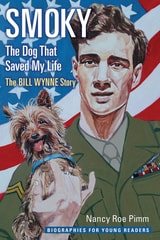
Smoky, the Dog That Saved My Life
The Bill Wynne StoryNancy Roe Pimm
Ohio University Press, 2019
World War II soldier Bill Wynne met Smoky while serving in New Guinea, where the dog, who was smaller than Wynne’s army boot, was found trying to scratch her way out of a foxhole. After he adopted her, she served as the squadron mascot and is credited as being the first therapy dog for the emotional support she provided the soldiers. When they weren’t fighting, Bill taught Smoky hundreds of tricks to entertain the troops. Smoky became a war hero herself at an airstrip in Luzon, the Philippines, where she helped save forty airplanes and hundreds of soldiers from imminent attack.
After the war, Bill worked as a Hollywood animal trainer and then returned to his hometown of Cleveland, Ohio. He and Smoky continued to perform their act, even getting their own TV show, How to Train Your Dog with Bill Wynne and Smoky.
Nancy Roe Pimm presents Bill and Smoky’s story to middle-grade readers in delightful prose coupled with rich archival illustrations. Children will love learning about World War II from an unusual perspective, witnessing the power of the bond between a soldier and his dog, and seeing how that bond continued through the exciting years following the war.

Stanley Kubrick at Look Magazine
Authorship and Genre in Photojournalism and FilmPhilippe D. Mather
Intellect Books, 2013
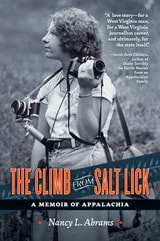
The Climb from Salt Lick
A Memoir of AppalachiaNancy L. Abrams
West Virginia University Press, 2018
The Climb from Salt Lick is the remarkable memoir of an outsider coming into adulthood. It is the story of a unique place and its people from the perspective of a woman who documents its burdens and its beauty, using words and pictures to tell the rich stories of those around her.