Results by title
20 books match the query 'Physician & Patient (incl. Narrative Medicine)'
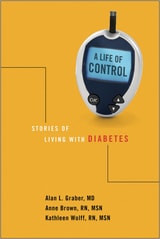
A Life of Control
Stories of Living with DiabetesAlan L. Graber
Vanderbilt University Press, 2010
The people who describe their experiences with diabetes range from teenagers to physicians, immigrants, athletes, pregnant women, accountants, a prisoner, and a dairy farmer. They speak of the variety of ways they handle monitoring, diet, insurance coverage, sports, and fashion. Some talk of how they manage to drive trucks for a living or, for recreation, fly airplanes or go spelunking. Many speak frankly of their anxieties and frustrations.
The authors acknowledge that both the patient and clinician have a story about their relationship, and describe the richness and tension in their interaction. Families, too, are sources of both support and conflict. These relationships are acknowledged in the organization of the book, which is divided into sections defined by the main elements of diabetes control: patient self-determination, the role of the family, the social situation, and the patient-clinician encounter.
The book provides a wealth of information about diabetes, including material on prevention, complications, and new technology, as well as a superb glossary, but it is not intended as a textbook on diabetes or as a self-care manual for patients. Rather the book provides a textured account of the health professional's view of diabetes control and the perspective of the patient whose life is complicated by diabetes.

Alabama and the Borderlands
From Prehistory To StatehoodEdited by R. Reid Badger and Lawrence A. Clayton
University of Alabama Press, 1985
Brings together the nation's leading scholars on the prehistory and early history of Alabama and the southeastern US
This fascinating collection was born of a concern with Alabama's past and the need to explore and explain that legacy, so often hidden by the veils of time, ignorance, or misunderstanding. In 1981 The University of Alabama celebrated its 150th anniversary, and each College contributed to the celebration by sponsoring a special symposium. The College of Arts and Sciences brought together the nation's leading scholars on the prehistory and early history of Alabama and the Southeastern United States, and for two memorable days in September 1981 several hundred interested listeners heard those scholars present their interpretations of Alabama's remarkable past.
The organizers of the symposium deliberately chose to focus on Alabama's history before statehood. Alabama as a constituent state of the Old South is well known. Alabama as a home of Indian cultures and civilizations of a high order, as an object of desire, exploration, and conquest in the sixteenth century, and as a borderland disputed by rival European nationalities for almost 300 years is less well known. The resulting essays in this collection prove as interesting, enlightening, and provocative to the casual reader as to the professional scholar, for they are intended to bring to the general reader artifacts and documents that reveal the realities and romance of that older Alabama.
Topics in the collection range from the Mississippian Period in archaeology and the de Soto expedition (and other early European explorations and settlements of Alabama) to the 1780 Siege of Mobile.
Building Confianza
Empowering Latinos/as Through Transcultural Health Care CommunicationDalia Magaña
The Ohio State University Press, 2021
Death Foretold
Prophecy and Prognosis in Medical CareNicholas A. Christakis
University of Chicago Press, 2000
"Highly recommended for everyone from patients wrestling with their personal prognosis to any medical practitioner touched by this bioethical dilemma."—Library Journal, starred review
"[T]he first full general discussion of prognosis ever written. . . . [A] manifesto for a form of prognosis that's equal parts prediction-an assessment of likely outcomes based on statistical averages-and prophecy, an intuition of what lies ahead."—Jeff Sharlet, Chicago Reader
"[S]ophisticated, extraordinarily well supported, and compelling. . . . [Christakis] argues forcefully that the profession must take responsibility for the current widespread avoidance of prognosis and change the present culture. This prophet is one whose advice we would do well to heed."—James Tulsky, M.D., New England Journal of Medicine
Generalism in Clinical Practice and Education
Edited by Sophie Park and Kay Leedham-Green
University College London, 2024
Generalism is a key approach to healthcare organization and delivery that enables person-centered, dynamic, and cost-effective patient care. With its emphasis on adaptability, generalism requires expansive, nurturing, and personalized approaches to clinical education in which a generalist attends to and explores patient priorities.
Generalism in Clinical Practice and Education outlines a generalist philosophy of practice, which is brought to life through interleaved examples. Written by a range of international clinicians, patients, and academics this book does not prescribe a single way to do generalism properly. Rather, it seeks to inspire readers’ future engagement with generalism in practice and education through sharing underpinning concepts, values, and principles. This ‘big picture’ attention to generalism across public health, social determinants of health, and clinical care is at the heart of sustainable and efficient use of resources to prioritize those in need. The book explores four key principles that aim to achieve creative, inclusive, and agile approaches to clinical care. Its goal is to support generalism in clinical practice and education and to produce clinical practitioners and learners who enjoy, embrace, and enhance future clinical care.
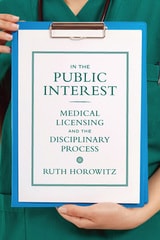
In the Public Interest
Medical Licensing and the Disciplinary ProcessHorowitz, Ruth
Rutgers University Press, 2012
Winner of the American Sociological Association Sociology of Law Section 2013 Outstanding Book Award
How do we know when physicians practice medicine safely? Can we trust doctors to discipline their own? What is a proper role of experts in a democracy? In the Public Interest raises these provocative questions, using medical licensing and discipline to advocate for a needed overhaul of how we decide public good in a society dominated by private interest groups. Throughout the twentieth century, American physicians built a powerful profession, but their drive toward professional autonomy has made outside observers increasingly concerned about physicians’ ability to separate their own interests from those of the general public.
Ruth Horowitz traces the history of medical licensure and the mechanisms that democratic societies have developed to certify doctors to deliver critical services. Combining her skills as a public member of medical licensing boards and as an ethnographer, Horowitz illuminates the workings of the crucial public institutions charged with maintaining public safety. She demonstrates the complex agendas different actors bring to board deliberations, the variations in the board authority across the country, the unevenly distributed institutional resources available to board members, and the difficulties non-physician members face as they struggle to balance interests of the parties involved.
In the Public Interest suggests new procedures, resource allocation, and educational initiatives to increase physician oversight. Horowitz makes the case for regulations modeled after deliberative democracy that promise to open debates to the general public and allow public members to take a more active part in the decision-making process that affects vital community interests.
Intuition in Medicine
A Philosophical Defense of Clinical ReasoningHillel D. Braude
University of Chicago Press, 2012
Intuition is central to discussions about the nature of scientific and philosophical reasoning and what it means to be human. In this bold and timely book, Hillel D. Braude marshals his dual training as a physician and philosopher to examine the place of intuition in medicine.
Lessons in Mortality
Doctors and Patients Struggling TogetherAllen B. Weisse, M.D.
University of Missouri Press, 2006
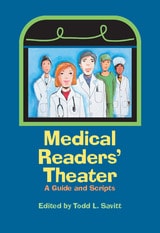
Medical Readers' Theater
A Guide and ScriptsTodd L. Savitt
University of Iowa Press, 2002
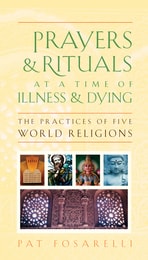
Prayers and Rituals at a Time of Illness and Dying
The Practices of Five World ReligionsPatricia Fosarelli
Templeton Press, 2008
In the course of caring for the ill or dying, health care professionals are sometimes the only ones available to provide spiritual comfort to their patients. In our modern pluralistic society, where patients could come from any number of religious traditions, it can often be difficult to find exactly the right words in these situations.
Prayers and Rituals at a Time of Illness and Dying: The Practices of Five World Religions by experienced physician and theologian Pat Fosarelli offers clear instructions for health care professionals on how to better understand the needs of their Buddhist, Hindu, Muslim, Christian, and Jewish patients during these difficult times. Devoting separate chapters to each tradition, Fosarelli briefly outlines the basic beliefs and then looks at the main tenets of each religion, exploring the varied approaches that they take to illness and end-of-life issues. For each tradition, she also describes practices and offers suitable prayers. Each chapter suggests modifications that may be necessary for Western hospitals, modifications for children, and specific suggestions about what not to do or say in respect to different faith traditions.
This easy-to-use, pocket-sized resource will be referenced again and again by physicians, paramedics, hospital and military chaplains, pastoral counselors, hospice providers, and other medical professionals.
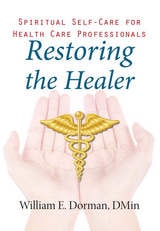
Restoring the Healer
Spiritual Self-Care for Health Care ProfessionalsWilliam Dorman
Templeton Press, 2015
Yet, more are noticing and research confirms that self-care is needed, not only for personal sanity but also for quality of work. Unwell medical professionals are not the best at treating others. And this self-care includes not just rest, food, and water, but a deeper care, one that tends the spiritual side as well.
To both the spiritually active and the spiritually resistant, hospital chaplain William Dorman offers a guide to understand a more comprehensive, full-bodied self-care. Each chapter begins with case studies, concrete experiences that help unpack abstract concepts which bring much needed peace to stressed individuals. Dorman also structures each chapter to end with prayers and action steps, which offer more concrete ways to care for the self.
From working as a hospital chaplain for over 18 years, and serving as the director of chaplaincy services for the largest integrated health care system in New Mexico, Rev. Dorman recognizes the stresses that come to those who have made it their profession to heal others. Healers need healing too—and this guide is the first step.
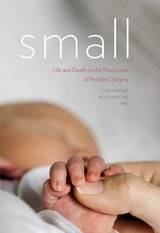
Small
Life and Death on the Front Lines of Pediatric SurgeryCatherine Musemeche
Dartmouth College Press, 2014
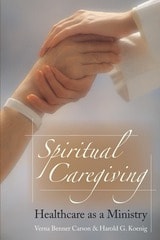
Spiritual Caregiving
Healthcare As A MinistryVerna Benner Carson
Templeton Press, 2004
With today's cumbersome insurance procedures, government regulations, endless paperwork, and concerns about malpractice rates, many health care professionals are asking: "Why am I doing this? Am I making a difference to my patients? Is there a better way—and if so, what is it?" In this book, Carson and Koenig examine the state of the health care system with the goal of providing healthcare professionals and caregivers the inspiration and practical tools to reclaim their sense of purpose.
The book begins with an evaluation of the current system from the perspective of the spiritual vision that initially motivated and nourished many caregivers. The authors then pose a vision of a health care system that supports and nurtures the spirituality of patients and their families, of which some elements already exist.
An overview is provided on the preparation necessary for health care professionals to offer spiritual care when there are major implications—for people with chronic illnesses, psychiatric issues, devastating injuries, and those preparing for surgery, facing death, and those living with chronic pain. Also explored are ways that health professionals and caregivers can maintain their own spiritual health even as they work to bring about healing, comfort, and solace to others.
Woven throughout the book are the personal narratives of physicians, nurses, chaplains, health care educators, community resource workers, administrators, therapists, and psychologists—all from a wide range of religious traditions. Their examples inspire and assist professionals in renewing the spiritual focus of health care.
Spirituality In Patient Care
Why, How, When, and WhatHarold Koenig
Templeton Press, 2002
This book is intended as a guide for practicing physicians, medical students, and residents to help identify and address the spiritual needs of patients. Those who will benefit most will be physicians who wish to know how to integrate spirituality into clinical practice in an effective and sensitive manner. Other professionals, such as nurses and chaplains, may use this book as they interact with doctors, other health professionals, and hospital administrators.
Spirituality in Patient Care
Why, How, When, and WhatHarold G Koenig
Templeton Press, 2007
Spirituality in Patient Care
Why, How, When, and WhatHarold G Koenig
Templeton Press, 2013
The Renewal of Generosity
Illness, Medicine, and How to LiveArthur W. Frank
University of Chicago Press, 2004
The Renewal of Generosity evokes medicine as the face-to-face encounter that comes before and after diagnostics, pharmaceuticals, and surgeries. Frank calls upon the Roman emperor Marcus Aurelius, philosopher Emmanuel Levinas, and literary critic Mikhail Bakhtin to reflect on stories of ill people, doctors, and nurses who transform demoralized medicine into caring relationships. He presents their stories as a source of consolation for both ill and professional alike and as an impetus to changing medical systems. Frank shows how generosity is being renewed through dialogue that is more than the exchange of information. Dialogue is an ethic and an ideal for people on both sides of the medical encounter who want to offer more to those they meet and who want their own lives enriched in the process.
The Renewal of Generosity views illness and medical work with grace and compassion, making an invaluable contribution to expanding our vision of suffering and healing.
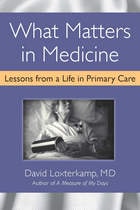
What Matters in Medicine
Lessons from a Life in Primary CareDavid Loxterkamp, MD
University of Michigan Press, 2013
Primary care has come into the limelight with the passage of the Patient Protection and Affordable Care Act, the unchecked and unsustainable rise in American health care expenditures, and the crest of Baby Boomers who are now Medicare-eligible and entering the most health care–intensive period of their lives. Yet how much is really known about primary care? What Matters in Medicine: Lessons from a Life in Primary Care is a look at the past, present, and future of general practice, which is not only the predecessor to the modern primary care movement, but its foundation. Through memoir and conversation, Dr. David Loxterkamp reflects on the heroes and role models who drew him to family medicine and on his many years in family practice in a rural Maine community, and provides a prescription for change in the way that doctors and patients approach their shared contract for good health and a happy life. This book will be useful to those on both sides of primary care, doctors and patients alike.
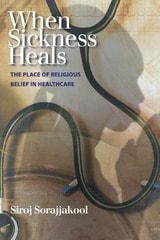
When Sickness Heals
The Place of Religious Belief in HealthcareSiroj Sorajjakool
Templeton Press, 2006
In When Sickness Heals, Dr. Siroj Sorajjakool draws on more than ten years of studies on health benefits in relation to spirituality, especially focusing on the function of "meaning." He expounds on his theory that healing is primarily the function of meaning, and meaning transcends sickness and even death itself. He concludes that what people ultimately seek in life is the healing of their souls.
Sorajjakool brings many Eastern and Western resources to his conversation on health, meaning, and healing. He incorporates the perspectives of theologians and philosophers like Paul Tillich, Carl Jung, Søren Kierkegaard, Raimundo Panikkar, Dietrich Bonhoeffer, and John Macquarrie; as well as references to religious texts, including yin and yang, and alchemy.
A clear, distinct understanding of spirituality in clinical contexts is presented, with an argument for the role of meaning in the healing process, based on evidence that there may be healing even in the face of death. Sorajjakool identifies the transitional processes people may go through as they seek to make sense of their experiences during a health crisis. He suggests an alternative approach to spiritual assessment and provides methods of spiritual care that speak to the soul.