Results by title
5 books match the query 'Physiological Psychology'
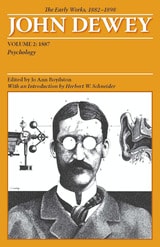
The Early Works of John Dewey, Volume 2, 1882 - 1898
Psychology, 1887John Dewey. Edited by Jo Ann Boydston
Southern Illinois University Press, 2008
With an original publication date of 1887, Psychology us Volume 2 of "The Early Works." It appears first in the series to introduce scholars and general readers to the use of modern textual criticism in a work outside the literary field. Designed as a "scholar's reading edition," the volumes presents the text of Dewey's work as the author intended, clear of editorial footnotes. All apparatus is conveniently arranged in appendix form. As evidence of its wide adoption and use as a college textbook, Psychology had a publishing history of twenty-six printings. For two of the reprintings, Dewey made extensive revisions in content to incorporate developments in the field of psychology as well as in his own thinking. The textual appendices include a thorough tabulation of these changes and detailed evidence for editorial decisions.
In recognition of the high quality and scholarly standards of the textual editing, this edition of Psychology is the first nonliterary work awarded the Seal of the Modern Language Association Center for Editions of American Authors. By applying to the work of a philosopher the procedures used in modern textual editions of American writers such as Hawthorne, the Southern Illinois University Dewey edition is establishing a pattern for future collected editions of the writings of American philosophers.
At the time Dewey wrote Psychology, the relation between psychology and philosophy was in dispute, and he attempted to incorporate the new physiological psychology represented by G. Stanley Hall into the philosophical system and ethics of George Sylvester Morris. He wrote in May, 1886, that he wanted his textbook in psychology to be one "with the greatest possible unity of principle, so that without ceasing to be a psychology, it shall be an introduction to philosophy in general." His goal, expressed in these terms, foreshadowed the direction of his work in the years that followed, with its continuing emphasis on the interrelations among the various disciplines rather than on separate specializations. In his long and fruitful professional career, this was to be his only attempt to treat the whole field of psychology systematically. Although he maintained a lively interest in psychology, that interest was expressed in connection with his writing in other areas such as ethics, education, logic, social philosophy and aesthetics.
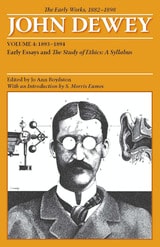
The Early Works of John Dewey, Volume 4, 1882 - 1898
Early Essays and The Study of Ethics, A Syllabus, 1893-1894John Dewey. Edited by Jo Ann Boydston
Southern Illinois University Press, 2008
Volume 4 of’ “The Early Works” series covers the period of Dewey’s last year and one-half at the University of Michigan and his first half-year at the University of Chicago. In addition to sixteen articles the present volume contains Dewey’s reviews of six books and three articles, verbatim reports of three oral statements made by Dewey, and a full-length book, The Study of Ethics.
Like its predecessors in this series, this volume presents a “clear text,” free of interpretive or reference material. Apparatus, including references, corrections, and emendations, is confined to appendix material. Fredson Bowers, the Consulting Textual Editor, has provided an essay on the textual principles and procedures, and Wayne A. R. Leys, Professor of Philosophy at Southern Illinois University, has written an Introduction discussing the relationship between Dewey’s writings of this period and his later work. That Dewey’s scholarship and writing was at an especially high level during 1893 and 1894 may be considered an index to the significance of this two-year period.
The Science of Sleep
What It Is, How It Works, and Why It MattersWallace B. Mendelson
University of Chicago Press, 2017
In The Science of Sleep, sleep expert Wallace B. Mendelson explains the elements of human sleep states and explores the variety of sleep disorders afflicting thousands of people worldwide. Mendelson lays out the various treatments that are available today and provides a helpful guide for one of life’s most important activities. By offering the first scientific yet accessible account of sleep science, Mendelson allows readers to assess their personal relationships with sleep and craft their own individual approaches to a comfortable and effective night’s rest.
Addressing one of the major public health issues of the day with cutting-edge research and empathetic understanding, The Science of Sleep is the definitive illustrated reference guide to sleep science.
The Science of Stress
Living Under PressureEdited by Gregory L. Fricchione, Ana Ivkovic, and Albert S. Yeung
University of Chicago Press, 2016
As Fricchione and his colleagues show, alleviating stress is a task that no one physician can alleviate for us on his own. It is not the sort of problem that a surgeon can excise with a scalpel or an internist can eradicate with antibiotics. It requires everyone’s efforts—the healthy, the sick, doctors, nurses, psychologists, clergy, community leaders, and everyone else—to pull together to address the stress-induced drivers in our community that undermine our health. Clearly and accessibly exploring the latest in modern neuroscience and immunology, the authors examine what those drivers are and how they reduce the body’s metabolic reserve, making us more vulnerable to illness. They then look at the antidote: enhanced resilience, something we can achieve by smartly adjusting how we face the significant adversities that can spring up in so many facets of our lives.
Offering innumerable insights on the personal and social causes of stress and the physiological effects they have, this book serves as an essential guide to show us how to alleviate stress and properly take care of ourselves. In doing so, it offers a crucial first step toward meeting the biggest health challenge of this century.

When Pain Strikes
Bill Burns, Cathy Busby, and Kim Sawchuk, Editors
University of Minnesota Press, 1998
When Pain Strikes was first published in 1998. Minnesota Archive Editions uses digital technology to make long-unavailable books once again accessible, and are published unaltered from the original University of Minnesota Press editions.
When pain strikes, do you raid the medicine cabinet? Read a self-help manual? Hit the roof? How we in North America respond to pain-what we think about it, what we say, and what we do-is the subject of this collection of writings and images.
The book's five sections contain a myriad of complex reactions to the occurrence of pain: "Measure It" discusses biomedical responses; "Scream and Yell" explores therapeutic solutions; "Cut It Open" takes up surgical interventions; "Take a Pill" looks at pharmacology; and "Intensify It" examines positions that embrace pain. Each section comprises original artwork, scholarly analyses, poetic and literary texts, and discussions by activists. Hailing from the university, the gallery, and the community organization, the authors—as TV watchers, recreational drug users, recipients of medical attention, caregivers, midwives, or the HIV positive—inhabit and reconfigure our contemporary painscape, offering a new approach to the puzzle of pain.
Contributors: Charles R. Acland; Barbara McGill Balfour; Isabelle Brabant; Stephen Busby; Millie Chen; Michael Fernandes; Bob Flanagan; Thyrza Nichols Goodeve; Marie-Paule Macdonald; Ronald Melzack; Margaret Morse; Celeste Olalquiaga; John O'Neill; Gerard Päs; Elsie Petch; D. L. Pughe; Julia Scher; Cathy Sisler; Johanne Sloan; Jana Sterbak; Fred Tomaselli; Patrick D. Wall; Theodore Wan; Gregory Whitehead; Fred Wilson.
When Pain Strikes is published in collaboration with the Banff Centre for the Arts.