Results by title
9 books match the query 'Phytogeography'

Distribution of Illinois Vascular Plants
Robert H. Mohlenbrock and Douglas M. Ladd
Southern Illinois University Press, 1978
There are 251 pages of distribution maps included in this book. The plants are arranged alphabetically by genus, and under each genus alphabetically by species. The nomenclature follows Mohlenbrock, Guide to the Vascular Flora of Illinois (1975).
In addition, a list of synonyms applied to Illinois taxa by Fernald (1950), Gleason (1952), and Jones (1963) follows the distribution maps.
Finally, in order to gain an understanding of relationships of the plants in the Illinois flora, all 3,001 taxa are arranged in a phylogenetic sequence at the end of the book.
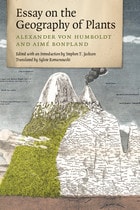
Essay on the Geography of Plants
Alexander von Humboldt and Aimé Bonpland
University of Chicago Press, 2010
The chronicles of the expedition were published in Paris after Humboldt’s return, and first among them was the 1807 “Essay on the Geography of Plants.” Among the most cited writings in natural history, after the works of Darwin and Wallace, this work appears here for the first time in a complete English-language translation. Covering far more than its title implies, it represents the first articulation of an integrative “science of the earth, ” encompassing most of today’s environmental sciences. Ecologist Stephen T. Jackson introduces the treatise and explains its enduring significance two centuries after its publication.
Flowering Plants
Smartweeds to HazelnutsRobert H. Mohlenbrock and Paul M. Thomson Jr.
Southern Illinois University Press, 2009
Since the publication of the first edition of Smartweeds to Hazelnuts in 1987, thirteen additional species and one hybrid have been discovered in Illinois. In addition, numerous nomenclatural changes have occurred for plants already known.
This second edition updates the status of the Polygonaceae, Hamamelidaceae, Platanaceae, Fagaceae, Betulaceae, and Corylaceae in Illinois. Each of the newly discovered species has been added and is fully illustrated. Updated nomenclature as well as Illinois distributional data are included for each species. In addition to the fourteen new plant illustrations, the appendix contains new information on the descriptions and the geographical locations of plants in the first edition, and revised identification keys.
Robert H. Mohlenbrock and Paul M. Thomson Jr. have included a complete description, illustrations showing diagnostic features, distribution maps, and ecological notes for each plant included in this volume.
This new edition will be invaluable to scholars of botany as well as laypersons interested in observing plants in their natural habitat.
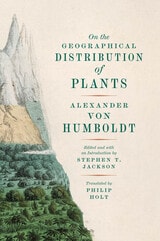
On the Geographical Distribution of Plants
Alexander von Humboldt
University of Chicago Press, 2027
The first English translation of an essay that is among Alexander von Humboldt’s least known but most important scientific works.
In the nineteenth century, Alexander von Humboldt was arguably the world’s most famous celebrity after Napoleon. What started in 1799 as a serendipitous trip to the New World tropics with his friend Aimé Bonpland to collect plants and minerals expanded into a five-year exploration of Venezuela, Colombia, Ecuador, Perú, México, and Cuba. The discoveries the two amassed were nothing short of staggering, and much of our knowledge of tropical botany, zoology, geography, and geology can be traced back to these journeys. The voyage, and the publication of Humboldt’s travel narratives and scientific studies from these expeditions, which totaled dozens of books, elevated Humboldt to cult status.
In the past two decades, Humboldt’s writings have been rediscovered in multiple fields, including biogeography; Earth and environmental sciences; American and Latin American studies; nineteenth-century art, poetry, and literature; and transatlantic cultural history. His ideas are profoundly relevant to twenty-first-century thinking on the relationship between humans and nature, and the ecological framework in which he viewed the world remains essential two centuries after his travels.
Among his many interests, Humboldt invested considerable effort in explaining the underlying causes of the uneven distribution of plant species across the globe. His extended essay On the Geographical Distribution of Plants is among his least known but most important works, laying foundations for the development of ecology, climatology, and evolutionary biology in the following decades. It was first published in 1815 as an introduction to a seven-volume Latin botanical monograph, Nova genera et species plantarum (New Genera and Species of Plants). The essay, republished in 1817 as a standalone volume, held great influence over nineteenth-century naturalists. It is Humboldt’s most comprehensive and detailed treatment of plant geography. In the essay, he applies what he calls “botanical arithmetic” to reveal ecological and biogeographic patterns of plants, applications that still ground modern macroecology; and he provides frameworks to link vegetation patterns and climate, which are essential in modern Earth system science. Introduced and organized by ecologist Stephen T. Jackson and translated from Latin to English by Philip Holt, this book is essential for the libraries of scientists, historians, and all Humboldt admirers.
Plant Communities of New Jersey
A Study in Landscape DiversityCollins, Beryl Robichaud
Rutgers University Press, 1994
From the ridgetops of the north to the Pinelands of the south, New Jersey’s natural areas display an astonishing variety of plant life. This book--a completely revised edition of the classic Vegetation of New Jersey--enables readers to understand why the vegetation of New Jersey is what it is today and what it may become.
The book portrays New Jersey as an ecosystem--its geology, topography and soil, climate, plant-plant and plant-animal relationships, and the human impact on the environment. The authors describe in detail the twelve types of plant habitats distinguished in New Jersey and suggest places to observe good examples of them.
The book is amply illustrated with photographs of plant communities and individual species and maps. The appendixes provide a cross reference between the common and scientific names of native plants of New Jersey, and hints for plant identification.
Scientifically accurate yet written in a lively style, Plant Communities of New Jersey belongs on the bookshelf of every New Jerseyan who cares about the environment.
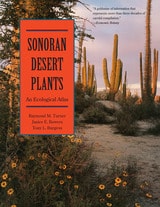
Sonoran Desert Plants
An Ecological AtlasRaymond M. Turner, Janice E. Bowers, and Tony L. Burgess
University of Arizona Press, 1995
An encyclopedia as well as an atlas, this monumental work describes the taxonomy, geographic distribution, and ecology of 339 plants, most of them common and characteristic trees, shrubs, or succulants. Also included is valuable information on natural history and ethnobotanical, commercial, and horticultural uses of these plants. The entry for each species includes a range map, an elevational profile, and a narrative account. The authors also include an extensive bibliography, referring the reader to the latest research and numerous references of historical importance, with a glossary to aid the general reader. Sonoran Desert Plants is a monumental work, unlikely to be superseded in the next generation. As the region continues to attract more people, there will be an increasingly urgent need for basic knowledge of plant species as a guide for creative and sustainable habitation of the area. This book will stand as a landmark resource for many years to come.
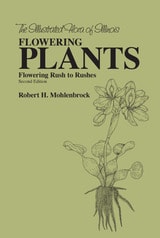
The Flowering Plants
Flowering Rush to RushesRobert H. Mohlenbrock
Southern Illinois University Press, 2006
The second edition of Flowering Plants: Flowering Rush to Rushes offers new material, including a preface, seventeen new illustrations of the additional species now known from Illinois, a revised list of illustrations, and an appendix of the additions and changes since 1970 in the identification, classification, and location of the plants included in the first edition. This new edition of the first volume in the multi-volume series of The Illustrated Flora of Illinois—which provides a working reference for the identification and classification of these plant forms in the state—includes flowering rushes, arrowheads, pondweeds, naiads, duckweeds, cattails, bur reeds, spiderworts, and rushes.
In his introduction, Robert H. Mohlenbrock defines terms and procedures used in the identification and classification of this group of flowering plants referred to as monocotyledons—plants that produce upon germination a single cotyledon or seed-leaf and are often identified by their tall, slender, grass-like leaves. He outlines the life histories and morphologies of the representative monocots and illustrates the plants’ habits and frequencies in Illinois.
Geared to the amateur as well as the professional botanist, the volume includes a glossary of definitions and identification keys to classify the plants according to order, family, genus, and species. The identifying characteristics of each descending class are also given in detail. The morphology of each species is outlined along with data on frequency of occurrence, related soil and climate conditions, and history of past collections. Among the 125 illustrations are detailed sketches of the important features of each species and maps indicating the geographical locations of each species in Illinois.
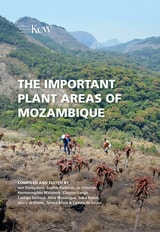
The Important Plant Areas of Mozambique
Edited by Iain Darbyshire, Sophie Richards, and Jo Osborne
Royal Botanic Gardens, Kew, 2023
The Important Plant Areas of Mozambique is based on the Mozambique TIPAs project run in collaboration between Royal Botanic Gardens, Kew, Mozambique’s Agricultural Research Institute (Instituto de Investigação Agrária de Moçambique – IIAM), and the University Eduardo Mondlane. Drawing on information from the TIPAs database, The Important Plant Areas of Mozambique includes color maps and photographs, site descriptions, and tables to present information on the botanical significance, habitat, and geology of the region. The book will also address conservation issues and ecosystem services to promote Mozambique’s critical plant sites and inform conservation leaders in government, NGOs, universities, and local communities about Mozambique’s threatened habitats.

The Physico-Chemical Properties of Plant Saps in Relation to Phytogeography
Data on Native Vegetation in its Natural EnvironmentJ. Harris
University of Minnesota Press, 1934