Results by title
6 books match the query 'Picasso, Pablo'
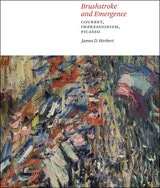
Brushstroke and Emergence
Courbet, Impressionism, PicassoJames D. Herbert
University of Chicago Press, 2015
No pictorial device in nineteenth-century French painting more clearly represented the free-ranging self than the loose brushstroke. From the romantics through the impressionists and post-impressionists, the brushstroke bespoke autonomous artistic individuality and freedom from convention.
Yet the question of how much we can credit to the individual brushstroke is complicated—and in Brushstroke and Emergence, James D. Herbert uses that question as a starting point for an extended essay that draws on philosophy of mind, the science of emergence, and art history. Brushstrokes, he reminds us, are as much creatures of habit and embodied experience as they are of intent. When they gather in great numbers they take on a life of their own, out of which emerge complexity and meaning. Analyzing ten paintings by Courbet, Manet, Cézanne, Monet, Seurat, and Picasso, Herbert exposes vital relationships between intention and habit, the singular and the complex. In doing so, he uncovers a space worthy of historical and aesthetic analysis between the brushstroke and the self.
Yet the question of how much we can credit to the individual brushstroke is complicated—and in Brushstroke and Emergence, James D. Herbert uses that question as a starting point for an extended essay that draws on philosophy of mind, the science of emergence, and art history. Brushstrokes, he reminds us, are as much creatures of habit and embodied experience as they are of intent. When they gather in great numbers they take on a life of their own, out of which emerge complexity and meaning. Analyzing ten paintings by Courbet, Manet, Cézanne, Monet, Seurat, and Picasso, Herbert exposes vital relationships between intention and habit, the singular and the complex. In doing so, he uncovers a space worthy of historical and aesthetic analysis between the brushstroke and the self.
[more]
Conversations with Picasso
Brassaï
University of Chicago Press, 1999
"Read this book if you want to understand me."—Pablo Picasso
Conversations with Picasso offers a remarkable vision of both Picasso and the entire artistic and intellectual milieu of wartime Paris, a vision provided by the gifted photographer and prolific author who spent the early portion of the 1940s photographing Picasso's work. Brassaï carefully and affectionately records each of his meetings and appointments with the great artist, building along the way a work of remarkable depth, intimate perspective, and great importance to anyone who truly wishes to understand Picasso and his world.
Conversations with Picasso offers a remarkable vision of both Picasso and the entire artistic and intellectual milieu of wartime Paris, a vision provided by the gifted photographer and prolific author who spent the early portion of the 1940s photographing Picasso's work. Brassaï carefully and affectionately records each of his meetings and appointments with the great artist, building along the way a work of remarkable depth, intimate perspective, and great importance to anyone who truly wishes to understand Picasso and his world.
[more]
Picasso and the Chess Player
Pablo Picasso, Marcel Duchamp, and the Battle for the Soul of Modern ArtLarry Witham
University Press of New England, 2013
In the fateful year of 1913, events in New York and Paris launched a great public rivalry between the two most consequential artists of the twentieth century, Pablo Picasso and Marcel Duchamp. The New York Armory Show art exhibition unveiled Duchamp’s Nude Descending a Staircase, a “sensation of sensations” that prompted Americans to declare Duchamp the leader of cubism, the voice of modern art. In Paris, however, the cubist revolution was reaching its peak around Picasso. In retrospect, these events form a crossroads in art history, a moment when two young bohemians adopted entirely opposite views of the artist, giving birth to the two opposing agendas that would shape all of modern art. Today, the museum-going public views Pablo Picasso as the greatest figure in modern art. Over his long lifetime, Picasso pioneered several new styles as the last great painter in the Western tradition. In the rarefied world of artists, critics, and collectors, however, the most influential artist of the last century was not Picasso, but Marcel Duchamp: chess player, prankster, and a forefather of idea-driven dada, surrealism, and pop art. Picasso and the Chess Player is the story of how Picasso and Duchamp came to define the epochal debate between modern and conceptual art—a drama that features a who’s who of twentieth-century art and culture, including Henri Matisse, Gertrude Stein, André Breton, Salvador Dalí, and Andy Warhol. In telling the story, Larry Witham weaves two great art biographies into one tumultuous century.
[more]
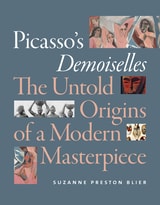
Picasso's Demoiselles
The Untold Origins of a Modern MasterpieceSuzanne Preston Blier
Duke University Press, 2019
In Picasso's Demoiselles, eminent art historian Suzanne Preston Blier uncovers the previously unknown history of Pablo Picasso's Les Demoiselles d’Avignon, one of the twentieth century's most important, celebrated, and studied paintings. Drawing on her expertise in African art and newly discovered sources, Blier reads the painting not as a simple bordello scene but as Picasso's interpretation of the diversity of representations of women from around the world that he encountered in photographs and sculptures. These representations are central to understanding the painting's creation and help identify the demoiselles as global figures, mothers, grandmothers, lovers, and sisters, as well as part of the colonial world Picasso inhabited. Simply put, Blier fundamentally transforms what we know about this revolutionary and iconic work.
[more]
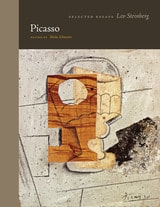
Picasso
Selected EssaysLeo Steinberg
University of Chicago Press, 2022
The fourth volume in the Essays by Leo Steinberg series, focusing on the artist Pablo Picasso.
Leo Steinberg was one of the most original art historians of the twentieth century, known for taking interpretive risks that challenged the profession by overturning reigning orthodoxies. In essays and lectures ranging from old masters to modern art, he combined scholarly erudition with eloquent prose that illuminated his subject and a credo that privileged the visual evidence of the image over the literature written about it. His writings, sometimes provocative and controversial, remain vital and influential reading. Steinberg’s perceptions evolved from long, hard looking at his objects of study. Almost everything he wrote included passages of formal analysis but always put into the service of interpretation.
This volume brings together Steinberg’s essays on Pablo Picasso, many of which have been studied and debated for decades, such as “The Philosophical Brothel,” as well as unpublished lectures, including “The Intelligence of Picasso,” a wide-ranging look at Picasso’s enduring ambition to stretch the agenda of representation, from childhood drawings to his last self-portrait. An introduction by art historian Richard Shiff contextualizes these works and illuminates Steinberg’s lifelong dedication to refining the expository, interpretive, and rhetorical features of his writing.
Picasso is the fourth volume in a series that presents Steinberg’s writings, selected and edited by his longtime associate Sheila Schwartz.
[more]
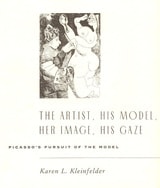
The Artist, His Model, Her Image, His Gaze
Picasso's Pursuit of the ModelKaren L. Kleinfelder
University of Chicago Press, 1993
Although Pablo Picasso's name is virtually synonymous with modernity, his late graphics repeatedly turn back to the traditional theme of the artist and model. Had the aging artist turned reactionary, or is Picasso's treatment of the theme more subversive than anyone has suspected?
In this innovative study, Karen L. Kleinfelder rejects the claim that Picasso's later work was a failure. The failing, she claims, lies more in the way we typically have read the images, treating them merely as reflections of an "old-age" style or of the artist's private life.
Focusing on graphics dating from 1954 to 1970, Kleinfelder shows how Picasso plays with the artist-model theme to extend, subvert, and parody both the possibilities and limits of representation. For Kleinfelder, Picasso's graphic work both mystifies and demystifies the creative process, venerates and mocks the effects of aging and the artist's self-image as a living "old master," and acknowledges and denies his own fear of death.
Using recent interpretive and literary theory, Kleinfelder probes the three-way relationship between artist, model, and canvas. The dynamics of this relationship provided Picasso with an open-ended textual framework for exploring the dichotomies of man/woman, self/other, and vitality/mortality. What unfolds is the artist's struggle not only with the impossibility of representing the model on canvas, but also with the inevitability of his own death.
Kleinfelder explores how Picasso's means of pursuing these issues allows him to defer closure on a long, productive career. By focusing on the graphics rather than the paintings, Kleinfelder contradicts the primacy of the painted "masterpiece"; she steers the reader away from the assumption that the artist must work toward creating a final body of work that signifies the culmination of his search for a coherent identify.
Picasso's search, she argues, realizes itself in the creative process. She interprets the late graphics not as a biographical statement but as a tool for investigating the possibilities of representation within the limits of Picasso's medium and his lifetime. Richly illustrated, Kleinfelder's book will open up new approaches to the late work of this complex artist.
[more]