Results by title
2 books match the query 'Picq, Manuela Lavinas'
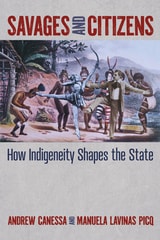
Savages and Citizens
How Indigeneity Shapes the StateAndrew Canessa and Manuela Lavinas Picq; Foreword by Jeff Ganohalidoh Corntassel
University of Arizona Press, 2024
Although Indigenous peoples are often perceived as standing outside political modernity, Savages and Citizens takes the provocative view that Indigenous people have been fundamental to how contemporary state sovereignty was imagined, theorized, and practiced.
Delving into European political philosophy, comparative politics, and contemporary international law, the book shows how the concept of indigeneity has shaped the development of the modern state. The exclusion of Indigenous people was not a collateral byproduct; it was a political project in its own right. The book argues that indigeneity is a political identity relational to modern nation-states and that Indigenous politics, although marking the boundary of the state, are co-constitutive of colonial processes of state-making. In showing how indigeneity is central to how the international system of states operates, the book forefronts Indigenous peoples as political actors to reject essentializing views that reduce them to cultural “survivors” rooted in the past.
With insights drawn from diverse global contexts and empirical research from Bolivia and Ecuador, this work advocates for the relevance of Indigenous studies within political science and argues for an ethnography of sovereignty in anthropology. Savages and Citizens makes a compelling case for the centrality of Indigenous perspectives to understand the modern state from political theory to international studies.
[more]
Vernacular Sovereignties
Indigenous Women Challenging World PoliticsManuela Lavinas Picq
University of Arizona Press, 2018
Indigenous women are rarely accounted for in world politics. Imagined as passive subjects at the margins of political decision-making, they often epitomize the antithesis of international relations. Yet from their positions of marginality they are shaping sovereignty.
In Vernacular Sovereignties, Manuela Lavinas Picq shows that Indigenous women have long been dynamic political actors who have partaken in international politics and have shaped state practices carrying different forms of resistance. Her research on Ecuador shows that although Kichwa women face overlapping oppressions from socioeconomic exclusions to sexual violence, they are achieving rights unparalleled in the world. They successfully advocated for women’s participation in the administration of Indigenous justice during the 2008 constitutional reform, creating the first constitution in Latin America to explicitly guarantee the rights of Indigenous women and the first constitution worldwide to require gender parity in the administration of justice.
Picq argues that Indigenous women are among the important forces reshaping states in Latin America. She offers empirical research that shows the significance of Indigenous women in international politics and the sophistication of their activism. Indigenous women strategically use international norms to shape legal authority locally, defying Western practices of authority as they build what the author calls vernacular sovereignties. Weaving feminist perspectives with Indigenous studies, this interdisciplinary work expands conceptual debates on state sovereignty.
Picq persuasively suggests that the invisibility of Indigenous women in high politics is more a consequence of our failure to recognize their agency than a result of their de facto absence. It is an invitation not merely to recognize their achievements but also to understand why they matter to world politics.
[more]