Results by title
12 books match the query 'Pictorial'
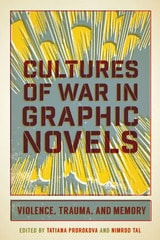
Cultures of War in Graphic Novels
Violence, Trauma, and MemoryProrokova, Tatiana
Rutgers University Press, 2018
Cultures of War in Graphic Novels examines the representation of small-scale and often less acknowledged conflicts from around the world and throughout history. The contributors look at an array of graphic novels about conflicts such as the Boxer Rebellion (1899-1901), the Irish struggle for national independence (1916-1998), the Falkland War (1982), the Bosnian War (1992-1995), the Rwandan genocide (1994), the Israel-Lebanon War (2006), and the War on Terror (2001-). The book explores the multi-layered relation between the graphic novel as a popular medium and war as a pivotal recurring experience in human history. The focus on largely overlooked small-scale conflicts contributes not only to advance our understanding of graphic novels about war and the cultural aspects of war as reflected in graphic novels, but also our sense of the early twenty-first century, in which popular media and limited conflicts have become closely interrelated.
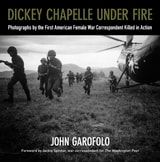
Dickey Chapelle Under Fire
Photographs by the First American Female War Correspondent Killed in ActionJohn Garofolo
Wisconsin Historical Society Press, 2026
Striking photographs and stories from more than two decades on the frontlines by a groundbreaking photojournalist—and the first female American war correspondent to be killed in action.
In 1941, twenty-two-year-old Georgette "Dickey" Chapelle sold her first photo essay to Look magazine. A year later, with World War II underway, she was photographing American soldiers in combat training in Panama. By the end of the war, she had captured the devastation at Iwo Jima and Okinawa, and in the ensuing decades, Dickey and her camera were on the scene at many of the world’s hotspots—from Cuba and the Dominican Republic to Algeria and Lebanon to Vietnam and Laos. Dickey Chapelle Under Fire exposes her remarkable story and shares over 150 stunning images from her extraordinary career as a photojournalist.
In the male-dominated world of war journalism, Chapelle fought to be taken seriously. She eventually earned the respect of many of her male colleagues and broke down barriers for future generations of female journalists. She embedded herself with military units on frontlines around the globe, capturing not only the horrors of war but also the camaraderie and everyday routines of service men and women.
Always one to follow the action, Chapelle traveled with Algerian rebels across the North African desert and with Fidel Castro through the jungles of Cuba. She spent two months in a Hungarian prison after being caught smuggling aid to refugees fleeing a Soviet invasion. Beginning in 1961, Chapelle set her lens and viewfinder on Southeast Asia, capturing the growing conflict there, until she was killed while on patrol with marines in Vietnam in April 1965—making her the first female American war correspondent to be killed in action.
For twenty-five years, Chapelle's photographs graced the pages of National Geographic, the National Observer, Life, and other major publications. Despite her tragic end, Chapelle’s tenacity, courage, and compassion shine throughout her work, highlighting the human impact of war while revealing the larger stories beyond the battlefield. Her legacy lives on through this powerful collection.
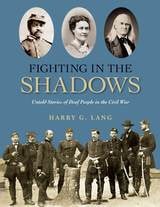
Fighting in the Shadows
Untold Stories of Deaf People in the Civil WarHarry G. Lang
Gallaudet University Press, 2017
Lang pieces together hundreds of stories, accompanied by numerous historical images, to reveal a powerful new perspective on the Civil War. These soldiers and civilians were not “disabled” by their deafness. On the contrary, despite the marginalization and paternalism they experienced in society, they were able to apply their skills and knowledge to support the causes in which they ardently believed.
Fighting in the Shadows is a story of how deaf civilians and soldiers put aside personal concerns about deafness, in spite of the discrimination they faced daily, in order to pursue a cause larger than themselves. Yet their stories have remained in the shadows, leaving most Americans, hearing and deaf, largely unaware of the deaf people who made significant contributions to the events that changed the course of our nation’s history. This book provides new insights into Deaf history as well as into mainstream interpretations of the Civil War.
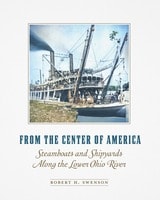
From the Center of America
Steamboats and Shipyards Along the Lower Ohio RiverRobert H. Swenson
Southern Illinois University Press, 2026
Charting the legacy of mid-America's shipyards and iconic steamboats
Before the railroad stitched together the American landscape, the dominant mode of transportation in the United States was by steamboat. These grand vessels, their iconic paddlewheels churning the country’s rivers, have long captured the national imagination as symbols of innovation and adventure.
In the heart of America, four major rivers converge—the Cumberland and Tennessee with the Ohio; then the Ohio with the Mississippi. These three confluences, which author Robert Swenson christens the Four Rivers Reach, played a unique role in the development of the steamboats that dominated American continental transport for almost 100 years. Between 1825 and 1936, the river towns of Smithland, Paducah, Metropolis, Mound City, and Cairo launched 295 wood-hulled, steam-powered vessels. Drawing from a wealth of archival sources, Swenson presents detailed histories of these steamboats over a span of 110 years, accompanied by nearly one hundred illustrations and photographs.
The book focuses on distinct events in steamboat history, tracing the impact of these shipyards on the economies and communities of the river towns where they were built. It reveals how the availability of steamboats along this sixty-mile Reach affected migration, politics, and the US economy of the nineteenth century. Steamboats built at the Four Rivers Reach played pivotal roles in the forced relocation of Native Americans from southern Appalachia to Oklahoma, the outcome of the Civil War, and the Montana gold rush. From the Center of America demonstrates how steamboat building shaped the culture, people, and economy of this region—and how, in turn, the area and its steamships influenced the growth of the young United States.
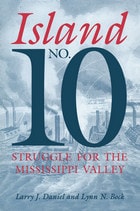
Island No. 10
Struggle for the Mississippi ValleyLynn N. Bock
University of Alabama Press, 1996
A definitive study of strategy, river warfare, and Union triumph in the Mississippi Valley.
Island No. 10: Struggle for the Mississippi Valley is a deeply researched, narrative-driven history of the Civil War New Madrid–Island No. 10 campaign in 1862—an episode overshadowed by Fort Donelson and Shiloh yet vital to Union mastery of the Mississippi River. The authors argue that the campaign was far more consequential than its marginalization in traditional Civil War histories suggests, demonstrating that the fall of Island No. 10 consolidated Union control of the upper Mississippi, accelerated the collapse of Confederate fortunes in the West, and highlighted the transformative power of joint Army–Navy operations.
The book’s strengths lie in its rich use of diaries, letters, official military records, and contemporary press accounts, weaving together strategy, engineering, naval innovation, politics, and the lived experience of soldiers. Vivid descriptions of fortification design, the ironclad flotilla, the dramatic night battery runs, and the grueling canal‑cutting operation offer readers a ground‑level and command‑level view of the campaign. Larry J. Daniel, an acclaimed Civil War historian and award‑winning author of Cannoneers in Gray and Soldiering in the Army of Tennessee, together with Lynn N. Bock, a historian, attorney, and longtime steward of New Madrid’s local history, bring scholarly authority and regional expertise to the subject.
This book will captivate readers interested in Civil War military history, riverine warfare, engineering feats, and the Western theater. It is especially valuable for scholars, buffs seeking a fresh perspective on neglected campaigns, students of joint operations, and anyone exploring how geography, logistics, and technology shaped the course of the war.
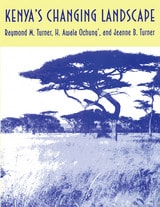
Kenya's Changing Landscape
Raymond M. Turner
University of Arizona Press, 1998
Turner's discussions of the photographs and the conclusions he draws provide an important reference for ecologists, geographers, botanists, and other researchers attempting similar studies. By documenting vegetation change in a region broadly similar climatically to North America's subtropical deserts and grasslands but different in its wildlife and its human culture, the book shows that the endpoints of landscape status are similar despite the vastly different histories of these two regions of the world.

Railroads of Nevada and Eastern California
Volume 3: More on the Northern RoadsDavid F. Myrick
University of Nevada Press, 2007
The final volume in the complete history of Nevada and Eastern California railroads David Myrick's monumental railroad histories have become essential reference works for railroaders, historians, and hobbyists. Volume III contains additional information about the northern roads, including some not covered in previous volumes, and about developments since the publication of the first two volumes in the railroads of the region. It provides new facts gleaned from the correspondence of Collis P. Huntington, one of the builders of the Central Pacific and Southern Pacific railroads. It also covers roads connected with the lumber industry and the construction of electric power plants, and Southern Pacific branch lines, including some that never advanced beyond surveys.
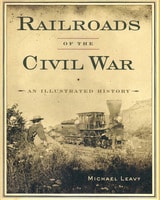
Railroads of the Civil War
An Illustrated HistoryMichael Leavy
Westholme Publishing, 2010
The Photographic Record of the First Wide-Scale Mechanization of War
Over the course of the first half of the nineteenth century, America would find itself following two increasingly divergent tracks: an industrialized North and an agricultural South. By 1860 railroads were firmly entrenched in our culture, reshaping our cities and steering us through the industrial age towards worldwide prominence. From sleepy post towns to the largest east coast cities, the distant hooting of the locomotive whistle drew ever closer and louder, filling listeners with fascination while brightening the eyes of profit-driven industrialists. But this admirable invention, lavishly adorned in brass and iron trimmings, was about to take on a new and deadly role. America’s regional differences would result in a spectacular collision over slavery, and between 1861–1865, the nation fought a savage war. The “iron horse” became a major weapon in the first war fully dependent on railroads. Moreover railroads would escalate and prolong the war, leading to its terrible carnage. Trains were used to move troops rapidly and over great distances, completely changing military strategy. Trains were also used as mobile artillery, armed with large-caliber cannons that could pound cities and fortifications. Trains were a crucial means for supplying the armies on both sides, and it was the severing of the railway lines providing food and munitions to the Army of Northern Virginia that led to Robert E. Lee’s surrender at Appomattox Court House.
In Railroads of the Civil War: An Illustrated History, Michael Leavy uses compelling period photographs and drawings and a rich narrative to reevaluate and illuminate the role of railroads in the Civil War. In addition to identifying details about the various trains and ancillary equipment and buildings in the illustrations, the author explains how trains influenced the outcome of battles and the war in general.

The Hocking Valley Railway
Edward H. Miller
Ohio University Press, 2024
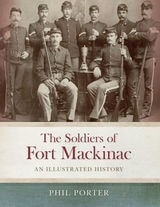
The Soldiers of Fort Mackinac
An Illustrated HistoryPhil Porter
Michigan State University Press, 2018
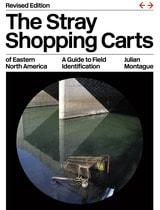
The Stray Shopping Carts of Eastern North America
A Guide to Field IdentificationJulian Montague
University of Chicago Press, 2023
Abandoned shopping carts are everywhere, and yet we know so little about them. Where do they come from? Why are they there? Their complexity and history baffle even the most careful urban explorer.
Thankfully, artist Julian Montague has created a comprehensive and well-documented taxonomy with The Stray Shopping Carts of Eastern North America. Spanning thirty-three categories from damaged, fragment, and plow crush to plaza drift and bus stop discard, it is a tonic for times defined increasingly by rhetoric and media and less by the plain objects and facts of the real world. Montague’s incomparable documentation of this common feature of the urban landscape helps us see the natural and man-made worlds—and perhaps even ourselves—anew.
First published in 2006 to great perplexity and acclaim alike, Montague’s book now appears in refreshed and expanded form. Told in an exceedingly dry voice, with full-color illustrations and photographs throughout, it is both rigorous and absurd, offering a strangely compelling vision of how we approach, classify, and understand the environments around us. A new afterword sheds light on the origins of the project.

Wordsworth and the Green Romantics
Affect and Ecology in the Nineteenth CenturyLisa Ottum
University of New Hampshire Press, 2016