Results by title
4 books match the query 'Piekut, Benjamin'
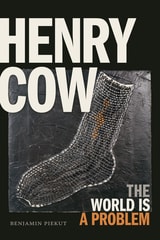
Henry Cow
The World Is a ProblemBenjamin Piekut
Duke University Press, 2019
In its open improvisations, lapidary lyrics, errant melodies, and relentless pursuit of spontaneity, the British experimental band Henry Cow pushed rock music to its limits. Its rotating personnel, sprung from rock, free jazz, and orchestral worlds, synthesized a distinct sound that troubled genre lines, and with this musical diversity came a mixed politics, including Maoism, communism, feminism, and Italian Marxism. In Henry Cow: The World Is a Problem Benjamin Piekut tells the band’s story—from its founding in Cambridge in 1968 and later affiliation with Virgin Records to its demise ten years later—and analyzes its varied efforts to link aesthetics with politics. Drawing on ninety interviews with Henry Cow musicians and crew, letters, notebooks, scores, journals, and meeting notes, Piekut traces the group’s pursuit of a political and musical collectivism, offering up its history as but one example of the vernacular avant-garde that emerged in the decades after World War II. Henry Cow’s story resonates far beyond its inimitable music; it speaks to the avant-garde’s unpredictable potential to transform the world.
[more]
Sensing the Future
Experiments in Art and Technology (E.A.T.)Nancy Perloff
J. Paul Getty Trust, The, 2024
In the 1960s and '70s, collaborations between artists and engineers led to groundbreaking innovations in multisensory performance art that continue to resonate today.
In 1966, Billy Klüver and Fred Waldhauer, engineers at Bell Labs in Murray Hill, New Jersey, teamed up with artists Robert Rauschenberg and Robert Whitman to form a nonprofit organization, Experiments in Art and Technology (E.A.T.). E.A.T.’s debut event, 9 Evenings: Theatre & Engineering, integrated art, theater, and groundbreaking technology in a series of performances at the 69th Regiment Armory in Manhattan. Its second major event, the Pepsi Pavilion at Expo ’70 in Osaka, Japan, presented a multisensory environment for the first world exposition held in Asia. At these events, and in the hundreds of collaborations E.A.T. facilitated in between, the participants—including John Cage, Lucinda Childs, Deborah Hay, Steve Paxton, Yvonne Rainer, and David Tudor—imagined innovative ways for art and science to intersect and enrich society.
Sensing the Future tells the story of these collaborations between artists and engineers and how they led to new installations and technology-based artworks. Through the examination of films, photographs, diagrams, and artists’ records from the E.A.T. archive at the Getty Research Institute, this volume provides a new perspective on multimedia art in the 1960s and ’70s and highlights the ways E.A.T. pushed the role of the artist beyond the traditional art world.
This volume is published to accompany an exhibition on view at the Getty Research Institute at the Getty Center from September 10, 2024, to February 23, 2025.
[more]
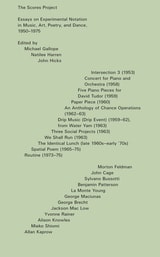
The Scores Project
Essays on Experimental Notation in Music, Art, Poetry, and Dance, 1950–1975Michael Gallope
J. Paul Getty Trust, The, 2025
A collection of essays examining experimental scores and source documents from the postwar avant-gardes, interpreted by experts on art, music, dance, and poetry.
Individuals working in and across the fields of visual art, music, poetry, theater, and dance in the mid–twentieth century began to use experimental scores in ways that revolutionized artistic practice and opened up new forms of interdisciplinary collaboration. Their experimental methods—associated with the neo-avant-garde, neo-Dadaism, intermedia, Fluxus, and postmodernism—exploded in notoriety during the 1960s in locales from New York to Europe, East Asia, and Latin America, becoming foundational to global trends in contemporary art and performance.
The Scores Project provides an in-depth view of this historical moment. Through expert commentaries from an interdisciplinary team of scholars with accompanying illustrations, this publication examines a series of experimental scores by John Cage, George Brecht, Sylvano Bussotti, Morton Feldman, Allan Kaprow, Alison Knowles, Jackson Mac Low, Benjamin Patterson, Yvonne Rainer, Mieko Shiomi, David Tudor, and La Monte Young. Ambitious, provocative, and playful, The Scores Project is an illuminating resource to scholars and students who seek to understand this innovative and historically complex moment in the history of art.
An expanded edition of this open-access publication is available for free online at www.getty.edu/publications/scores/. It includes more than 2,800 images, audio/video files, and interactive features. Also available are free PDF and EPUB downloads of the book.
[more]
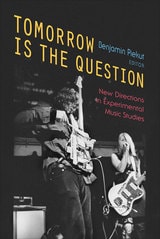
Tomorrow Is the Question
New Directions in Experimental Music StudiesEdited by Benjamin Piekut
University of Michigan Press, 2014
In recent decades, experimental music has flourished outside of European and American concert halls. The principles of indeterminacy, improvisation, nonmusical sound, and noise, pioneered in concert and on paper by the likes of Henry Cowell, John Cage, and Ornette Coleman, can now be found in all kinds of new places: activist films, rock recordings, and public radio broadcasts, not to mention in avant-garde movements around the world.
The contributors to Tomorrow Is the Question explore these previously unexamined corners of experimental music history, considering topics such as Sonic Youth, Julius Eastman, the Downtown New York pop avant-garde of the 1970s, Fluxus composer Benjamin Patterson, Tokyo’s Music group (aka Group Ongaku), the Balinese avant-garde, the Leicester school of British experimentalists, Cuba’s Grupo de Experimentación Sonora del ICAIC, Pauline Oliveros’s score for the feminist documentary Maquilapolis, NPR’s 1980s RadioVisions, and the philosophy of experimental musical aesthetics.
Taken together, this menagerie of people, places, and things makes up an actually existing experimentalism that is always partial, compromised, and invented in its local and particular formations—in other words, these individual cases suggest that experimentalism has been a far more variegated set of practices and discourses than previously recognized. Asking new questions leads to researching new materials, new individuals, and new contexts and, eventually, to the new critical paradigms that are necessary to interpret these materials. Gathering contributions from historical musicology, enthnomusicology, history, philosophy, and cultural studies, Tomorrow Is the Question generates future research directions in experimental music studies by way of a productive inquiry that sustains and elaborates critical conversations.
[more]