Results by title
13 books match the query 'Pieper, Josef'

A Journey to Point Omega
Autobiography from 1964Josef Pieper
St. Augustine's Press, 2018
Themes with which the reader of his previous works would be well acquainted recur in this volume. The dedicated Catholic philosopher, who preferred his independence as a trainer of teachers to the less independent role of a professor in a Catholic university, was quite prepared to criticize developments in the Church which resulted from Vatican II. In his defense of the sacred, which he deemed threatened by popularizing trends in the Church, he criticized what he saw as the watered down language in modern German translations of Church liturgical texts; the growing preference for secular garb; and the compromising developments which saw the sacramental signs – surrounding baptism, for instance – being reduced to such an extent that they no longer had the power to signify their sacred meaning even to a well-intentioned congregation.
A great lover of the philosophy of Plato, Augustine, and Aquinas – among many others –, Pieper highlighted the need for living a life of truth. He did not consider truth to be merely something abstract but as something to be lived existentially. While he could explain his philosophy in clear rational terms, something which especially stood to him in his post-war lectures to eager students who were hungry for intellectual guidance and leadership, the great interest of his philosophy was, possibly, his preoccupation with mystery – that which impinges on our inner lives but frustrates all our attempts to account for it in purely rational terms.
As a philosopher – one might say a Christian philosopher – Pieper seems to have observed the traditional boundaries drawn between philosophy and theology. His generation was exposed to the modernist debates in the Church. It would have been deemed heretical to say that the Divine could be grasped by our purely human thought processes – access to the Divine being only possible through faith and grace. Pieper was no heretic. But he was also not altogether conservative. In fact, his philosophy, closely allied to existentialism – despite his care, for instance, to distance himself from the negative existentialism of Sartre – focused on the individual’s inner existential grasp of the most profound reality. Truth is to be found within us, even if it remains a mystery. What lies beyond death is, for the individual, the ultimate mystery.
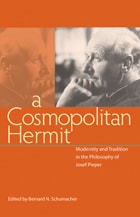
A cosmopolitan hermit
modernity and tradition in the philosophy of Josef PieperBernard N Schumacher
Catholic University of America Press, 2009

Death And Immortality
Josef Pieper
St. Augustine's Press, 1999
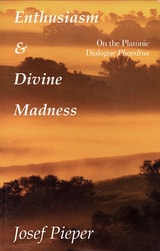
Enthusiasm And Divine Madness
Josef Pieper
St. Augustine's Press, 1999
Pieper gives interpretation of the dialogue. Leaving the more recondite scholarly preoccupations aside, he concentrates on the content, bringing the actual situation in the dialogue – Athens and its intellectuals engaged in spirited debate – alive. Equally alive is the discussion of ideas, which are brought to bear on contemporary experience and made to prove the perennial validity of Socratic wisdom, and its power to excite the mind. The main thesis – that in poetry and in love man is "beside himself," that is, divinely inspired - is discussed with reference to modern poets, novelists, and modern psychology.
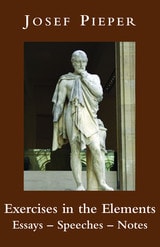
Exercises in the Elements
Essays, Speeches, NotesJosef Pieper
St. Augustine's Press, 2016
A fundamental issue for Pieper is “createdness.” He sees this as the fundamental truth of our being – all being – and the fundamental virtue we can practise is the striving to live according to our perception of real truth in any given situation.
The strength and attraction of Pieper’s writing is its direct and intuitive character which is independent of abstract systematization. He advocates staying in touch with the “real” as we experience it deep within ourselves. Openness to the totality of being – in no matter what context being reveals itself – and the affirmation of all that is founded in this totality are central pillars of all his thinking. Given the “simplicity” of this stance, it is no surprise that much of it is communicated – and successfully – through his gift for illustration by anecdote. Like Plato, this philosopher is a story-teller and, like him, very readable.
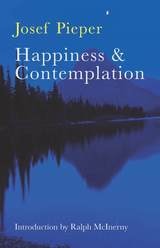
Happiness and Contemplation
Josef Pieper
St. Augustine's Press, 1998
“The ultimate of human happiness is to be found in contemplation.” In offering this proposition of Thomas Aquinas to our thought, Josef Pieper uses traditional wisdom in order to throw light on present-day reality and present-day psychological problems. What, in fact, does one pursue in pursuing happiness? What, in the consensus of the wisdom of the early Greeks, of Plato and Aristotle, of the New Testament, of Augustine and Aquinas, is that condition of perfect bliss toward which all life and effort tend by nature? In this profound and illuminating inquiry, Pieper considers the nature of contemplation, and the meaning and goal of life.
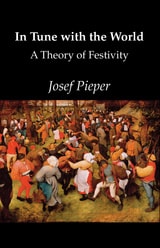
In Tune With The World
Josef Pieper
St. Augustine's Press, 1999
In this stimulating and still-timely study, Josef Pieper takes up a theme of paramount importance to his thinking – that festivals belong by rights among the great topics of philosophical discussion. As he develops his theory of festivity, the modern age comes under close and painful scrutiny. It is obvious that we no longer know what festivity is, namely, the celebration of existence under various symbols
Pieper exposes the pseudo-festivals, in their harmless and their sinister forms: traditional feasts contaminated by commercialism; artificial holidays created in the interest of merchandisers; holidays by coercion, decreed by dictators the world over; festivals as military demonstrations; holidays empty of significance. And lastly we are given the apocalyptic vision of a nihilistic world which would seek its release not in festivities but in destruction.
Formulated with Pieper's customary clarity and elegance, enhanced by brilliantly chosen quotations, this is an illuminating contribution to the understanding of traditional and contemporary experience.
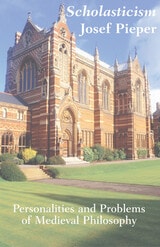
Scholasticism
Personalities & Problems Medieval PhilosophyJosef Pieper
St. Augustine's Press, 2001
The account is broken by the gradual replacement of the synthesis of faith and reason that had been achieved in the early Middle Ages by a new one that made use of Aristotle. Pieper gives a thorough and lively account of the struggle between Aristotelians and anti-Aristotelians, and the famous condemnations that put the effort of Saint Thomas Aquinas at risk. But the Summa theologiae is regarded by Pieper as the unique achievement of the period.
If the early centuries, the medieval period, can be seen as moving toward the thirteenth and Thomas's unique achievement, subsequent centuries saw the decline of scholasticism and theappearance of harbingers of modern philosophy.
The book closes with Pieper's thoughts on the permanent philosophical and theological significance of scholasticism and the Middle Ages. Once again, wearing his learning lightly, writing with a clarity that delights, Josef Pieper has taken the field from stuffier and more extended accounts.

Silence Of St Thomas
Josef Pieper
St. Augustine's Press, 1999
The Silence of Goethe
Josef Pieper
St. Augustine's Press, 2009
But no matter how many astonishing things I saw in these unforgettable weeks of undisturbed inner focus, nothing was more surprising or unexpected than this: to realize how much of what was peculiar to this life occurred in carefully preserved seclusion; how much the seemingly communicative man who carried on a world-wide correspondence still never wanted to expose in words the core of his existence.
However manifold the forms of this silence and of their unconscious roots and conscious motives may have been, is it not always the possibility of hearing, the possibility of a purer perception of reality that is aimed at? And so, is not Goethe’s type of silence above all the silence of one who listens? . . .
The meaning of being silent is hearing – a hearing in which the simplicity of the receptive gaze at things is like the naturalness, simplicity, and purity of one receiving a confidence, the reality of which is creatura, God’s creation. And insofar as Goethe’s silence is in this sense a hearing silence, to that extent it has the status of the model and paradigm – however much, in individual instances, reservations and criticism are justified. One could remain circumspectly silent about this exemplariness after the heroic nihilism of our age has proclaimed the attitude of the knower to be by no means that of a silent listener but rather as that of self-affirmation over against being: insight and knowledge are naked defiance, the severest endangering of existence in the midst of the superior strength of concrete being. The resistance of knowledge opposes the oppressive superior power. However, that the knower is not a defiant rebel against concrete being, but above all else a listener who stays silent and, on the basis of his silence, a hearer – it is here that Goethe represents what, since Pythagoras, may be considered the silence tradition of the West.
Tradition
Concept and ClaimJosef Pieper
St. Augustine's Press, 2010
Traditional Truth, Poetry, Sacrament
For My Mother, on Her 70th BirthdayJosef Pieper
St. Augustine's Press, 2019
Pieper collects his contributions to radio programs and to a number of journals and periodicals. The book also includes a selection of notes and comments. The contributions fall into two main groups: the period which encompasses the immediate pre-war period as well as the war period itself, and the post-war period up to 1953.The reader becomes witness, first, to Pieper’s problems with the National Socialist regime and, second, to his problems with the ensuing challenges to religious life as it is exposed to increasing secularization.
As with his later works, Pieper draws on traditional wisdom which, for him, dates back to Plato and Aristotle, and in these contributions we also see his early preoccupation with the wisdom of St. Thomas Aquinas. The normal boundaries between philosophy and theology are here not clearly drawn. Pieper is preoccupied with the mystery of our world and its importance as a source of symbols signifying deeper levels of reality. He sees the sacraments as achieving their fundamental effect from divine intervention, but he also highlights the need for careful observance of the rituals, so that their meaning is not obscured. Proper execution of the sacrament should enable the faithful to enjoy the existential fruits of their participation in the ritual.
This work manifests the organic cohesion of Pieper’s thinking, and it reflects his profound awareness of the role to be played not so much by the professional (academic) philosopher as by the existential Philosophizer.
What Catholics Believe
Josef Pieper
St. Augustine's Press, 0
The authors give, in brief and simple form, a summary of the fundamental teachings of the Catholic Church, and of the fruits of the faith contained in the teachings.
The first part, The Faith of the Christian, outlines the basic teachings as embodied in the Apostles Creed, followed by chapters on the Seven Sacraments and the Liturgical Year. The second part, entitled The Life of the Christian, is concerned with the fruits of faith, treats Christian virtues.
No similar book covers so much ground, in such simple terms, in one brief work. What Catholics Believe was written before the liturgical changes implemented by the Second Vatican Council, but its theology and anthropology remain as relevant today as they did a half-century ago, and its impact is all the more startling for the clear, direct, orthodox approach it takes. This edition adds explanatory notes that cross-reference the text with contemporary rubrics for the benefit of modern readers.