Results by title
3 books match the query 'Pike, Fredrick B.'

FDR's Good Neighbor Policy
Sixty Years of Generally Gentle ChaosBy Fredrick B. Pike
University of Texas Press, 1995
During the 1930s, the United States began to look more favorably on its southern neighbors. Latin America offered expanded markets to an economy crippled by the Great Depression, while threats of war abroad nurtured in many Americans isolationist tendencies and a desire for improved hemispheric relations.
One of these Americans was Franklin Delano Roosevelt, the primary author of America's Good Neighbor Policy. In this thought-provoking book, Fredrick Pike takes a wide-ranging look at FDR's motives for pursuing the Good Neighbor Policy, at how he implemented it, and at how its themes have played out up to the mid-1990s.
Pike's investigation goes far beyond standard studies of foreign and economic policy. He explores how FDR's personality and Eleanor Roosevelt's social activism made them uniquely simpático to Latin Americans. He also demonstrates how Latin culture flowed north to influence U.S. literature, film, and opera. The book will be essential reading for everyone interested in hemispheric relations.
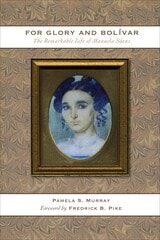
For Glory and Bolívar
The Remarkable Life of Manuela SáenzBy Pamela S. Murray
University of Texas Press, 2008
She was a friend, lover, and confidante of charismatic Spanish American independence hero Simón Bolívar and, after her death, a nationalist icon in her own right. Yet authors generally have chosen either to romanticize Manuela Sáenz or to discount her altogether. For Glory and Bolivar: The Remarkable of Life of Manuela Sáenz, by contrast, offers a comprehensive and clear-eyed biography of her. Based on unprecedented archival research, it paints a vivid portrait of the Quito-born "Libertadora," revealing both an exceptional figure and a flesh-and-blood person whose life broadly reflected the experiences of women during Spanish America's turbulent Age of Revolution.
Already married at the time of her meeting with the famous Liberator, Sáenz abandoned her husband in order to become not only Bolívar's romantic companion, but also his official archivist, a member of his inner circle, and one of his most loyal followers. She played a central role in Spanish South America's independence drama and eventually in developments leading to the consolidation of new nations. Pamela Murray, for the first time, closely examines Sáenz's political trajectory including her vital, often-overlooked years in exile. She exposes the myths that still surround her. She offers, in short, a nuanced and much-needed historical perspective, one that balances recognition of Sáenz's uniqueness with awareness of the broader forces that shaped this dynamic nineteenth-century woman.
The United States and Latin America
Myths and Stereotypes of Civilization and NatureBy Fredrick B. Pike
University of Texas Press, 1992
The lazy greaser asleep under a sombrero and the avaricious gringo with money-stuffed pockets are only two of the negative stereotypes that North Americans and Latin Americans have cherished during several centuries of mutual misunderstanding. This unique study probes the origins of these stereotypes and myths and explores how they have shaped North American impressions of Latin America from the time of the Pilgrims up to the end of the twentieth century.
Fredrick Pike's central thesis is that North Americans have identified themselves with "civilization" in all its manifestations, while viewing Latin Americans as hopelessly trapped in primitivism, the victims of nature rather than its masters. He shows how this civilization-nature duality arose from the first European settlers' perception that nature—and everything identified with it, including American Indians, African slaves, all women, and all children—was something to be conquered and dominated. This myth eventually came to color the North American establishment view of both immigrants to the United States and all our neighbors to the south.