Results by title
5 books match the query 'Pilgrims and pilgrimages'
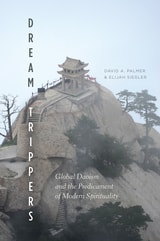
Dream Trippers
Global Daoism and the Predicament of Modern SpiritualityDavid A. Palmer and Elijah Siegler
University of Chicago Press, 2017
Dream Trippers draws on more than a decade of ethnographic work with Daoist monks and Western seekers to trace the spread of Westernized Daoism in contemporary China. David A. Palmer and Elijah Siegler take us into the daily life of the monastic community atop the mountain of Huashan and explore its relationship to the socialist state. They follow the international circuit of Daoist "energy tourism," which connects a number of sites throughout China, and examine the controversies around Western scholars who become practitioners and promoters of Daoism. Throughout are lively portrayals of encounters among the book’s various characters—Chinese hermits and monks, Western seekers, and scholar-practitioners—as they interact with each other in obtuse, often humorous, and yet sometimes enlightening and transformative ways. Dream Trippers untangles the anxieties, confusions, and ambiguities that arise as Chinese and American practitioners balance cosmological attunement and radical spiritual individualism in their search for authenticity in a globalized world.
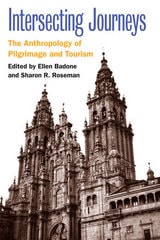
Intersecting Journeys
The Anthropology of Pilgrimage and TourismEdited by Ellen Badone and Sharon R. Roseman
University of Illinois Press, 2004
Pilgrimage and Healing
Edited by Jill Dubisch and Michael Winkelman
University of Arizona Press, 2005
This volume brings together anthropological and interdisciplinary perspectives on these persistent forms of popular religion to expand our understanding of the role of the traditional practice of pilgrimage in what many believe to be an increasingly secular world. Focusing on the healing dimensions of pilgrimage, the authors present case studies grounded in specific cultures and pilgrimage traditions to help readers understand the many therapeutic resources pilgrimage provides for people around the world. The chapters examine a variety of pilgrimage forms, both religious and non-religious, from Nepalese and Huichol shamanism pilgrimage to Catholic journeys to shrines and feast days to Nevada’s Burning Man festival. These diverse cases suggest a range of meanings embodied in the concept of healing itself, from curing physical ailments and redefining the self to redressing social suffering and healing the wounds of the past.
Collectively and individually, the chapters raise important questions about the nature of ritual in general, and healing through pilgrimage in particular, and seek to illuminate why so many participants find pilgrimage a compelling way to address the problem of suffering. They also illustrate how pilgrimage exerts its social and political influence at the personal, local, and national levels, as well as providing symbols and processes that link people across social and spiritual boundaries. By examining the persistence of pilgrimage as a significant source of personal engagement with spirituality, Pilgrimage and Healing shows that the power of pilgrimage lies in its broad transformative powers. As our world increasingly adopts a secular and atheistic perspective in many domains of experience, it reminds us that, for many, spiritual quest remains a potent force.
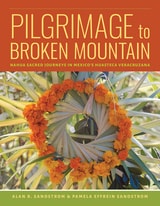
Pilgrimage to Broken Mountain
Nahua Sacred Journeys in Mexico's Huasteca Veracruzanaby Alan R. Sandstrom & Pamela Effrein Sandstrom illustrated by Michael K. Aakhus, Ana Laura Ávila-Myers & Michael A. Sandstrom
University Press of Colorado, 2022
Pilgrimage to Broken Mountain contains richly detailed descriptions and analyses of ritual procedures as well as translations from the Nahuatl of core myths, chants performed before decorated altars, and statements from participants. Particular emphasis is placed on analyzing the role of sacred paper figures that are produced by the thousands for each pilgrimage. The work contains drawings of these cuttings of spirit entities along with hundreds of color photographs illustrating how they are used throughout the pilgrimages. The analysis reveals the monist philosophy that underlies Nahua religious practice in which altars, dancing, chanting, and the paper figures themselves provide direct access to the sacred.
In the context of their pilgrimage traditions, the ritual practices of Nahua religion show one way that people interact effectively with the forces responsible for not only their own prosperity but also the very survival of humanity. A magnum opus with respect to Nahua religion and religious practice, Pilgrimage to Broken Mountain is a significant contribution to several fields, including but not limited to anthropology, Indigenous literatures of Mesoamerica, Nahuatl studies, Latinx and Chicanx studies, and religious studies.
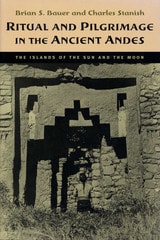
Ritual and Pilgrimage in the Ancient Andes
The Islands of the Sun and the MoonBy Brian S. Bauer and Charles Stanish
University of Texas Press, 2001
The Islands of the Sun and the Moon in Bolivia's Lake Titicaca were two of the most sacred locations in the Inca empire. A pan-Andean belief held that they marked the origin place of the Sun and the Moon, and pilgrims from across the Inca realm made ritual journeys to the sacred shrines there. In this book, Brian Bauer and Charles Stanish explore the extent to which this use of the islands as a pilgrimage center during Inca times was founded on and developed from earlier religious traditions of the Lake Titicaca region.
Drawing on a systematic archaeological survey and test excavations in the islands, as well as data from historical texts and ethnography, the authors document a succession of complex polities in the islands from 2000 BC to the time of European contact in the 1530s AD. They uncover significant evidence of pre-Inca ritual use of the islands, which raises the compelling possibility that the religious significance of the islands is of great antiquity. The authors also use these data to address broader anthropological questions on the role of pilgrimage centers in the development of pre-modern states.