Results by title
4 books match the query 'Pimería Alta (Mexico and Ariz.)'
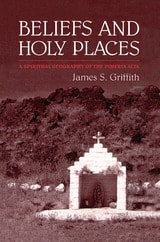
Beliefs and Holy Places
A Spiritual Geography of the Pimería AltaJames S. Griffith
University of Arizona Press, 1992
Folklorist Jim Griffith has lived in the Pimería Alta for more than thirty years, visiting its holy places and attending its fiestas, and has uncovered a background of belief, tradition, and history lying beneath the surface of these cultural expressions. In Beliefs and Holy Places, he reveals some of the supernaturally sanctioned relationships that tie people to places within that region, describing the cultural and religious meanings of locations and showing how bonds between people and places have in turn created relationships between places, a spiritual geography undetectable on physical maps.
Throughout the book, Griffith shows how culture moves from legend to art to belief to practice, all the while serving as a dynamic link between past and future. Now as the desert gives way to newcomers, Griffith's book offers visitors and residents alike a rare opportunity to share in these rich traditions.
Mission of Sorrows
Jesuit Guevavi and the Pimas, 1691–1767John L. Kessell; Foreword by Ernest J. Burrus, S.J.
University of Arizona Press, 1970
For three-quarters of a century, from the first visit by the renowned Eusebio Francisco Kino in 1691 until the Jesuit Expulsion in 1767, the difficult process of replacing one culture with another—the heart of the Spanish mission system—went on at Guevavi. Yet all but the initial years presided over by Father Kino have been forgotten.
Drawing upon archival materials in Mexico, Spain, and the United States—including accounts by the missionaries themselves and the surviving pages of the Guevavi record books—Kessell brings to life those forgotten years and forgotten men who struggled to transform a native ranchería into an ordered mission community.
Of the eleven Black Robes who resided at Guevavi between 1701 and 1767, only a few are well known to history. Others—such as Joseph Garrucho, who presided more years at Guevavi than any other Padre; Alexandro Rapicani, son of a favorite of Sweden's Queen Christina; Custodio Zimeno, Guevavi's last Jesuit—have the details of their roles filled in here for the first time.
In this in-depth study of a single missionary center, Kessell describes in detail the daily round of the Padres in their activities as missionaries, educators, governors, and intercessors among the often-indifferent and occassionally hostile Pimas. He discusses the Pima uprising of 1751 and the events that led up to it, concluding that it actually continued sporadically for some ten years.
The growing ferocity of the Apache, the disastrous results of certain government policies—especially the removal of the Sobaípuri Indians from the San Pedro Valley—and the declining native population due to a combination of enforced culture change and epidemics of European diseases are also carefully explored.
The story of Guevavi is one of continuing adversity and triumph. It is the story, finally, of explusion for the Jesuits and, a few short years later, the end of Mission Guevavi at the hands of the Apaches.
In Mission of Sorrows Kessell has projected meticulous research into a highly readable narrative to produce an important contribution to the history of the Spanish Borderlands.
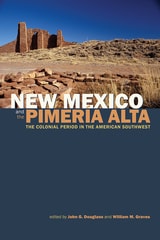
New Mexico and the Pimería Alta
The Colonial Period in the American SouthwestJohn G. Douglass
University Press of Colorado, 2017
Focusing on the two major areas of the Southwest that witnessed the most intensive and sustained colonial encounters, New Mexico and the Pimería Alta compares how different forms of colonialism and indigenous political economies resulted in diverse outcomes for colonists and Native peoples. Taking a holistic approach and studying both colonist and indigenous perspectives through archaeological, ethnohistoric, historic, and landscape data, contributors examine how the processes of colonialism played out in the American Southwest.
Although these broad areas—New Mexico and southern Arizona/northern Sonora—share a similar early colonial history, the particular combination of players, sociohistorical trajectories, and social relations within each area led to, and were transformed by, markedly diverse colonial encounters. Understanding these different mixes of players, history, and social relations provides the foundation for conceptualizing the enormous changes wrought by colonialism throughout the region. The presentations of different cultural trajectories also offer important avenues for future thought and discussion on the strategies for missionization and colonialism.
The case studies tackle how cultures evolved in the light of radical transformations in cultural traits or traditions and how different groups reconciled to this change. A much needed up-to-date examination of the colonial era in the Southwest, New Mexico and the Pimería Alta demonstrates the intertwined relationships between cultural continuity and transformation during a time of immense change and highlights contemporary thought on the colonial experience.
Contributors: Joseph Aguilar, Jimmy Arterberry, Heather Atherton, Dale Brenneman, J. Andrew Darling, John G. Douglass, B. Sunday Eiselt, Severin Fowles, William M. Graves, Lauren Jelinek, Kelly L. Jenks, Stewart B. Koyiyumptewa, Phillip O. Leckman, Matthew Liebmann, Kent G. Lightfoot, Lindsay Montgomery, Barnet Pavao-Zuckerman, Robert Preucel, Matthew Schmader, Thomas E. Sheridan, Colleen Strawhacker, J. Homer Thiel, David Hurst Thomas, Laurie D. Webster
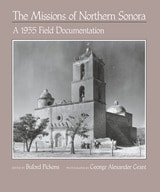
The Missions of Northern Sonora
A 1935 Field DocumentationBuford L. Pickens
University of Arizona Press, 1993
These "Kino Missions" were surveyed in 1935 by the National Park Service to prepare for the restoration of the mission at Tumacacori, Arizona, then a National Historic Monument. That report, which was never published, provided insights into the missions' history and architecture that remain of lasting relevance. Perhaps more important, it documented these structures in photographs and drawings—the latter including floor plans and sketches of architectural detail—that today are of historic as well as aesthetic interest.
This volume reproduces that 1935 report in its entirety, focusing on sixteen missions and including two maps, 52 drawings, and 76 photographs. With a new introduction and appendixes that place the original study in context, The Missions of Northern Sonora is an invaluable reference for scholars and mission visitors alike.