Results by title
8 books match the query 'Pioneer'
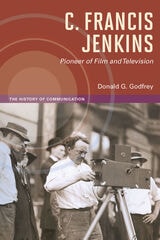
C. Francis Jenkins, Pioneer of Film and Television
Donald G. Godfrey
University of Illinois Press, 2014
This is the first biography of the important but long-forgotten American inventor Charles Francis Jenkins (1867-1934). Historian Donald G. Godfrey documents the life of Jenkins from his childhood in Indiana and early life in the West to his work as a prolific inventor whose productivity was cut short by an early death. Jenkins was an inventor who made a difference.
As one of America's greatest independent inventors, Jenkins's passion was to meet the needs of his day and the future. In 1895 he produced the first film projector able to show a motion picture on a large screen, coincidentally igniting the first film boycott among his Quaker viewers when the film he screened showed a woman's ankle. Jenkins produced the first American television pictures in 1923, and developed the only fully operating broadcast television station in Washington, D.C. transmitting to ham operators from coast to coast as well as programming for his local audience.
Godfrey's biography raises the profile of C. Francis Jenkins from his former place in the footnotes to his rightful position as a true pioneer of today's film and television. Along the way, it provides a window into the earliest days of both motion pictures and television as well as the now-vanished world of the independent inventor.
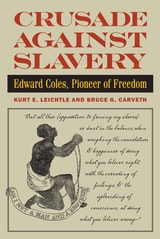
Crusade Against Slavery
Edward Coles, Pioneer of FreedomKurt E. Leichtle and Bruce G. Carveth
Southern Illinois University Press, 2011
Rejecting slavery from a young age, Coles's early wishes to free his family's slaves initially were stymied by legal, practical, and family barriers. Instead he went to Washington, D.C., where his work in the White House was a life-changing blend of social glitter, secretarial drudge, and distasteful political patronage. Returning home, he researched places where he could live out his ideals. After considerable planning and preparation, he left his family's Virginia tobacco plantation in 1819 and started the long trip west to Edwardsville, Illinois, pausing along the Ohio River on an emotional April morning to free his slaves and offer each family 160 acres of Illinois land of their own. Some continued to work for Coles, while others were left to find work for themselves. This book revisits the lives of the slaves Coles freed, including a noted preacher and contributor to the founding of what is now the second-oldest black Baptist organization in America.
Crusade Against Slavery details Coles's struggles with frontier life and his surprise run and election to the office of Illinois governor as well as his continuing antislavery activities. At great personal cost, he led the effort to block a constitutional convention that would have legalized slavery in the state, which resulted in an acrimonious civil suit brought on by his political enemies, who claimed he violated the law by not issuing a bond of emancipation for his slaves. Although initially convicted by a partisan jury, Coles was vindicated when the Illinois Supreme Court overturned the decisions of the lower courts. Through the story of Coles's moral and legal battles against slavery, Leichtle and Carveth unearth new perspectives on an institution that was on unsure footing yet strongly ingrained in the business interests at the economic base of the fledgling state.
In 1831, after less than a decade in Illinois-and after losing a bid for Congress-Coles left for Philadelphia, where he remained in correspondence with Madison about the issue of slavery. Drawing on previous incomplete treatments of Coles's life, including his own short memoir, Crusade Against Slavery includes the first published analysis of Madison's failure to free his slaves despite his plans to do so through his will and a fascinating exploration of Coles's struggle to understand Madison's inability to live up to the ideals both men shared.
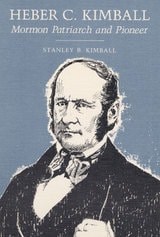
Heber C. Kimball
MORMON PATRIARCH AND PIONEERStanley B. Kimball
University of Illinois Press, 1981
"Superb! This is a superior biography, based almost entirely on manuscript sources, few of which have been used or even examined by other scholars. It is new, it is fresh, it is fast-moving, it has the ring of truth, there is little editorializing, and it is written with economy, clarity, and balance." -- Leonard J. Arrington, author of Brigham Young: American Moses
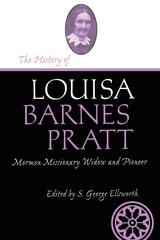
History Of Louisa Barnes Pratt
The Autobiography of a Mormon Missionary Widow and PioneerGeorge S Ellsworth
Utah State University Press, 1998
Volume 3, Life Writings of Frontier Women series, ed. Maureen Ursenbach Beecher
In her memoir, and 1870s revision of her journal and diary, Louisa Barnes Pratt tells of childhood in Massachusetts and Canada during the War of 1812, and independent career as a teacher and seamstress in New England, and her marriage to the Boston seaman Addison Pratt.
Converting to the LDS Church, the Pratts moved to Nauvoo, Illinois, from where Brigham Young sent Addison on the first of the long missions to the Society Islands that would leave Louisa on her own. As a sole available parent, she hauled her children west to Winter Quarters, to Utah in 1848, to California, and, in Addison's wake, to Tahiti in 1850.
The Pratts joined the Mormon colony at San Bernardino, California. When in 1858 a federal army's march on Utah led to the colonists' recall, Addision—alienated from the Mormon Church after long absences—chose not to go. Mostly separated thereafter (Addison died in 1872), Louisa settled in Beaver, Utah, where she campaigned for women's rights, contributed to the Woman's Exponent, and depended on her own means, as she had much of her life, until her death in 1880.
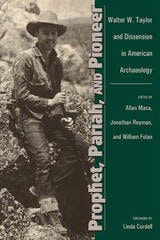
Prophet, Pariah, and Pioneer
Walter W. Taylor and Dissension in American ArchaeologyAllan Maca
University Press of Colorado, 2026
In his 1948 work A Study of Archeology, recently minted Harvard Ph.D. Walter W. Taylor delivered the strongest and most substantial critique of American archaeology ever published. He created many enemies with his dissection of the research programs of America's leading scholars, who took it as a personal affront. Taylor subsequently saw his ideas co-opted, his research pushed to the margins, and his students punished. Publicly humiliated at the 1985 Society for American Archaeology meeting, he suffered ridicule until his death in 1997.
Nearly everyone in the archaeological community read Taylor's book at the time, and despite the negative reaction, many were influenced by it. Few young scholars dared to directly engage and build on his "conjunctive approach," yet his suggested methods nevertheless began to be adopted and countless present-day authors highlight his impact on the 1960s formation of the "New Archaeology."
In Prophet, Pariah, and Pioneer, peers, colleagues, and former students offer a critical consideration of Taylor's influence and legacy. Neither a festschrift nor a mere analysis of his work, the book presents an array of voices exploring Taylor and his influence, sociologically and intellectually, as well as the culture of American archaeology in the second half of the twentieth century.
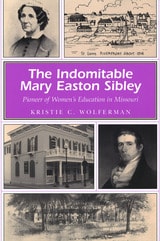
The Indomitable Mary Easton Sibley
Pioneer of Women's Education in MissouriKristie C. Wolferman
University of Missouri Press, 2008
The Reminiscences of George Strother Gaines
Pioneer and Statesman of Early Alabama and Mississippi, 1805–1843George Strother Gaines
University of Alabama Press, 1998
One man’s remarkable account of nation‑building, Native diplomacy, and the making of the early American South.
The Reminiscences of George Strother Gaines: Pioneer and Statesman of Early Alabama and Mississippi, 1805–1843 offers one of the most vivid, irreplaceable firsthand accounts of the American Southeast during its most transformative decades. Edited and expertly contextualized by historian James P. Pate, this volume gathers Gaines’s dictated memoirs, rare letters, early newspaper publications, oral-history interviews, and extensive editorial notes to illuminate a world on the cusp of monumental change.
George Strother Gaines was no ordinary frontier figure. Trusted by U.S. officials and Choctaw leaders alike, he played central roles as federal factor at the Choctaw Trading House, a key intermediary during treaty negotiations, a primary organizer of the first Choctaw removal, a banker and state senator in newly formed Alabama, and later a driving force behind the Mobile & Ohio Railroad. His reminiscences reveal intimate knowledge of the region’s political development, frontier economy, Native diplomacy, and daily life. They are written in a strikingly elegant “Addisonian” style praised even in his own lifetime.
This edition’s special features—including detailed maps, illustrations, genealogical material, and a robust scholarly introduction—make it the most comprehensive and authoritative presentation of Gaines’s writings ever published. It not only preserves his voice but situates him within the broader historical forces reshaping the Gulf South and Native nations in the nineteenth century.
Ideal readers include:
• Historians of Alabama, Mississippi, and the early American South
• Scholars of Native American and Choctaw/Chickasaw history
• Readers of frontier, antebellum, or political history
• Genealogists and local-history enthusiasts
• Anyone seeking an engaging, elegantly written window into the early Southeast
This is a foundational text for understanding the region’s past—and a compelling story told by one of its most influential witnesses.
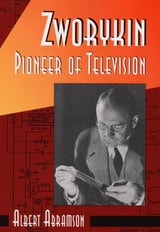
Zworykin, Pioneer of Television
Albert Abramson. Foreword by Erik Barnouw
University of Illinois Press, 1995
"His achievements rank him with Thomas Edison and Alexander Graham Bell," states Albert Abramson in this discerning, often dramatic biography of Vladimir Kosma Zworykin, the Russian-born scientist who "did more to create our present system of cathode-ray television than any other person."