Results by title
7 books match the query 'Piracy'
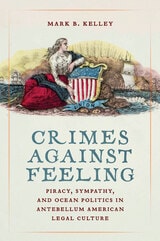
Crimes Against Feeling
Piracy, Sympathy, and Ocean Politics in Antebellum American Legal CultureMark B. Kelley
University of Massachusetts Press, 2026
Demonstrating how emotion became central to the legal and literary meanings of piracy in nineteenth-century America
Pirates have long occupied a central yet unstable place in American law and national identity. In the decades leading up to and including the U.S. Civil War, the charge of piracy was leveled against an unusually wide range of figures: foreign heads of state, imperial filibusters, transoceanic enslavers, enslaved mutineers, radical abolitionists, and others who challenged established forms of authority. Early American literature reflects this instability, portraying pirates who vary dramatically in politics, race, gender, and allegiance. As Mark B. Kelley shows, these characters are united less by ideology than by their challenge to landed social norms and fixed national belonging. The pirate, in both law and literature, emerges as an individual defined by multiplicity rather than political coherence.
Crimes Against Feeling examines how Americans made sense of this ambiguous figure by turning to emotion. Drawing on legal materials including treaties, trial transcripts, congressional debates, and U.S. Supreme Court decisions, as well as popular sentimental fiction (often written by women), Kelley argues that piracy was codified as an offense against moral feeling rather than being a singular political position. Legal thinkers and writers such as John Quincy Adams, Abraham Lincoln, Jefferson Davis, Catharine Maria Sedgwick, Harriet Beecher Stowe, and Maria S. Cummins relied on shared affective frameworks—sympathy, sentiment, and domestic vulnerability—to render piracy legible and punishable. American pirate law, Kelley demonstrates, was shaped by the same emotional logics that structured the era’s popular fiction.
By tracing piracy across debates over domestic sovereignty, global enslavement and abolition, imperial expansion, postbellum reparations, and international copyright, Crimes Against Feeling reveals the pirate as a key figure for understanding gender, home, family, and nation in early America. Reading law and literature together, the book shows how emotional judgment—not political consensus—became a foundational tool for managing oceanic violence and transnational disorder in the nineteenth-century United States.
Merchants, Pirates, and Smugglers
Criminalization, Economics, and the Transformation of the Maritime World (1200–1600)Edited by Thomas Heebøll-Holm, Philipp Höhn, and Gregor Rohmann
Campus Verlag, 2019
Piracy
The Intellectual Property Wars from Gutenberg to GatesAdrian Johns
University of Chicago Press, 2009
Since the rise of Napster and other file-sharing services in its wake, most of us have assumed that intellectual piracy is a product of the digital age and that it threatens creative expression as never before. The Motion Picture Association of America, for instance, claimed that in 2005 the film industry lost $2.3 billion in revenue to piracy online. But here Adrian Johns shows that piracy has a much longer and more vital history than we have realized—one that has been largely forgotten and is little understood.
Piracy explores the intellectual property wars from the advent of print culture in the fifteenth century to the reign of the Internet in the twenty-first. Brimming with broader implications for today’s debates over open access, fair use, free culture, and the like, Johns’s book ultimately argues that piracy has always stood at the center of our attempts to reconcile creativity and commerce—and that piracy has been an engine of social, technological, and intellectual innovations as often as it has been their adversary. From Cervantes to Sonny Bono, from Maria Callas to Microsoft, from Grub Street to Google, no chapter in the story of piracy evades Johns’s graceful analysis in what will be the definitive history of the subject for years to come.
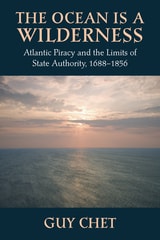
The Ocean Is a Wilderness
Atlantic Piracy and the Limits of State Authority, 1688-1856Guy Chet
University of Massachusetts Press, 2014
Chet shows how the traditional focus on the growth of the modern state overlooked the extent to which old attitudes and cultural practices continued to hold sway. Even as the British government extended its naval, legal, and bureaucratic reach, in many parts of the Atlantic world illegal trade was not only tolerated but encouraged. In part this was because Britain's constabulary command of the region remained more tenuous than some have suggested, and in part because maritime insurance and wartime tax policies ensured that piracy and smuggling remained profitable. When Atlantic piracy eventually waned in the early nineteenth century, it had more to do with a reduction in its profitability at port than with forceful confrontation at sea.
Challenging traditional accounts that chronicle forces of civilization taming a wild Atlantic frontier, this book is a valuable addition to a body of borderlands scholarship reevaluating the relationship between the emerging modern state and its imperial frontiers.
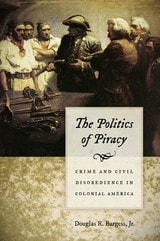
The Politics of Piracy
Crime and Civil Disobedience in Colonial AmericaDouglas R. Burgess
University Press of New England, 2014
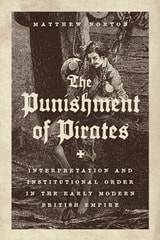
The Punishment of Pirates
Interpretation and Institutional Order in the Early Modern British EmpireMatthew Norton
University of Chicago Press, 2023
Early in the seventeenth-century boom of seafaring, piracy allowed many enterprising and lawless men to make fortunes on the high seas, due in no small part to the lack of policing by the British crown. But as the British empire grew from being a collection of far-flung territories into a consolidated economic and political enterprise dependent on long-distance trade, pirates increasingly became a destabilizing threat. This development is traced by sociologist Matthew Norton in The Punishment of Pirates, taking the reader on an exciting journey through the shifting legal status of pirates in the seventeenth and eighteenth centuries.
Norton shows us that eliminating this threat required an institutional shift: first identifying and defining piracy, and then brutally policing it. The Punishment of Pirates develops a new framework for understanding the cultural mechanisms involved in dividing, classifying, and constructing institutional order by tracing the transformation of piracy from a situation of cultivated ambiguity to a criminal category with violently patrolled boundaries—ending with its eradication as a systemic threat to trade in the English Empire. Replete with gun battles, executions, jailbreaks, and courtroom dramas, Norton’s book offers insights for social theorists, political scientists, and historians alike.

Who Rules the Waves?
Piracy, Overfishing and Mining the OceansDenise Russell
Pluto Press, 2010
With piracy raging in the Indian Ocean, international disputes over undersea oil and gas, and chronic overfishing, the oceans have rarely been subject to such varied and environmentally damaging conflict outside a world war. In Who Rules the Waves? Denise Russell gives us a rare insight into these issues and how they could be resolved.
International law states that a coastal country has territorial rights for 12 miles into the sea beyond its coastline, and economic rights for 200 miles, but in practice many countries have virtually no control over their own waters, and there is no international agency powerful enough to settle disputes. Russell provides a thorough examination of the politics of the sea, showing that without a radical change in ocean governance, accelerating climate change and overuse of the sea's resources is likely to have catastrophic effects.