Results by title
16 books match the query 'Planet'
A Planet in Hospice
Environmental Justice in Existential EcofictionLauren S. Cardon
The Ohio State University Press, 2026
How do we continue to love and care for a planet it’s too late to save? In A Planet in Hospice, Lauren S. Cardon analyzes works of “existential ecofiction” that invite us to reflect on our mortality and the many ways that people are already affected by disaster, while also encouraging hope and connection. These texts from authors such as N. K. Jemisin, Paolo Bacigalupi, Darcie Little Badger, Rivers Solomon, Richard Powers, and Margaret Atwood are characterized by themes of ecological crisis, planetary demise, and human extinction, and they center environmental justice and human oppression. Cardon argues that, by invoking the end of the world, these writers directly engage with death anxiety and consequently intervene in current theories of existential psychology and intersectional ecocriticism. They highlight the inextricability of environmental care and social justice and offer visions of a path forward through the global climate crisis humans now face.
A Planet of Viruses
Carl Zimmer
University of Chicago Press, 2011
For years, scientists have been warning us that a pandemic was all but inevitable. Now it's here, and the rest of us have a lot to learn.
Fortunately, science writer Carl Zimmer is here to guide us. In this compact volume, he tells the story of how the smallest living things known to science can bring an entire planet of people to a halt--and what we can learn from how we've defeated them in the past.
Planet of Viruses covers such threats as Ebola, MERS, and chikungunya virus; tells about recent scientific discoveries, such as a hundred-million-year-old virus that infected the common ancestor of armadillos, elephants, and humans; and shares new findings that show why climate change may lead to even deadlier outbreaks. Zimmer’s lucid explanations and fascinating stories demonstrate how deeply humans and viruses are intertwined. Viruses helped give rise to the first life-forms, are responsible for many of our most devastating diseases, and will continue to control our fate for centuries. Thoroughly readable, and, for all its honesty about the threats, as reassuring as it is frightening, A Planet of Viruses is a fascinating tour of a world we all need to better understand.
A Planet of Viruses
Second EditionCarl Zimmer
University of Chicago Press, 2015
Fortunately, science writer Carl Zimmer is here to guide us. In this compact volume, he tells the story of how the smallest living things known to science can bring an entire planet of people to a halt--and what we can learn from how we've defeated them in the past.
Planet of Viruses covers such threats as Ebola, MERS, and chikungunya virus; tells about recent scientific discoveries, such as a hundred-million-year-old virus that infected the common ancestor of armadillos, elephants, and humans; and shares new findings that show why climate change may lead to even deadlier outbreaks. Zimmer’s lucid explanations and fascinating stories demonstrate how deeply humans and viruses are intertwined. Viruses helped give rise to the first life-forms, are responsible for many of our most devastating diseases, and will continue to control our fate for centuries. Thoroughly readable, and, for all its honesty about the threats, as reassuring as it is frightening, A Planet of Viruses is a fascinating tour of a world we all need to better understand.
A Planet of Viruses
Third EditionCarl Zimmer
University of Chicago Press, 2021
Fully revised and updated, with new illustrations and a new chapter about coronaviruses and the spread of Covid-19, this third edition of Carl Zimmer’s A Planet of Viruses pulls back the veil on this hidden world. It presents the latest research on how viruses hold sway over our lives and our biosphere, how viruses helped give rise to the first life-forms, how viruses are producing new diseases, how we can harness viruses for our own ends, and how viruses will continue to control our fate as long as life endures.
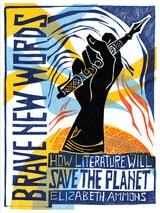
Brave New Words
How Literature Will Save the PlanetAmmons, Elizabeth
University of Iowa Press, 2010
The activist tradition in American literature has long testified to the power of words to change people and the power of people to change the world, yet in recent years many professional humanists have chosen to distract themselves with a postmodern fundamentalism of indeterminacy and instability rather than engage with social and political issues. Throughout her bold and provocative call to action, Elizabeth Ammons argues that the responsibility now facing humanists is urgent: inside and outside academic settings, they need to revive the liberal arts as a progressive cultural force that offers workable ideas and inspiration in the real-world struggle to achieve social and environmental justice.
Brave New Words challenges present and future literary scholars and teachers to look beyond mere literary critique toward the concrete issue of social change and how to achieve it. Calling for a profound realignment of thought and spirit in the service of positive social change, Ammons argues for the continued importance of multiculturalism in the twenty-first century despite attacks on the concept from both right and left. Concentrating on activist U.S. writers—from ecocritics to feminists to those dedicated to exposing race and class biases, from Jim Wallis and Cornel West to Winona LaDuke and Paula Moya and many others—she calls for all humanists to link their work to the progressive literature of the last half century, to insist on activism in the service of positive change as part of their mission, and to teach the power of hope and action to their students.
As Ammons clearly demonstrates, much of American literature was written to expose injustice and motivate readers to work for social transformation. She challenges today’s academic humanists to address the issues of hope and purpose by creating a practical activist pedagogy that gives students the knowledge to connect their theoretical learning to the outside world. By relying on the transformative power of literature and replacing nihilism and powerlessness with conviction and faith, the liberal arts can offer practical, useful inspiration to everyone seeking to create a better world.
Feeding the Planet
Environmental Protection through Sustainable AgricultureKlaus Hahlbrock
Haus Publishing, 2009
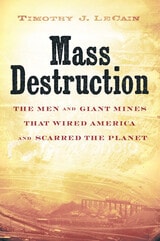
Mass Destruction
The Men and Giant Mines That Wired America and Scarred the PlanetTimothy J. LeCain
Rutgers University Press, 2009
Mass destruction mining soon spread around the nation and the globe, providing raw materials essential to the mass production and mass consumption that increasingly defined the emerging "American way of life." At the dawn of the last century, Jackling's open pit replaced immense but constricted underground mines that probed nearly a mile beneath the earth, to become the ultimate symbol of the modern faith that science and technology could overcome all natural limits. A new culture of mass destruction emerged that promised nearly infinite supplies not only of copper, but also of coal, timber, fish, and other natural resources.
But, what were the consequences? Timothy J. LeCain deftly analyzes how open-pit mining continues to affect the environment in its ongoing devastation of nature and commodification of the physical world. The nation's largest toxic Superfund site would be one effect, as well as other types of environmental dead zones around the globe. Yet today, as the world's population races toward American levels of resource consumption, truly viable alternatives to the technology of mass destruction have not yet emerged.
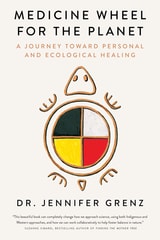
Medicine Wheel for the Planet
A Journey Toward Personal and Ecological HealingJennifer Grenz
University of Minnesota Press, 2024
A personal journey of bringing together Western science and Indigenous ecology to transform our understanding of the human role in healing our planet
I used to be an ecologist. . . . Now, I am a community gatherer, working to help bring healing beyond just the land. I am a story-listener. I am a storyteller. I am a shaper of ecosystems. I work on bringing communities together, in circle, to listen to each other.
A farm kid at heart, and a Nlaka’pamux woman of mixed ancestry, Dr. Jennifer Grenz always felt a deep connection to the land. However, after nearly two decades of working as a restoration ecologist in the Pacific Northwest, she became frustrated that despite the best efforts of her colleagues and numerous volunteers, they weren’t making the meaningful change needed for plant, animal, and human communities to adapt to a warming climate. Restoration ecology is grounded in an idea that we must return the natural world to an untouched, pristine state, placing humans in a godlike role—a notion at odds with Indigenous histories of purposeful, reciprocal interaction with the environment. This disconnect sent Dr. Grenz on a personal journey of joining her head (Western science) and her heart (Indigenous worldview) to find a truer path toward ecological healing.
In Medicine Wheel for the Planet, building on sacred stories, field observations, and her own journey, Dr. Grenz invites readers to share in the teachings of the four directions of the medicine wheel: the North, which draws upon the knowledge and wisdom of elders; the East, where we let go of colonial narratives and see with fresh eyes; the South, where we apply new-old worldviews to envision a way forward; and the West, where a relational approach to land reconciliation is realized.
Eloquent, inspiring, and disruptive, Medicine Wheel for the Planet circles around an argument that we need more than a singular worldview to protect the planet and make the significant changes we are running out of time for.

People And The Planet
Holism and Humanism in Environmental EthicsDon Marietta
Temple University Press, 1994
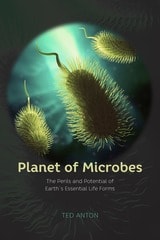
Planet of Microbes
The Perils and Potential of Earth's Essential Life FormsTed Anton
University of Chicago Press, 2017
In Planet of Microbes, Ted Anton takes readers through the most recent discoveries about microbes, revealing their unexpected potential to reshape the future of the planet. For years, we knew little about these invisible invaders, considering them as little more than our enemies in our fight against infectious disease. But the more we learn about microbes, the more it’s become clear that our very lives depend on them. They may also hold the answers to some of science’s most pressing problems, including how to combat a warming planet, clean up the environment, and help the body fight off a wide variety of diseases. Anton has spent years interviewing and working with the determined scientists who hope to harness the work of microbes, and he breaks down the science while also sharing incredible behind-the-scenes stories of the research taking place everywhere from microbreweries to Mars.
The world’s tiniest organisms were here more than three billion years before us. We live in their world, and Planet of Microbes at last gives these unsung heroes the recognition they deserve.
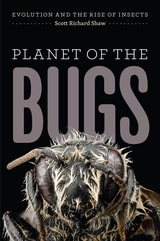
Planet of the Bugs
Evolution and the Rise of InsectsScott Richard Shaw
University of Chicago Press, 2014
Leaving no stone unturned, Shaw explores how evolutionary innovations such as small body size, wings, metamorphosis, and parasitic behavior have enabled insects to disperse widely, occupy increasingly narrow niches, and survive global catastrophes in their rise to dominance. Through buggy tales by turns bizarre and comical—from caddisflies that construct portable houses or weave silken aquatic nets to trap floating debris, to parasitic wasp larvae that develop in the blood of host insects and, by storing waste products in their rear ends, are able to postpone defecation until after they emerge—he not only unearths how changes in our planet’s geology, flora, and fauna contributed to insects’ success, but also how, in return, insects came to shape terrestrial ecosystems and amplify biodiversity. Indeed, in his visits to hyperdiverse rain forests to highlight the current insect extinction crisis, Shaw reaffirms just how crucial these tiny beings are to planetary health and human survival.
In this age of honeybee die-offs and bedbugs hitching rides in the spines of library books, Planet of the Bugs charms with humor, affection, and insight into the world’s six-legged creatures, revealing an essential importance that resonates across time and space.
Reading for the Planet
Toward a GeomethodologyChristian Moraru
University of Michigan Press, 2015
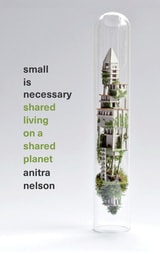
Small Is Necessary
Shared Living on a Shared PlanetAnitra Nelson
Pluto Press, 2018
Using successful examples from a range of countries, Anitra Nelson shows how 'eco-collaborative housing' - resident-driven low impact living with shared facilities and activities - can address the great social, economic and sustainability challenges that householders and capitalist societies face today. Sharing living spaces and facilities results in householders having more amenities and opportunities for neighbourly interaction.
Small is Necessary places contemporary models of 'alternative' housing and living at centre stage arguing that they are outward-looking, culturally rich, with low ecological footprints and offer governance techniques for a more equitable and sustainable future.
Solidarity with the Other Beings on the Planet
Alice Walker, Ecofeminism, and Animals in LiteraturePamela B. June
Northwestern University Press, 2020
Grounded in ecofeminist theory, this literary analysis examines Walker’s evolving views on animals in relation to her discussions of other oppressed groups. Pamela B. June argues that Walker’s fiction can help readers understand and perhaps challenge American culture’s mistreatment of nonhuman animals. Walker has withstood criticism for her decision to abandon vegetarianism, and this book also problematizes the slippery territory of viewing writers as moral guides. Solidarity with the Other Beings on the Planet will appeal to readers in literary studies, ecofeminist studies, African American studies, and critical animal studies.
The Nutmeg's Curse
Parables for a Planet in CrisisAmitav Ghosh
University of Chicago Press, 2021
A powerful work of history, essay, testimony, and polemic, Amitav Ghosh’s new book traces our contemporary planetary crisis back to the discovery of the New World and the sea route to the Indian Ocean. The Nutmeg’s Curse argues that the dynamics of climate change today are rooted in a centuries-old geopolitical order constructed by Western colonialism. At the center of Ghosh’s narrative is the now-ubiquitous spice nutmeg. The history of the nutmeg is one of conquest and exploitation—of both human life and the natural environment. In Ghosh’s hands, the story of the nutmeg becomes a parable for our environmental crisis, revealing the ways human history has always been entangled with earthly materials such as spices, tea, sugarcane, opium, and fossil fuels. Our crisis, he shows, is ultimately the result of a mechanistic view of the earth, where nature exists only as a resource for humans to use for our own ends, rather than a force of its own, full of agency and meaning.
Writing against the backdrop of the global pandemic and the Black Lives Matter protests, Ghosh frames these historical stories in a way that connects our shared colonial histories with the deep inequality we see around us today. By interweaving discussions on everything from the global history of the oil trade to the migrant crisis and the animist spirituality of Indigenous communities around the world, The Nutmeg’s Curse offers a sharp critique of Western society and speaks to the profoundly remarkable ways in which human history is shaped by non-human forces.
Wasted World
How Our Consumption Challenges the PlanetRob Hengeveld
University of Chicago Press, 2012