Results by title
11 books match the query 'Planets'
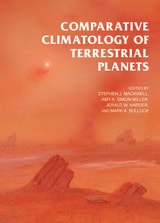
Comparative Climatology of Terrestrial Planets
Edited by Stephen J. Mackwell, Amy A. Simon-Miller, Jerald W. Harder, and Mark A. Bullock
University of Arizona Press, 2014
Deducing the initial conditions for these diverse worlds and unraveling how and why they diverged to their current climates is a challenge at the forefront of planetary science. Through the contributions of more than sixty leading experts in the field, Comparative Climatology of Terrestrial Planets sets forth the foundations for this emerging new science and brings the reader to the forefront of our current understanding of atmospheric formation and climate evolution. Particular emphasis is given to surface-atmosphere interactions, evolving stellar flux, mantle processes, photochemistry, and interactions with the interplanetary environment, all of which influence the climatology of terrestrial planets. From this cornerstone, both current professionals and most especially new students are brought to the threshold, enabling the next generation of new advances in our own solar system and beyond.
Contents
Jim Hansen
Mark Bullock
Scot Rafkin
Caitlin Griffith
Shawn Domagal-Goldman and Antigona Segura
Kevin Zahnle
Part II: The Greenhouse Effect and Atmospheric Dynamics
Curt Covey
G. Schubert and J. Mitchell
Tim Dowling
Francois Forget and Sebastien Lebonnois
Vladimir Krasnopolsky
Adam Showman
Part III: Clouds, Hazes, and Precipitation
Larry Esposito
A. Määttänen, K. Pérot, F. Montmessin, and A. Hauchecorne
Nilton Renno
Zibi Turtle
Mark Marley
Part IV: Surface-Atmosphere Interactions
Colin Goldblatt
Teresa Segura et al.
John Grotzinger
Adrian Lenardic
D. A. Brain, F. Leblanc, J. G. Luhmann, T. E. Moore, and F. Tian
Part V: Solar Influences on Planetary Climate
Aaron Zent
Jerry Harder
F. Tian, E. Chassefiere, F. Leblanc, and D. Brain
David Des Marais
Origin and Evolution of Planetary and Satellite Atmospheres
Edited by S. K. Atreya, J. B. Pollack, and M.S. Matthews
University of Arizona Press, 1989
Placing Outer Space
An Earthly Ethnography of Other WorldsLisa Messeri
Duke University Press, 2016
Planets and Perception
Telescopic Views and Interpretations, 1609-1909William Sheehan
University of Arizona Press, 1988
Planets in Peril
A Critical Study of C. S. Lewis's Ransom TrilogyDavid C. Downing
University of Massachusetts Press, 1992
A critical study of C.S. Lewis's “Ransom Trilogy” which analyses Lewis's methods and meanings, concentrating on this trilogy but also including relevant secondary work. Lewis's literary scholarship and display of Christian values are incorporated into this discussion.
Planets, Stars and Nebulae Studied with Photopolarimetry
Edited by T. Gehrels
University of Arizona Press, 1974
“The high quality of this book is clearly due to strict editorial attention to each paper and the discussions. Gehrels’s book will surely stand for many years as the fundamental reference source for polarization studies in astronomy as well as in atmospheric physics.”—Journal of the Association of Lunar and Planetary Observers
Protostars and Planets
Tom Gehrels
University of Arizona Press, 1979
Protostars and Planets II
David C. Black
University of Arizona Press, 1985
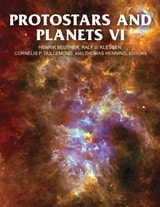
Protostars and Planets VI
Edited by Henrik Beuther, Ralf S. Klessen, Cornelis P. Dullemond, and Thomas Henning
University of Arizona Press, 2014
question: How do planets and their host stars form and evolve? Protostars and Planets VI brings together more than 250 contributing authors at the forefront of their field, conveying the latest results in this research area and establishing a new foundation for advancing our understanding of stellar and planetary formation.
Continuing the tradition of the Protostars and Planets series, this latest volume uniquely integrates the cross-disciplinary aspects of this broad field. Covering an extremely wide range of scales, from the formation of large clouds in our Milky Way galaxy down to small chondrules in our solar system, Protostars and Planets VI takes an encompassing view with the goal of not only highlighting what we know but, most importantly, emphasizing the frontiers of what we do not know.
As a vehicle for propelling forward new discoveries on stars, planets, and their origins, this latest volume in the Space Science Series is an indispensable resource for both current scientists and new students in astronomy, astrophysics, planetary science, and the study of meteorites.
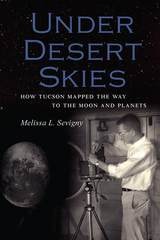
Under Desert Skies
How Tucson Mapped the Way to the Moon and PlanetsMelissa L. Sevigny
University of Arizona Press, 2016
An upstart planetary laboratory in Tucson would play a vital role in the nation’s grand new venture, and in doing so, it would help create the field of planetary science. Founded by Gerard P. Kuiper in 1960, the Lunar and Planetary Laboratory (LPL) at the University of Arizona broke free from traditional astronomical techniques to embrace a wide range of disciplines necessary to the study of planets, including geology, atmospheric sciences, and the elegant emerging technology of spacecraft. Brash, optimistic young students crafted a unique sense of camaraderie in the fledgling institution. Driven by curiosity and imagination, LPL scientists lived through—and, indeed, made happen—the shattering transition in which Earth’s nearest neighbors became more than simple points of light in the sky.
Under Desert Skies tells the story of how a small corner of Arizona became Earth’s ambassador to space. From early efforts to reach the Moon to the first glimpses of Mars’s bleak horizons and Titan’s swirling atmosphere to the latest ambitious plans to touch an asteroid, LPL’s history encompasses humanity’s unfolding knowledge about our place in the universe.

Worlds in the Sky
Planetary Discovery from Earliest Times Through Voyager and MagellanWilliam Sheehan
University of Arizona Press, 1992
In Worlds in the Sky, William Sheehan gives us a history of this long fascination, weaving together scientific history, anecdotes surrounding planetary discoveries, and the personal reflections of an incurable amateur astronomer. He describes how we arrived at our current understanding of the Moon and the planets and shows how certain individuals in history shaped the world’s knowledge about the Solar System.