Results by title
4 books match the query 'Plant conservation'
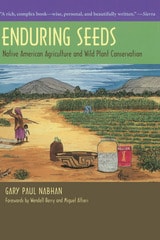
Enduring Seeds
Native American Agriculture and Wild Plant ConservationGary Paul Nabhan; Forewords by Wendell Berry and Miguel Altieri
University of Arizona Press, 2002
As biological diversity continues to shrink at an alarming rate, the loss of plant species poses a threat seemingly less visible than the loss of animals but in many ways more critical. In this book, one of America's leading ethnobotanists warns about our loss of natural vegetation and plant diversity while providing insights into traditional Native agricultural practices in the Americas.
Gary Paul Nabhan here reveals the rich diversity of plants found in tropical forests and their contribution to modern crops, then tells how this diversity is being lost to agriculture and lumbering. He then relates "local parables" of Native American agriculture—from wild rice in the Great Lakes region to wild gourds in Florida—that convey the urgency of this situation and demonstrate the need for saving the seeds of endangered plants. Nabhan stresses the need for maintaining a wide gene pool, not only for the survival of these species but also for the preservation of genetic strains that can help scientists breed more resilient varieties of other plants.
Enduring Seeds is a book that no one concerned with our environment can afford to ignore. It clearly shows us that, as agribusiness increasingly limits the food on our table, a richer harvest can be had by preserving ancient ways.
This edition features a new foreword by Miguel Altieri, one of today's leading spokesmen for sustainable agriculture and the preservation of indigenous farming methods.
[more]
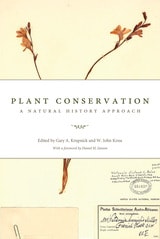
Plant Conservation
A Natural History ApproachEdited by Gary A. Krupnick and W. John Kress
University of Chicago Press, 2005
Natural history has always been the foundation of conservation biology. For centuries, botanists collected specimens in the field to understand plant diversity; now that many habitats are threatened, botanists have turned their focus to conservation, and, increasingly, they look to the collections of museums, herbaria, and botanical gardens for insight on developing informed management programs. Plant Conservation explores the value of these collections in light of contemporary biodiversity studies.
Plant Conservation opens with a broad view of plant biodiversity and then considers evolutionary and taxonomic threats and consequences of habitat alteration; specific threats to plant diversity, such as invasive species and global climate change; consequences of plant population decline at the ecological, evolutionary, and taxonomic levels; and, finally, management strategies that protect plant biodiversity from further decline. With a unique perspective on biodiversity and scientific collections, Plant Conservation ultimately emphasizes the role museums and botanical gardens will play in future conservation.
Plant Conservation opens with a broad view of plant biodiversity and then considers evolutionary and taxonomic threats and consequences of habitat alteration; specific threats to plant diversity, such as invasive species and global climate change; consequences of plant population decline at the ecological, evolutionary, and taxonomic levels; and, finally, management strategies that protect plant biodiversity from further decline. With a unique perspective on biodiversity and scientific collections, Plant Conservation ultimately emphasizes the role museums and botanical gardens will play in future conservation.
[more]
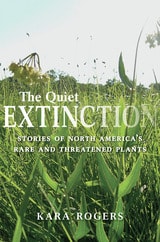
The Quiet Extinction
Stories of North America’s Rare and Threatened PlantsKara Rogers
University of Arizona Press, 2015
In the United States and Canada, thousands of species of native plants are edging toward the brink of extinction, and they are doing so quietly. They are slipping away inconspicuously from settings as diverse as backyards and protected lands. The factors that have contributed to their disappearance are varied and complex, but the consequences of their loss are immeasurable.
With extensive histories of a cast of familiar and rare North American plants, The Quiet Extinction explores the reasons why many of our native plants are disappearing. Curious minds will find a desperate struggle for existence waged by these plants and discover the great environmental impacts that could come if the struggle continues.
Kara Rogers relates the stories of some of North America’s most inspiring rare and threatened plants. She explores, as never before, their significance to the continent’s natural heritage, capturing the excitement of their discovery, the tragedy that has come to define their existence, and the remarkable efforts underway to save them. Accompanied by illustrations created by the author and packed with absorbing detail, The Quiet Extinction offers a compelling and refreshing perspective of rare and threatened plants and their relationship with the land and its people.
[more]
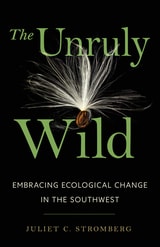
The Unruly Wild
Embracing Ecological Change in the SouthwestJuliet C. Stromberg
University of Arizona Press, 2026
What is considered a beneficial plant? In this era of global change, The Unruly Wild is a timely and relevant look at plant conservation and the evolving plant communities of the American Southwest.
Challenging the traditional invasion biology paradigm, Juliet C. Stromberg invites readers to reconsider the “alien invader” narrative and explore the beneficial roles that newly arrived plants can play in our ecosystems. Drawing from her extensive experience as a plant and restoration ecologist, Stromberg introduces a cast of plant characters that includes longtimers as well as newcomers.
Through compelling stories and scientific insights, Stromberg explains why some plants are thriving while others are in decline. Stromberg’s engaging narrative, enriched with personal anecdotes and detailed vignettes, encourages readers to pause, reflect, and deepen their relationship with the plant world. By promoting a more nuanced and respectful dialogue about our natural surroundings, this book offers valuable insights into biodiversity, climate resilience, and ecosystem restoration. This book is a call to embrace a more inclusive and adaptive approach to wild plants.
[more]