Results by title
4 books match the query 'Platt, Rutherford H.'

Cities on the Beach
Management Issues of Developed Coastal BarriersEdited by Rutherford H. Platt, Sheila G. Pelczarski, and Barbara K. Burbank
University of Chicago Press, 1987
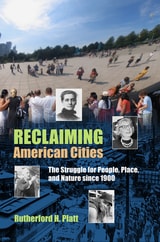
Reclaiming American Cities
The Struggle for People, Place, and Nature since 1900Rutherford H. Platt
University of Massachusetts Press, 2014
For most of the past century, urban America was dominated by top-down policies serving the white business and cultural elite, the suburbs, and the automobile. At times these approaches were fiercely challenged by reformers such as Jane Addams and Jane Jacobs. Yet by the 1980s, mainstream policies had resulted in a nation of ravaged central cities, sprawling suburbs, social and economic polarization, and incalculable environmental damage.
In the 1990s, this entrenched model finally yielded to change as local citizens, neighborhood groups, and other stakeholders, empowered by a spate of new laws and policies, began asserting their own needs and priorities. Though hampered by fiscal crises and internal disagreements, these popular initiatives launched what the author terms a new era of “humane urbanism” marked by a determination to make cities and suburbs greener, healthier, safer, more equitable, more efficient, and generally more people-friendly. In the process, the mayors, architects, engineers, and bureaucrats who had previously dominated urban policy found themselves relegated to supporting roles.
As Rutherford H. Platt points out, humane urbanism can take many forms, from affordable housing and networks of bike paths to refurbished waterfronts and urban farms. Often spontaneous, low-tech, and self-sustaining programs, their shared goal is to connect people to one another and to bring nature back into the city. Reclaiming American Cities examines both sides of this historic transformation: the long struggle against patricians and technocrats of earlier decades and the recent sprouting of grassroots efforts to make metropolitan America more humane and sustainable.
The Ecological City
Preserving and Restoring Urban BiodiversityRutherford H. Platt
University of Massachusetts Press, 1994
Interdisciplinary in content as well as approach, this collection of original essays takes a fresh look at the ecology of urban communities. Written by experts from a variety of professions—academic researchers, private and public program managers, and citizen activists—the book explores issues of geography, ecology, landscape architecture, urban forestry, law, and environmental education. Contributions include broad overviews of common problems a well as detailed case studies of specific programs.
Although several contributors are natural scientists, the book focuses on matters of public policy and public-private collaboration. The aim is not only to assess the impact of increasing urbanization on biodiversity, but also to propose new ways of preserving and restoring the balance between the natural and the built environment through planning and design.
The Humane Metropolis
People and Nature in the 21st-Century CityRutherford H. Platt
University of Massachusetts Press, 2006
Four-fifths of Americans now live in the nation's sprawling metropolitan areas, and half of the world's population is now classified as “urban.” As cities become the dominant living environment for humans, there is growing concern about how to make such places more habitable, more healthy and safe, more ecological, and more equitable—in short, more “humane.”
This book explores the prospects for a more humane metropolis through a series of essays and case studies that consider why and how urban places can be made greener and more amenable. Its point of departure is the legacy of William H. Whyte (1917-1999), one of America's most admired urban thinkers. From his eyrie high above Manhattan in the offices of the Rockefeller Brothers Fund, Whyte laid the foundation for today's “smart growth” and “new urbanist” movements with books such as The Last Landscape (1968). His passion for improving the habitability of cities and suburbs is reflected in the diverse grassroots urban design and regreening strategies discussed in this volume.
Topics examined in this book include urban and regional greenspaces, urban ecological restoration, social equity, and green design. Some of the contributors are recognized academic experts, while others offer direct practical knowledge of particular problems and initiatives. The editor's introduction and epilogue set the individual chapters in a broader context and suggest how the strategies described, if widely replicated, may help create more humane urban environments.
In addition to Rutherford H. Platt, contributors to the volume include Carl Anthony, Thomas Balsley, Timothy Beatley, Eugenie L. Birch, Edward J. Blakely, Colin M. Cathcart, Steven E. Clemants, Christopher A. De Sousa, Steven N. Handel, Peter Harnik, Michael C. Houck, Jerold S. Kayden, Albert LaFarge, Andrew Light, Charles E. Little, Anne C. Lusk, Thalya Parilla, Deborah E. Popper, Frank J. Popper, Mary V. Rickel, Cynthia Rosenzweig, Robert L. Ryan, Laurin N. Sievert, Andrew G. Wiley-Schwartz, and Ann Louise Strong.
Included in the back of the book is a DVD of a 22-minute film created by Ted White, which serves as a companion to the text.