Results by title

4 books match the query 'Plautus, Titus Maccius'
cover of A Commentary on Plautus' Curculio

A Commentary on Plautus' Curculio

T. H. M. Gellar-Goad

University of Michigan Press, 2024

Lively and critically aware, T. H. M. Gellar-Goad’s A Commentary on Plautus’ Curculio is the new reference text on the play. Curculio follows the efforts of the title character to trick a sex-trafficker into handing over an enslaved woman to the young man infatuated with her instead of to the soldier who’s paid for her—and will turn out to be her long-lost brother. As Plautus’ shortest comedy, Curculio has proven to be a desirable text for university performances. The play exemplifies Plautus’ style, with a blend of erotic, deception, and recognition plotlines, plus a wide range of archetypal characters. Gellar-Goad’s commentary is the complete package, with introductions to themes, content, humor, meter, and syntax; notes on matters of performance, interpretation, and social history; and a text with aids to scansion and clarifying stage directions.

This up-to-date, authoritative commentary on the play will prove useful to directors and actors and will readily introduce students to the joys of Roman comedy.
 
[more]
cover of Asinaria: The One about the Asses

Asinaria

The One about the Asses

Plautus; Translated and with commentary by John Henderson

University of Wisconsin Press, 2006
Asses, asses, and more asses! This new edition of Plautus' rumbustious comedy provides the complete original Latin text, witty scholarly commentary, and an English translation that both complements and explicates Plautus' original style. John Henderson reveals this play as a key to Roman social relations centered on many kinds of slavery: to sex, money, and family structure; to masculinity and social standing; to senility and partying; and to jokes, lies, and idiocy. The translation remains faithful to Plautus' syllabic style for reading aloud, as well as to his humorous colloquialisms and wordplay, providing readers with a comfortable affinity to Plautus himself. An indispensable teaching and learning tool for the study of Roman New Comedy, this edition includes comprehensive commentary, useful indexes, and a pronunciation guide that will help readers of all levels understand and appreciate Plautus and his era.
[more]
cover of Plautus' Poenulus: A Student Commentary

Plautus' Poenulus

A Student Commentary

Erin K. Moodie

University of Michigan Press, 2015

Erin K. Moodie presents a rigorous yet accessible guide to Plautus’ satirical play Poenulus for use in the contemporary classroom. Likely written and staged in the years following the Second Punic War between Rome and Carthage, Poenulus tells the tale of a young Carthaginian,
the adopted son and heir of the man who purchased him as a slave when he was a child, who is in love with a female Carthaginian slave and prostitute. The comedy, especially Plautus’ portrayal of his main character, compels the reader to consider Rome’s relationship with Carthage, its former enemy; Plautus’ role in choosing and adapting plays for the Roman stage; and the constraints of the palliata genre.

The full Latin text, based primarily on that of Friedrich Leo, is included in this volume. Moodie’s detailed introduction, map, and comprehensive notes approach the text from multiple angles, enabling the advanced undergraduate or graduate student to grapple directly with the issues
Poenulus raises. Her commentary, clearly correlated with specific points in the text by the use of line numbers, provides assistance with early Latin grammar and syntax, Plautine meter, Roman history, and the influences on and performance contexts of Roman comedy. The commentary also introduces students to modern scholarship on the genre, including metatheatrical interpretations and performance criticism.

“A comprehensive, user-friendly tool for students of Plautus and ancient comedy . . . almost everything that a student could ask seems to have been anticipated by the author.”
—Radd Ehrman, Kent State University
 
[more]
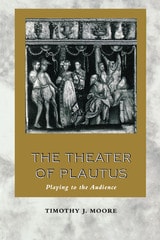
cover of The Theater of Plautus: Playing to the Audience

The Theater of Plautus

Playing to the Audience

By Timothy J. Moore

University of Texas Press, 1998

The relationship between actors and spectators has been of perennial interest to playwrights. The Roman playwright Plautus (ca. 200 BCE) was particularly adept at manipulating this relationship. Plautus allowed his actors to acknowledge freely the illusion in which they were taking part, to elicit laughter through humorous asides and monologues, and simultaneously to flatter and tease the spectators.

These metatheatrical techniques are the focus of Timothy J. Moore's innovative study of the comedies of Plautus. The first part of the book examines Plautus' techniques in detail, while the second part explores how he used them in the plays Pseudolus, Amphitruo, Curculio, Truculentus, Casina, and Captivi. Moore shows that Plautus employed these dramatic devices not only to entertain his audience but also to satirize aspects of Roman society, such as shady business practices and extravagant spending on prostitutes, and to challenge his spectators' preconceptions about such issues as marriage and slavery. These findings forge new links between Roman comedy and the social and historical context of its performance.

[more]