Results by title
6 books match the query 'Plazas'
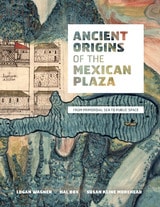
Ancient Origins of the Mexican Plaza
From Primordial Sea to Public SpaceBy Logan Wagner, Hal Box, and Susan Kline Morehead
University of Texas Press, 2013
The plaza has been a defining feature of Mexican urban architecture and culture for at least 4,000 years. Ancient Mesoamericans conducted most of their communal life in outdoor public spaces, and today the plaza is still the public living room in every Mexican neighborhood, town, and city—the place where friends meet, news is shared, and personal and communal rituals and celebrations happen. The site of a community’s most important architecture—church, government buildings, and marketplace—the plaza is both sacred and secular space and thus the very heart of the community.
This extensively illustrated book traces the evolution of the Mexican plaza from Mesoamerican sacred space to modern public gathering place. The authors led teams of volunteers who measured and documented nearly one hundred traditional Mexican town centers. The resulting plans reveal the layers of Mesoamerican and European history that underlie the contemporary plaza. The authors describe how Mesoamericans designed their ceremonial centers as embodiments of creation myths—the plaza as the primordial sea from which the earth emerged. They discuss how Europeans, even though they sought to eradicate native culture, actually preserved it as they overlaid the Mesoamerican sacred plaza with the Renaissance urban concept of an orthogonal grid with a central open space. The authors also show how the plaza’s historic, architectural, social, and economic qualities can contribute to mainstream urban design and architecture today.
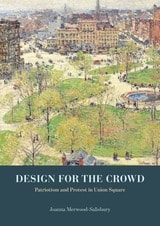
Design for the Crowd
Patriotism and Protest in Union SquareJoanna Merwood-Salisbury
University of Chicago Press, 2019
In this sweeping history of an iconic urban square, Merwood-Salisbury gives us a review of American political activism, philosophies of urban design, and the many ways in which a seemingly stable landmark can change through public engagement and design.
Published with the support of Furthermore: a program of the J. M. Kaplan Fund.
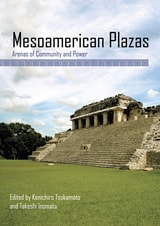
Mesoamerican Plazas
Arenas of Community and PowerEdited by Kenichiro Tsukamoto and Takeshi Inomata
University of Arizona Press, 2014
The primary question that has motivated the contributors is how Mesoamerican plazas became arenas for the creation and negotiation of social relations and values in a community. The thirteen contributions stress the significance of interplay between power relations and embodied practices set in specific historical and material settings, as outlined by practice theory and performance theory. This approach allows the contributors to explore broader anthropological issues, such as the negotiation of power relations, community making, and the constitution of political authorities.
Overall, the contributions establish that physical interactions among people in communal events were not the outcomes of political machinations held behind the scenes, but were the actual political processes through which people created, negotiated, and subverted social realities. If so, spacious plazas that were arguably designed for interactions among a large number of individuals must have also provided critical arenas for the constitution and transformation of society.
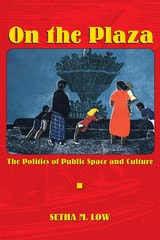
On the Plaza
The Politics of Public Space and CultureBy Setha M. Low
University of Texas Press, 2000
Robert B. Textor Prize for Excellence in Anticipatory Anthropology, American Anthropological Association, 2000
Honorable Mention, Victor Turner Award, Society for Humanistic Anthropology, 2001
Leeds Prize, Society of Urban, National, and Transnational/Global Anthropology, 2001
Friendly gossip, political rallies, outdoor concerts, drugs, shoeshines, and sex-for-sale—almost every aspect of Latin American life has its place and time in the public plaza. In this wide-ranging, multi-disciplinary study, Setha M. Low explores the interplay of space and culture in the plaza, showing how culture acts to shape public spaces and how the physical form of the plaza encodes the social and economic relations within its city.
Low centers her study on two plazas in San José, Costa Rica, with comparisons to public plazas in the United States, Europe, and elsewhere. She interweaves ethnography, history, literature, and personal narrative to capture the ambiance and meaning of the plaza. She also uncovers the contradictory ethnohistories of the European and indigenous origins of the Latin American plaza and explains why the plaza is often a politically contested space.
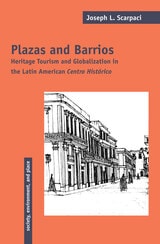
Plazas and Barrios
Heritage Tourism and Globalization in the Latin American Centro HistóricoJoseph L. Scarpaci
University of Arizona Press, 2004
This book explores how heritage tourism and globalization are reshaping the Latin American centro histórico, analyzing the transformation of the urban core from town plaza to historic center in nine cities: Bogotá, Colombia; Buenos Aires, Argentina; Cartagena, Colombia; Cuenca, Ecuador; Havana, Cuba; Montevideo, Uruguay; Puebla, Mexico; Quito, Ecuador; and Trinidad, Cuba. It tells how these pressures, combined with the advantage of a downtown location, have raised the potential of redeveloping these inner city areas but have also created the dilemma of how to restore and conserve them while responding to new economic imperatives.
In an eclectic and interdisciplinary study, Joseph Scarpaci documents changes in far-flung corners of the Latin American metropolis using a broad palette of tools: urban morphology profiles, an original land-use survey of 30,000 doorways in nine historic districts, numerous photographs, and a review of the political, economic, and globalizing forces at work in historic districts. He examines urban change as reflected in architectural styles, neighborhood growth and decline, real estate markets, and local politics in order to show the long reach of globalization and modernity.
Plazas and Barrios spans all of Spanish-speaking America to address the socio-political dimensions of urban change. It offers a means for understanding the tensions between the modern and traditional aspects of the built environment in each city and provides a key resource for geographers, urban planners, architectural historians, and all concerned with the implications of the emerging global economy.
The Courthouse Square in Texas
By Robert E. Veselka
University of Texas Press, 2000
With its dignified courthouse set among shade trees and lawns dotted with monuments to prominent citizens and fallen veterans, the courthouse square remains the civic center in a majority of the county seats of Texas. Yet the squares themselves vary in form and layout, reflecting the different town-planning traditions that settlers brought from Europe, Mexico, and the United States. In fact, one way to trace settlement patterns and ethnic dispersion in Texas is by mapping the different types of courthouse squares.
This book offers the first complete inventory of Texas courthouse squares, drawn from extensive archival research and site visits to 139 of the 254 county seats. Robert Veselka classifies every existing plan by type and origin, including patterns and variants not previously identified. He also explores the social and symbolic functions of these plans as he discusses the historical and modern uses of the squares. He draws interesting new conclusions about why the courthouse square remains the hub of commercial and civic activity in the smaller county seats, when it has lost its prominence in others.