Results by title

2 books match the query 'Pleasure Principle'
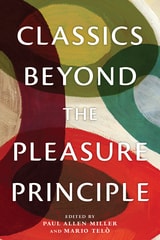
cover of Classics Beyond the Pleasure Principle

Classics Beyond the Pleasure Principle

Edited by Paul Allen Miller and Mario Telò

The Ohio State University Press, 2026

Classics Beyond the Pleasure Principle explores the concept of the Freudian death drive to interrogate both the ancient past and the present, highlighting how destruction and its remnants resist erasure and shape historical memory. Using Gaza’s rubble as a metaphor for the indestructibility of violence’s material traces, the text connects ancient Greco-Roman culture—from Homer and Sophocles to Ovid and Seneca—with modern figures and events, from Elena Ferrante to the war in Israel and Palestine. The volume engages psychoanalytic theory, queer theory, and feminism to challenge the boundaries of classical studies, arguing that only by confronting the discipline’s entanglement with the pleasure principle and its repressions can classics contribute to understanding the crises of the present and imagining a future distinct from the past.

Contributors:
Karen Bassi, Martin Devecka, Micaela Janan, Hagi Kenaan, Vered Lev Kenaan, Sara Lindheim, Paul Allen Miller, Helen Morales, Jay Oliver, Victoria Rimell, Mario Telò
[more]
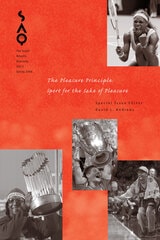
cover of The Pleasure Principle: Sport for the Sake of Pleasure, Volume 105

The Pleasure Principle

Sport for the Sake of Pleasure, Volume 105

David L. Andrews, ed.

Duke University Press, 0

From the ancient Olympic games to the savage gladiatorial contests of the Roman Empire, from the thrill of the World Cup to the hype of the Super Bowl, sport represents a singular source of social belonging and communal enjoyment—sometimes as intense as religious faith. The Pleasure Principle addresses the issue of sport as a form of pleasure, contending that sport, like any form of popular culture, reveals a lot about the society in which it appears. Examining sports through various theoretical lenses, including Marxist, feminist, and poststructuralist, and from numerous disciplinary viewpoints—history, sociology, cinema studies, literature, and cultural studies—this special issue demonstrates the complexity of contemporary sports culture.

Ranging from the humorous to the ironic, from the personal to the theoretical, and from sports as dissimilar as baseball and rugby, gambling and karate, this issue explains fandom itself and explores the intersections of sport and politics, sport and class, and sport and identity. One timely essay addresses the use of Native American imagery and nicknames and the recent NCAA ban on these references. Another classifies gambling as a popular American sport, one that in 2003 attracted three times as many attendees as all Major League Baseball franchises combined. Another essay delves into the history of the golfing mecca of Pinehurst, North Carolina, discussing the resort’s roots in the age of Jim Crow. Among the other topics addressed in this issue are how soccer fandom and commodity culture can be one and the same; why Liverpool’s 2005 victory in the European Champion’s League proves that God is red; and why the Olympic Games can represent performative nationalism.

Contributors. David L. Andrews, Amy Bass, Norman K. Denzin, Grant Farred, Keya Ganguly, John Hartley, Jane Juffer, Liz Moor, Jeffrey T. Nealon, Annie Paul, George Ritzer, Jim Shepard, Orin Starn, Kenneth Surin

[more]