Results by title
3 books match the query 'Poems New'
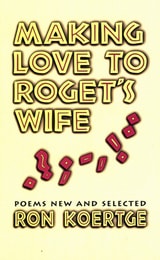
Making Love to Roget's Wife
Poems New and SelectedRon Koertge
University of Arkansas Press, 2001
In plain, unpretentious language, with brutal honesty, Ron Koertge can meld violence, love, human ugliness, joy, and modern depravity into a short lyric that makes us laugh out loud or socks us in the gut. His images arrive in giant clown shoes—cigars the size of Florida, the plastic man’s counter-length arms—or neatly packaged in carefully observed detail, as he writes of the “black little hearts” of ants or an ape’s “dark and leathery breast.”
Through every poem, there runs a constant and sincere humanity, a voice that laughs at itself, often goads us a bit, but always stuns and enlightens us when we dis – cover something of ourselves gambling with the crowd at the racetrack, driving from the parking lot of the Mexican restaurant, or shambling with the distraught parent leaving the hospital.
In Making Love to Roget’s Wife, Ron Koertge offers his best work from twenty-three years and a dozen earlier collections. With twenty-five new poems, and over eighty from previous books, this selection reawakens us to the presence of a superbly honed comic voice.

The Other Journey
Poems New and SelectedKatherine Chapin
University of Minnesota Press, 1959
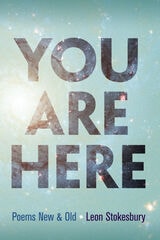
You Are Here
Poems New & OldLeon Stokesbury
University of Arkansas Press, 2016
Winnowed from a distinguished career, then distilled, then polished and winnowed again, the poems in You Are Here are Leon Stokesbury’s best from fifty years of published work.
The selections from his earlier volumes are as fully realized as one would expect from the winner of the AWP Poetry Competition and the Poets’ Prize. But it is in Stokesbury’s new work, collected under the heading “These Days,” that he reveals something completely different. From a carnival sideshow to Hitchcock’s Mount Rushmore, from John Keats’s backyard to the miseries of a failed crematorium operator, every turned page divulges a particular we didn’t see coming. You Are Here is like a sideshow of this modern world, even when we discover, amazed, our selves looking back at us.
“Why do we still only stand here?” Stokesbury asks in one of his earliest salvos. The poems in this collection give such varied answers that readers will have no idea what the next page holds, only that they will find themselves somewhere new.