Results by title
3 books match the query 'Poetic Form'

Affirming Limits
Essays on Mortality, Choice, and Poetic FormPack, Robert
University of Massachusetts Press, 1985
Robert Pack's Affirming Limits: Essays on Mortality, Choice, and Poetic Form is a collection of critical essays exploring the relationship between existential constraints and poetic expression. Written by the acclaimed poet and literary critic, the collection examines how limitations—of form, mortality, and human agency—become generative forces in poetry rather than obstacles to artistic vision. Pack investigates the paradox that accepting life's finitude and structural bounds can paradoxically liberate creative possibility.
The essays traverse major poetic traditions and individual poets, analyzing how mortality confronts choice within the strict demands of formal verse. Pack argues that poetic form is not a restrictive container but an enabling framework that gives shape and meaning to human experience. This work reflects Pack's dual expertise as both poet and theorist, bridging philosophical inquiry with close textual analysis. The volume addresses central concerns of late twentieth-century literary criticism: the value of formal aesthetics, the ethics of artistic creation, and the function of poetry in confronting human limitation. Essential for scholars of contemporary poetics and the philosophy of form.
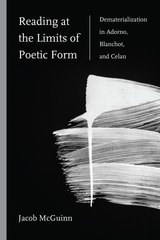
Reading at the Limits of Poetic Form
Dematerialization in Adorno, Blanchot, and CelanJacob McGuinn
Northwestern University Press, 2024
How does literary objecthood contend with the challenge of writing objects that emerge at an extreme limit of material presence? Jacob McGuinn delves into the ways literature writes this indeterminate presence in the context of pre- and post-’68 Paris, a vital moment in the history of criticism. The works of poet Paul Celan, philosopher Theodor Adorno, and writer Maurice Blanchot highlight how the complexities of reading such a dematerialized object are part of the indeterminacy of material itself. Indeterminate objects—glass, snow, walls, screens—are subjects Celan describes as existing in “meridian” space, while for Adorno and Blanchot, criticism not only responds to this indeterminacy but also takes it as its condition. Reading at the Limits of Poetic Form: Dematerialization in Adorno, Blanchot, and Celan shows how these readings simultaneously limit the object of criticism and outline alternative ways of thinking that lie between the models of critical formalism and historicism, ultimately revealing the possible materiality of literature in unrealized history, incomplete politics, and nondetermining thinking.
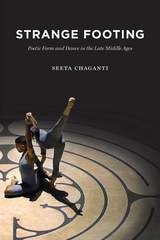
Strange Footing
Poetic Form and Dance in the Late Middle AgesSeeta Chaganti
University of Chicago Press, 2018
Exploring the complex relationship between medieval dance and medieval poetry, Strange Footing argues that the intersection of texts and dance produced an experience of poetic form based in disorientation, asymmetry, and even misstep. Medieval dance guided audiences to approach poetry not in terms of the body’s regular marking of time and space, but rather in the irregular and surprising forces of virtual motion around, ahead of, and behind the dancing body. Reading medieval poems through artworks, paintings, and sculptures depicting dance, Seeta Chaganti illuminates texts that have long eluded our full understanding, inviting us to inhabit their strange footings askew of conventional space and time.
Strange Footing deploys the motion of dance to change how we read medieval poetry, generating a new theory of poetic form for medieval studies and beyond.