Results by title
3 books match the query 'Poisonous plants'
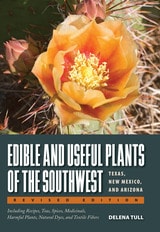
Edible and Useful Plants of the Southwest
Texas, New Mexico, and ArizonaBy Delena Tull
University of Texas Press, 2013
All around us there are wild plants useful for food, medicine, and clothing, but most of us don’t know how to identify or use them. Delena Tull amply supplies that knowledge in this book, which she has now expanded to more thoroughly address plants found in New Mexico and Arizona, as well as Texas.
Extensively illustrated with black-and-white drawings and color photos, this book includes the following special features:
- Recipes for foods made from edible wild plants
- Wild teas and spices
- Wild plant dyes, with instructions for preparing the plants and dying wool, cotton, and other materials
- Instructions for preparing fibers for use in making baskets, textiles, and paper
- Information on wild plants used for making rubber, wax, oil, and soap
- Information on medicinal uses of plants
- Details on hay fever plants and plants that cause rashes
- Instructions for distinguishing edible from poisonous berries
- Detailed information on poisonous plants, including poison ivy, oak, and sumac, as well as herbal treatments for their rashes
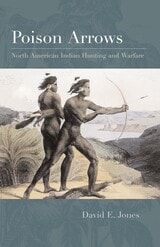
Poison Arrows
North American Indian Hunting and WarfareBy David E. Jones
University of Texas Press, 2007
Biological warfare is a menacing twenty-first-century issue, but its origins extend to antiquity. While the recorded use of toxins in warfare in some ancient populations is rarely disputed (the use of arsenical smoke in China, which dates to at least 1000 BC, for example) the use of "poison arrows" and other deadly substances by Native American groups has been fraught with contradiction. At last revealing clear documentation to support these theories, anthropologist David Jones transforms the realm of ethnobotany in Poison Arrows.
Examining evidence within the few extant descriptive accounts of Native American warfare, along with grooved arrowheads and clues from botanical knowledge, Jones builds a solid case to indicate widespread and very effective use of many types of toxins. He argues that various groups applied them to not only warfare but also to hunting, and even as an early form of insect extermination. Culling extensive ethnological, historical, and archaeological data, Jones provides a thoroughly comprehensive survey of the use of ethnobotanical and entomological compounds applied in wide-ranging ways, including homicide and suicide. Although many narratives from the contact period in North America deny such uses, Jones now offers conclusive documentation to prove otherwise.
A groundbreaking study of a subject that has been long overlooked, Poison Arrows imparts an extraordinary new perspective to the history of warfare, weaponry, and deadly human ingenuity.
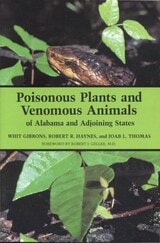
Poisonous Plants and Venomous Animals of Alabama and Adjoining States
Whit Gibbons, Robert R. Haynes, and Joab L. Thomas
University of Alabama Press, 1989
The essential guide to identifying and understanding the Southeast's toxic plants and venomous wildlife.
Wisteria, mistletoe, oleander, milkweed, narcissus, yellow Jessamine, wild hydrangea, trillium, all are plants easily recognized by most people. But these and more that 200 other plants in Alabama and the Southeast can cause systemic poisoning if ingested by human beings and livestock. This book describes these poisonous plants, including various mushrooms, and discusses the toxic properties, symptoms of poisoning, habitat occurrence, and geographic distribution. One chapter describes plants that cause dermatitis or other allergic reactions-plants including poison ivy, poison sumac, ragweed, clematis, and red maple.
Other chapters of the book discuss venous animals-not only the six venomous snakes of the Southeast but also certain jellyfishes, centipedes, spiders, scorpions, stinging caterpillars, wasps, hornets, bees, catfishes, stingrays, and others- that might be encountered by people during recreation or work. The authors describe habitat occurrence, geographic distribution, and general life history and behavior for these animals. Numerous color photographs and drawings of both plants and animals are included for identification, as well as hundreds of range maps.
The authors encourage an appreciation for the protective mechanisms hat help plants and animals defend themselves against predators or other threats. Although people must be able to recognize a poisonous plant or venomous animal in order to avoid suffering unwary contact, the book reassures the reader that Alabama’s flora and fauna gives us little cause to worry on a relative scale. The information provided increases our understanding of and admiration for these species and their environments.