Results by title
2 books match the query 'Polemics in literature'
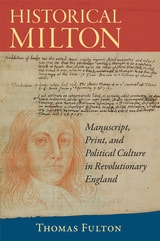
Historical Milton
Manuscript, Print, and Political Culture in Revolutionary EnglandThomas Fulton
University of Massachusetts Press, 2010
John Milton's Commonplace Book is the only known political notebook of a radical polemicist writing during the English civil war, and the most extensive manuscript record of reading we have from any major English poet from this period. In this rethinking of a surprisingly neglected body of evidence, Thomas Fulton explores Milton's reading practices and the ways he used this reading in his writing. Fulton's close study of the Commonplace Book suggests that this reading record is far from the haphazard collection of notes that it first appears but is instead a program of research which had its own ideology that responded to the reading habits and practices of Milton's contemporaries. Created mostly in the late 1630s and during the overthrow of the Stuart government in the 1640s, Milton's reading notes yield a number of surprises, the most fundamental being a highly structured commitment to political history. Fulton explores the relationship between the manuscript author and his polemical persona, placing the Commonplace Book, the manuscript "Digression" to the History of Britain, and some wartime poems in revealing contrast to the printed political texts of this period.
[more]
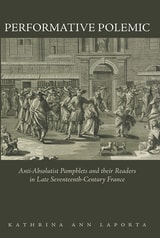
Performative Polemic
Anti-Absolutist Pamphlets and their Readers in Late Seventeenth-Century FranceKathrina Ann LaPorta
University of Delaware Press, 2021
Performative Polemic is the first literary historical study to analyze the “war of words” unleashed in the pamphlets denouncing Louis XIV’s absolute monarchy between 1667 and 1715. As conflict erupted between the French ruler and his political enemies, pamphlet writers across Europe penned scathing assaults on the Sun King’s bellicose impulses and expansionist policies. This book investigates how pamphlet writers challenged the monarchy’s monopoly over the performance of sovereignty by contesting the very mechanisms through which the crown legitimized its authority at home and abroad. Author Kathrina LaPorta offers a new conceptual framework for reading pamphlets as political interventions, asserting that an analysis of the pamphlet’s form is crucial to understanding how pamphleteers seduced readers by capitalizing on existing markets in literature, legal writing, and journalism. Pamphlet writers appeal to the theater-going public that would have been attending plays by Molière and Racine, as well as to readers of historical novels and periodicals. Pamphleteers entertained readers as they attacked the performative circuitry behind the curtain of monarchy.
[more]