Results by title
6 books match the query 'Police power'
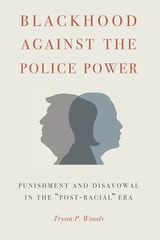
Blackhood Against the Police Power
Punishment and Disavowal in the "Post-Racial" EraTryon P. Woods
Michigan State University Press, 2019
Both significant and timely, Blackhood Against the Police Power addresses the punishment of “race” and the disavowal of sexual violence central to the contemporary “post-racial” culture of politics. Here the author asserts that the post-racial presents an antiblack animus that should be read as desiring the end of blackness and the black liberation movement’s singular ethical claims. The book redefines policing as a sociohistorical process of implementing antiblackness and, in so doing, redefines racism as an act of sexual violence that produces the punishment of race. It smartly critiques the way leading antiracist discourse is frequently complicit with antiblackness and recalls the original 1960s conception of black studies as a corrective to the deficiencies in today’s critical discourse on race and sex. The book explores these lines of inquiry to pinpoint how the history of racial slavery wraps itself in a new discourse of disavowal. In this way, Blackhood Against the Police Power responds to a range of texts, policies, practices, and representations complicit with the police power—from the Fourth Amendment and the movements to curtail stop-and-frisk policing and mass incarceration to popular culture treatments of blackness to the leading academic discourses on race and sex politics.
[more]
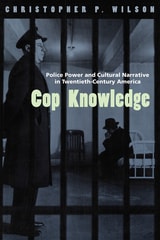
Cop Knowledge
Police Power and Cultural Narrative in Twentieth-Century AmericaChristopher P. Wilson
University of Chicago Press, 2000
Whether they appear in mystery novels or headline news stories, on prime-time TV or the silver screen, few figures have maintained such an extraordinary hold on the American cultural imagination as modern police officers. Why are we so fascinated with the police and their power? What relation do these pervasive media representations bear to the actual history of modern policing?
Christopher P. Wilson explores these questions by examining narratives of police power in crime news, popular fiction, and film, showing how they both reflect and influence the real strategies of law enforcement on the beat, in the squad room, and in urban politics. He takes us from Theodore Roosevelt's year of reform with the 1890s NYPD to the rise of "community policing," from the classic "police procedural" film The Naked City to the bestselling novels of LAPD veteran Joseph Wambaugh. Wilson concludes by demonstrating the ways in which popular storytelling about police power has been intimately tied to the course of modern liberalism, and to the rising tide of neoconservatism today.
"A thorough, brilliant blend that crosses disciplines."—Choice
"[S]ophisticated, highly theoretical and ambitious. . . . Connects the history of policing to cultural representations of crime, criminals and cops."—Times Literary Supplement
"[A] deeply satisfying approach to the crime narrative. . . . [Wilson] focuses, ultimately, on the role of police power in cultural storytelling."—American Quarterly
[more]
Policing Space
Territoriality and the Los Angeles Police DepartmentSteve Herbert
University of Minnesota Press, 1996
Policing Space is a fascinating firsthand account of how the Los Angeles Police Department attempts to control its vast, heterogeneous territory. As such, the book offers a rare, ground-level look at the relationship between the control of space and the exercise of power.
Author Steve Herbert spent eight months observing one patrol division of the LAPD on the job. A compelling story in itself, his fieldwork with the officers in the Wilshire Division affords readers a close view of the complex factors at play in how the police define and control territory, how they make and mark space. A remarkable ethnography of a powerful police department, underscored throughout with telling on-the-scene vignettes, this book is also an unusually intensive analysis of the exercise of territorial power-and of territoriality as a key component of police power. Unique in its application of fieldwork and theory to this complex subject, it should prove valuable to readers in urban and political geography, urban and political sociology, and criminology, as well as those who wonder about the workings of the LAPD.[more]
Regulatory Rights
Supreme Court Activism, the Public Interest, and the Making of Constitutional LawLarry Yackle
University of Chicago Press, 2007
We often hear—with particular frequency during recent Supreme Court nomination hearings—that justices should not create constitutional rights, but should instead enforce the rights that the Constitution enshrines. In Regulatory Rights, Larry Yackle sets out to convince readers that such arguments fundamentally misconceive both the work that justices do and the character of the American Constitution in whose name they do it. It matters who sits on the Supreme Court, he argues, precisely because justices do create individual constitutional rights.
Traversing a wide range of Supreme Court decisions that established crucial precedents about racial discrimination, the death penalty, and sexual freedom, Yackle contends that the rights we enjoy are neither more nor less than what the justices choose to make of them. Regulatory Rights is a bracing read that will be heatedly debated by all those interested in constitutional law and the judiciary.
Traversing a wide range of Supreme Court decisions that established crucial precedents about racial discrimination, the death penalty, and sexual freedom, Yackle contends that the rights we enjoy are neither more nor less than what the justices choose to make of them. Regulatory Rights is a bracing read that will be heatedly debated by all those interested in constitutional law and the judiciary.
[more]
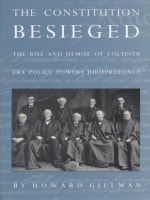
The Constitution Besieged
The Rise & Demise of Lochner Era Police Powers JurisprudenceHoward Gillman
Duke University Press, 1993
The Constitution Besieged offers a compelling reinterpretation of one of the most notorious periods in American constitutional history. In the decades following the Civil War, federal and state judges struck down as unconstitutional a great deal of innovative social and economic legislation. Scholars have traditionally viewed this as the work of a conservative judiciary more interested in promoting laissez-faire economics than in interpreting the Constitution. Gillman challenges this scholarly orthodoxy by showing how these judges were in fact observing a long-standing constitutional prohibition against "class legislation." Originally published in cloth by Duke University Press, this book received the 1994 C. Herman Pritchett Award for the "Best Book in the Field of Law and Courts," awarded by the Law and Courts Section of the American Political Science Association.
[more]

The Fabrication of Social Order
A Critical Theory of Police PowerMark Neocleous
Pluto Press, 2000
Anyone who considers questions of power cannot help but be struck by the ubiquitous nature, emotional force and political pull of the concept of order. The Fabrication of Social Order examines the role of policing in the fabrication of order.
After an initial exploration of the original relationship between police, state power and the question of order, Neocleous focuses on the ways in which eighteenth century liberalism refined and narrowed the concept of the police, a process which masked the power of capital and broader issues of social control. In doing so he challenges the way liberalism came to define policing solely in terms of the question of crime and the rule of law. This liberal definition created a limited and fundamentally misleading understanding of policing which remains in use today.
In contrast, Neocleous argues for an expanded concept of police, adequate to the expansive set of institutions through which policing takes place. These institutions are concerned not just with the maintenance or reproduction of order, but with its fabrication, especially the fabrication of a social order based on wage labour. This project, he argues, should be understood as the project of social security. Grasping this point allows a fuller understanding of the ways in which the state polices and secures civil society, and how order is fabricated through law and administration.
[more]