Results by title
2 books match the query 'Polio'
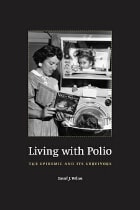
Living with Polio
The Epidemic and Its SurvivorsDaniel J. Wilson
University of Chicago Press, 2005
Polio was the most dreaded childhood disease of twentieth-century America. Every summer during the 1940s and 1950s, parents were terrorized by the thought that polio might cripple their children. They warned their children not to drink from public fountains, to avoid swimming pools, and to stay away from movie theaters and other crowded places. Whenever and wherever polio struck, hospitals filled with victims of the virus. Many experienced only temporary paralysis, but others faced a lifetime of disability.
Living with Polio is the first book to focus primarily on the personal stories of the men and women who had acute polio and lived with its crippling consequences. Writing from personal experience, polio survivor Daniel J. Wilson shapes this impassioned book with the testimonials of more than one hundred polio victims, focusing on the years between 1930 and 1960. He traces the entire life experience of the survivors—from the alarming diagnosis all the way to the recent development of post-polio syndrome, a condition in which the symptoms of the disease may return two or three decades after they originally surfaced.
Living with Polio follows every physical and emotional stage of the disease: the loneliness of long separations from family and friends suffered by hospitalized victims; the rehabilitation facilitieswhere survivors spent a full year or more painfully trying to regain the use of their paralyzed muscles; and then the return home, where they were faced with readjusting to school or work with the aid of braces, crutches, or wheelchairs while their families faced the difficult responsibilities of caring for and supporting a child or spouse with a disability.
Poignant and gripping, Living with Polio is a compelling history of the enduring physical and psychological experience of polio straight from the rarely heard voices of its survivors.
[more]
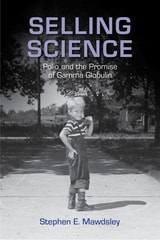
Selling Science
Polio and the Promise of Gamma GlobulinMawdsley, Stephen E
Rutgers University Press, 2016
Today, when many parents seem reluctant to have their children vaccinated, even with long proven medications, the Salk vaccine trial, which enrolled millions of healthy children to test an unproven medical intervention, seems nothing short of astonishing. In Selling Science, medical historian Stephen E. Mawdsley recounts the untold story of the first large clinical trial to control polio using healthy children—55,000 healthy children—revealing how this long-forgotten incident cleared the path for Salk’s later trial.
Mawdsley describes how, in the early 1950s, Dr. William Hammon and the National Foundation for Infantile Paralysis launched a pioneering medical experiment on a previously untried scale. Conducted on over 55,000 healthy children in Texas, Utah, Iowa, and Nebraska, this landmark study assessed the safety and effectiveness of a blood component, gamma globulin, to prevent paralytic polio. The value of the proposed experiment was questioned by many prominent health professionals as it harbored potential health risks, but as Mawdsley points out, compromise and coercion moved it forward. And though the trial returned dubious results, it was presented to the public as a triumph and used to justify a federally sanctioned mass immunization study on thousands of families between 1953 and 1954. Indeed, the concept, conduct, and outcome of the GG study were sold to health professionals, medical researchers, and the public at each stage. At a time when most Americans trusted scientists, their mutual encounter under the auspices of conquering disease was shaped by politics, marketing, and at times, deception.
Drawing on oral history interviews, medical journals, newspapers, meeting minutes, and private institutional records, Selling Science sheds light on the ethics of scientific conduct, and on the power of marketing to shape public opinion about medical experimentation.
[more]