Results by title
5 books match the query 'Polish literature'
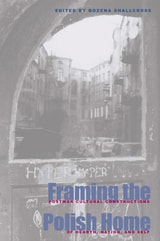
Framing the Polish Home
Postwar Cultural Constructions of Hearth, Nation, and SelfBozena Shallcross
Ohio University Press, 2002
As the subject of ideological, aesthetic, and existential manipulations, the Polish home and its representation is an ever-changing phenomenon that absorbs new tendencies and, at the same time, retains its centrality to Polish literature, whether written in Poland or abroad. Framing the Polish Home is a pioneering work that explores the idea of home as fundamental to the question of cultural and national identity within Poland's recent history and its tradition.
In this inaugural volume of the Polish and Polish-American Studies Series, the Polish home emerges in its rich verbal and visual representations and multiple material embodiments, as the discussion moves from the loss of the home during wartime to the Sovietized politics of housing and from the exilic strategies of having a home to the the idyllic evocation of the abodes of the past.
Although, as Bożena Shallcross notes in her introduction, “few concepts seem to have such universal appeal as the notion of the home,” this area of study is still seriously underdeveloped. In essays from sixteen scholars, Framing the Polish Home takes a significant step to correct that oversight, covering a broad range of issues pertinent to the discourse on the home and demonstrating the complexity of the home in Polish literature and culture.
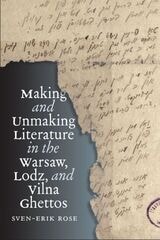
Making and Unmaking Literature in the Warsaw, Lodz, and Vilna Ghettos
Sven-Erik Rose
Brandeis University Press, 2025
A study of literature written by Jewish authors while interned in Nazi ghettos emphasizes how authors processed their horrific experiences through poetry and prose.
Published in Association with the United States Holocaust Memorial Museum
This is the first study devoted to how little known but essential authors grappled with the destitution of ghetto existence by writing within, at the limits of, and against an array of literary scenarios, tropes, plot lines, and generic conventions, including those of nature lyric, modernist interior monologue, the realist social novel, the detective story, and the gothic horror tale. Contending with starvation, disease, desperate housing conditions and the looming threat of being murdered, inhabitants of ghettos in Poland nonetheless made them sites of rich Jewish cultural production. Rose’s readings of these literary works reveal how authors asserted their humanity by insisting on writing works of literature. In such radically dehumanizing circumstances, however, their recourse to established literary genres was not naive. Rather, ghetto authors brilliantly meditated on the grotesque incongruities between established literary models and the extreme conditions of ghetto existence.
Pole/Jew
History, Literature, Identity, FutureJohn J. Bukowczyk and Halina Filipowicz
Ohio University Press, 0
Pole/Jew brings together a group of scholars—about half of them Jewish, about half of them ethnic Poles—from the United States, Poland, the United Kingdom, and Canada and enlists their diverse methodological and generational perspectives to push debates over Polish-Jewish relations beyond entrenched and reductive positions. At the core of the volume are the following questions:
–What impact has the Holocaust had on Polish history and Polish literature?
–How has the Holocaust affected Polish-Jewish—and Polish—identity?
–What future is there for relations between Poland’s small Jewish minority and the country’s overwhelming ethnic Polish majority? Between Poland and Israel? Between Jews of the diaspora and ethnic Poles abroad?
–Which research areas have yet to be addressed or revisited and reexamined?
–Are there ways to move beyond the reductive notion of 1989 (i.e., the fall of the communist regime in Poland) as wall and fulcrum?
By addressing these compelling questions, this volume offers fresh perspectives and encourages a nuanced understanding of Polish-Jewish relations.
Contributors:
M. B. B. Biskupski
Robert Blobaum
John J. Bukowczyk
Patrice M. Dabrowski
Halina Filipowicz
Agnieszka Jezyk
Bozena Karwowska
Kamil Kijek
Kate Korycki
Elzbieta Kossewska
Grazyna J. Kozaczka
Stanislaw Krajewski
Adam Lipszyc
Wiktor Marzec
Alina Molisak
Stanislaw Obirek
Benjamin Paloff
Antony Polonsky
Brian Porter-Szucs
Piotr Puchalski
Roma Sendyka
Dariusz Stola
Katarzyna Zechenter
Joshua D. Zimmerman
Geneviève Zubrzycki
Slawomir Zurek
Polish Literature and the Holocaust
Eyewitness Testimonies, 1942–1947Rachel Feldhay Brenner
Northwestern University Press, 2019
Polish Literature and the Holocaust: Eyewitness Testimonies,1942–1947 is a particularly timely book in view of the continuing debate about the attitudes of Poles toward the Jews during the war. The literary voices from the past that Brenner examines posit questions that are as pertinent now as they were then. And so, while this book speaks to readers who are interested in literary responses to the Holocaust, it also illuminates the universal issue of the responsibility of witnesses toward the victims of any atrocity.

Slavic Excursions
Essays on Russian and Polish LiteratureDonald Davie
University of Chicago Press, 1991