Results by title
2 books match the query 'Politeness (Linguistics)'
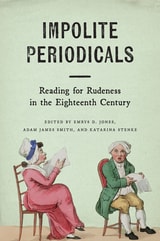
Impolite Periodicals
Reading for Rudeness in the Eighteenth CenturyEmrys D. Jones
Bucknell University Press, 2026
With an afterword by Manushag N. Powell.
Published by Bucknell University Press. Distributed worldwide by Rutgers University Press.
It’s Not What You Sign, It’s How You Sign It
Politeness in American Sign LanguageJack Hoza
Gallaudet University Press, 2007
The general stereotype regarding interaction between American Sign Language and English is a model of oversimplification: ASL signers are direct and English speakers are indirect. Jack Hoza’s study It’s Not What You Sign, It’s How You Sign It: Politeness in American Sign Language upends this common impression through an in-depth comparison of the communication styles between these two language communities. Hoza investigates relevant social variables in specific contexts and explores the particular linguistic strategies ASL signers and English speakers employ when they interact in these contexts.
It’s Not What You Sign, It’s How You Sign It is framed within politeness theory, an apt model to determine various interpretations of what speakers or signers mean in respect to the form of that which they say or sign. The variations reveal how linguistic and cultural differences intersect in ways that are often misinterpreted or overlooked in cross-cultural communication. To clarify these cross-linguistic differences, this volume explores two primary types of politeness and the linguistic strategies used by English speakers and ASL signers to express politeness concerns in face-to-face interaction. Hoza’s final analysis leads to a better understanding of the rich complexity of the linguistic choices of these language groups.