Results by title

2 books match the query 'Political Animal'
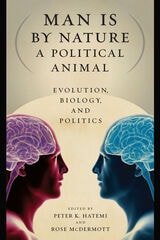
cover of Man Is by Nature a Political Animal: Evolution, Biology, and Politics

Man Is by Nature a Political Animal

Evolution, Biology, and Politics

Edited by Peter K. Hatemi and Rose McDermott

University of Chicago Press, 2011
In Man Is by Nature a Political Animal, Peter K. Hatemi and Rose McDermott bring together a diverse group of contributors to examine the ways in which evolutionary theory and biological research are increasingly informing analyses of political behavior. Focusing on the theoretical, methodological, and empirical frameworks of a variety of biological approaches to political attitudes and preferences, the authors consider a wide range of topics, including the comparative basis of political behavior, the utility of formal modeling informed by evolutionary theory, the genetic bases of attitudes and behaviors, psychophysiological methods and research, and the wealth of insight generated by recent research on the human brain. Through this approach, the book reveals the biological bases of many previously unexplained variances within the extant models of political behavior.
 
The diversity of methods discussed and variety of issues examined here will make this book of great interest to students and scholars seeking a comprehensive overview of this emerging approach to the study of politics and behavior.
[more]
cover of The Political Animal: Special Issue of SubStance, Issue 117, 37:3 (2008)

The Political Animal

Special Issue of SubStance, Issue 117, 37:3 (2008)

Chris Danta

University of Wisconsin Press, 2008

In the variegated history of the philosophical definitions of man, one has survived since it has been given the status of the self-evident. The definition in question comes from Aristotle’s Politics: “the human is a political animal” (1253a3). There is something indisputable about this characterization: humans are, indeed, the most social of animals – they are denizens of the polis with its institutions and laws, its rulers, judges and generals.  It would be difficult to contend that any other animal has recourse to the political as much as the human.
    Aristotle’s Politics need not be surrendered to the strictures of humanism. It remains amenable to the new schema for the political animal that we are sketching here. Each article collected in this issue responds – in its own way and by establishing its own protocols – to the exigency of the animal as it was formulated in Aristotle’s Politics. Each article is an act of response, a moment of interruption.

[more]