Results by title
5 books match the query 'Political Education'
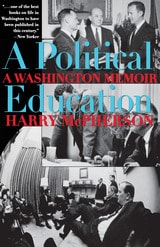
A Political Education
A Washington MemoirBy Harry McPherson
University of Texas Press, 1995
This insider's view of Washington in the 1950s and 1960s, of the tumultuous presidency of Lyndon Johnson, and of the conflicts and factions of the president's staff has become a political classic since its original publication in 1972. In this reissue, Harry McPherson adds a new preface in which he reflects on changes in Washington since the Johnson era and on the lessons Bill Clinton could learn from the presidency of Lyndon Johnson.
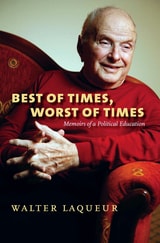
Best of Times, Worst of Times
Memoirs of a Political EducationWalter Laqueur
Brandeis University Press, 2009
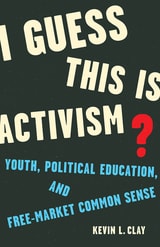
I Guess This Is Activism?
Youth, Political Education, and Free-Market Common SenseKevin L. Clay
University of Minnesota Press, 2026
How neoliberal capitalism and pedagogical deideologization constrain the radical possibilities of youth activism
In I Guess This Is Activism? Kevin L. Clay presents an eye-opening account of his experience with Youth Participatory Action Research (YPAR) as an Upward Bound educator. Grounded in Paulo Freire’s tradition of critical pedagogy, YPAR has been championed by community-based educators and scholars in the United States as an approach for supporting critical consciousness development and social change with working-class Black and Latino youth. Clay, however, questions whether YPAR can effectively prepare youths to subvert the systems reproducing their material conditions under neoliberal capitalism. Exposing the political and pedagogical limits of YPAR’s progressive education model, he reveals how omnipresent neoliberalism undermines youths’ radical potential when political education is not prioritized in youth activism.
I Guess This Is Activism? engages Black radical thinkers, including Ella Baker and Fred Hampton, to reveal the faulty assumptions implicit in YPAR’s program. Looking deeply into how he and his students navigated questions of community problems and social change at the twilight of the Obama presidency, Clay demonstrates how, in the absence of political education on the structures of race, class, and capitalism, youth activism is always eclipsed by the common sense of the free market.
As working-class Black and Latino youth inherit a society deeply shaped by neoliberal dogma, I Guess This Is Activism? delivers a much-needed reexamination of YPAR and visions for the future of youth activist education.
Retail e-book files for this title are screen-reader friendly with images accompanied by short alt text and/or extended descriptions.
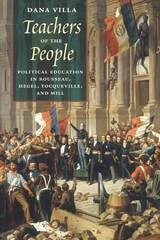
Teachers of the People
Political Education in Rousseau, Hegel, Tocqueville, and MillDana Villa
University of Chicago Press, 2017
In Teachers of the People, Dana Villa takes us back to the moment in history when “the people” first appeared on the stage of modern European politics. That moment—the era just before and after the French Revolution—led many major thinkers to celebrate the dawning of a new epoch. Yet these same thinkers also worried intensely about the people’s seemingly evident lack of political knowledge, experience, and judgment. Focusing on Rousseau, Hegel, Tocqueville, and Mill, Villa shows how reformist and progressive sentiments were often undercut by skepticism concerning the political capacity of ordinary people. They therefore felt that “the people” needed to be restrained, educated, and guided—by laws and institutions and a skilled political elite. The result, Villa argues, was less the taming of democracy’s wilder impulses than a pervasive paternalism culminating in new forms of the tutorial state.
Ironically, it is the reliance upon the distinction between “teachers” and “taught” in the work of these theorists which generates civic passivity and ignorance. And this, in turn, creates conditions favorable to the emergence of an undemocratic and illiberal populism.
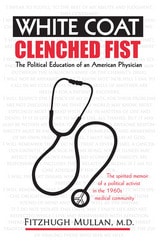
White Coat, Clenched Fist
The Political Education of an American PhysicianFitzhugh Mullan, M.D.
University of Michigan Press, 2006
In the sixties, Fitzhugh Mullan was an activist in the civil rights struggle. While in medical school, Mullan was shocked by gaps in what the students learned, and the lack of humanity in the classroom. Later, Dr. Mullan was outraged at the conditions he discovered when he began to practice. He helped found the Student Health Organization, organized the Controversial Medical Collective at Lincoln Hospital in the Bronx, and struggled to offer improved medical care to those who needed it most and could afford it least.
This landmark book charts the state of medical school and practices in the 1960s and 70s. This new edition is updated with a preface in which Dr. Mullan reflects on the changes in the medical field over the last thirty-plus years.
Fitzhugh Mullan is Murdock Head Professor of Medicine and Health Policy at George Washington University. He worked at the U.S. Public Health Service where he attained the rank of Assistant Surgeon General (1991-1996). Dr. Mullan is the co-founder of the National Coalition for Cancer Survivorship and the author of numerous books, including Plagues and Politics: The Story of the United States Public Health Service, and his most recent book, Narrative Matters: The Power of the Personal Essay in Health Policy.