Results by title
6 books match the query 'Political Islam'
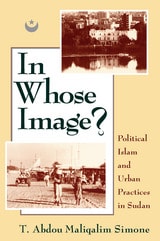
In Whose Image?
Political Islam and Urban Practices in SudanT. Abdou Maliqalim Simone
University of Chicago Press, 1994
Drawing a detailed portrait of political fundamentalism during the 1985-89 period of democratic rule in the Sudan, Simone shows how the Shari‘a Movement attempted to shape a viable social order by linking religious integrity and economic development, where religious practice was to dominate all aspects of society and individuals' daily lives. However, because Sudanese society is remarkably diverse ethnically and religiously, this often led to conflict, fragmentation, and violence in the name of Islam.
Simone's own Islamic background leads him to deplore the violence and the devastating psychological, economic, and cultural consequences of one form of Islamic radicalism, while holding to hope that a viable form of this inherently political religion can in fact be applied. As a counterpoint, he ends with a discussion of South Africa's Call of Islam, which seeks political unity through a more tolerant interpretation of Islam.
As an introduction to religious discourse in Africa, this book will be widely read by students and scholars throughout African Studies, Religious Studies, Anthropology, and Political Science.

The Contemporary Arab Reader on Political Islam
Edited by Ibrahim M. Abu-Rabi' and Tere Vaden
Pluto Press, 2010
The Contemporary Arab Reader on Political Islam brings together the writings of highly influential figures in the field of Islamism in the contemporary Arab world, many of whose writings have never been available before in English.
Addressing the key issues such as human rights, civil society, secularism, globalisation and ummah, and the impact of the West on the modern Arab world, this is the perfect starting point for students and academics looking to understand 'Political Islam' in contemporary Arab and Muslim societies.
The contributors include such important Islamist thinkers and activists as Abdullah Azzam, central to the spread of Islamism in Afghanistan, Sayyid Muhammad Hussain Fadlallah, a major Shiite figure in contemporary Lebanon and Ahmad Bin Yousuf, a political advisor to Akram Haniyya in Gaza.
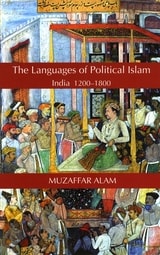
The Languages of Political Islam
India 1200-1800Muzaffar Alam
University of Chicago Press, 2004
Muzaffar Alam shows that the adoption of Arabo-Persian Islam in India changed the manner in which Islamic rule and governance were conducted. Islamic regulation and statecraft in a predominately Hindu country required strategic shifts from the original Islamic injunctions. Islamic principles could not regulate beliefs in a vast country without accepting cultural limitations and limits on the exercise of power. As a result of cultural adaptation, Islam was in the end forced to reinvent its principles for religious rule. Acculturation also forced key Islamic terms to change so fundamentally that Indian Islam could be said to have acquired a character substantially different from the Islam practiced outside of India.
The Many Faces of Political Islam, Second Edition
Religion and Politics in Muslim SocietiesMohammed Ayoob and Danielle N. Lussier
University of Michigan Press, 2020
Analysts and pundits from across the American political spectrum describe Islamic fundamentalism as one of the greatest threats to modern, Western-style democracy. Yet very few non-Muslims would be able to venture an accurate definition of political Islam. Fully revised and updated, The Many Faces of Political Islam thoroughly analyzes the many facets of this political ideology and shows its impact on global relations.
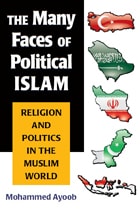
The Many Faces of Political Islam
Religion and Politics in the Muslim WorldMohammed Ayoob
University of Michigan Press, 2009
---Peter J. Katzenstein, Walter S. Carpenter, Jr. Professor of International Studies and Stephen H. Weiss Presidential Teaching Fellow, Cornell University
---Fawaz A. Gerges, Carnegie Scholar, and holds the Christian A. Johnson Chair in International Affairs and Middle Eastern Studies, Sarah Lawrence College
---François Burgat, Director, French National Centre for Scientific Research (CNRS) and the Institute for Research and Study on the Arab and Muslim World (IREMAM), Aix-en-Provence, France
---Shibley Telhami, Anwar Sadat Professor for Peace and Development, University of Maryland, and Senior Fellow, Brookings Institution
Understanding the Somalia Conflagration
Identity, Political Islam and PeacebuildingAfyare Abdi Elmi
Pluto Press, 2010
Somalia has been devastated by a US-backed Ethiopian invasion and years of civil war, and it has long been without a central government. Against this background of violence, Somali academic Afyare Abdi Elmi, attempts to explain the multiple dimensions of the conflict and find a peace-building consensus.
Somalia is a failed state and a Muslim state. This combination means the West assumes that it will become a breeding ground for extremism. The country regularly hits the headlines as a piracy hotspot. This combination of internal division and outside interference makes for an intensely hostile landscape. Elmi shows that only by addressing the problem of the statelessness in the country can the long process of peace begin. He highlights clan identities, Islam and other countries in the region as the key elements in any peace-building effort.
This unique account from an author who truly understands Somalia should be required reading for students and academics of international relations and peace / conflict studies.