Results by title

11 books match the query 'Political crimes and offenses'
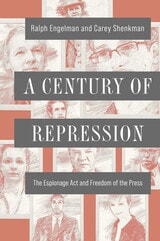
cover of A Century of Repression: The Espionage Act and Freedom of the Press

A Century of Repression

The Espionage Act and Freedom of the Press

Ralph Engelman and Carey Shenkman

University of Illinois Press, 2022
A Century of Repression offers an unprecedented and panoramic history of the use of the Espionage Act of 1917 as the most important yet least understood law threatening freedom of the press in modern American history. It details government use of the Act to control information about U.S. military and foreign policy during the two World Wars, the Cold War, and the War on Terror. The Act has provided cover for the settling of political scores, illegal break-ins, and prosecutorial misconduct.
[more]
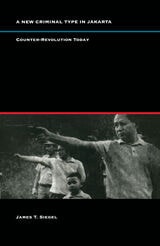
cover of A New Criminal Type in Jakarta: Counter-Revolution Today

A New Criminal Type in Jakarta

Counter-Revolution Today

James T. Siegel

Duke University Press, 1998

In A New Criminal Type in Jakarta, James T. Siegel studies the dependence of Indonesia’s post-1965 government on the ubiquitous presence of what he calls criminality, an ensemble of imagined forces within its society that is poised to tear it apart. Siegel, a foremost authority on Indonesia, interprets Suharto’s New Order—in powerful contrast to Sukarno’s Old Order—and shows a cultural and political life in Jakarta controlled by a repressive regime that has created new ideas among its population about crime, ghosts, fear, and national identity.
Examining the links between the concept of criminality and scandal, rumor, fear, and the state, Siegel analyzes daily life in Jakarta through the seemingly disparate but strongly connected elements of family life, gossip, and sensationalist journalism. He offers close analysis of the preoccupation with crime in Pos Kota (a newspaper directed toward the lower classes) and the middle-class magazine Tempo. Because criminal activity has been a sensationalized preoccupation in Jakarta’s news venues and among its people, criminality, according to Siegel, has pervaded the identities of its ordinary citizens. Siegel examines how and why the government, fearing revolution and in an attempt to assert power, has made criminality itself a disturbing rationalization for the spectacular massacre of the people it calls criminals—many of whom were never accused of particular crimes. A New Criminal Type in Jakarta reveals that Indonesians—once united by Sukarno’s revolutionary proclamations in the name of “the people”—are now, lacking any other unifying element, united through their identification with the criminal and through a “nationalization of death” that has emerged with Suharto’s strong counter-revolutionary measures.
A provocative introduction to contemporary Indonesia, this book will engage those interested in Southeast Asian studies, anthropology, history, political science, postcolonial studies, public culture, and cultural studies generally.

[more]
cover of Being Human: Political Modernity and Hospitality in Kurdistan-Iraq

Being Human

Political Modernity and Hospitality in Kurdistan-Iraq

Fazil Moradi

Rutgers University Press, 2024
The Iraqi Baʿth state’s Anfāl operations (1987-1991) is one of the twentieth century’s ultimate acts of destruction of the possibility of being human. It remains the first and only crime of state in the Middle East to be tried under the 1948 UN Genocide Convention, the 1950 Nuremberg Principles, and the 1969 Iraqi Penal Code and to be recognized as genocide, crimes against humanity, and war crimes in Baghdad between 2006 and 2007. Being Human: Political Modernity and Hospitality in Kurdistan-Iraq offers an unprecedented pathway to the study of political violence. It is a sweeping work of anthropological hospitality, returning to the Anfāl operations as the violence of political modernity only to turn to the human survivors’ hospitality and acts of translation—testimonial narratives, law, politics, archive, poetry, artworks, museums, memorials, symbolic cemeteries, and infinite pursuit of justice in the Kurdistan Region of Iraq. Being Human gathers together social sciences, humanities, and the arts to understand modernity's violence and its living on. 
 
[more]
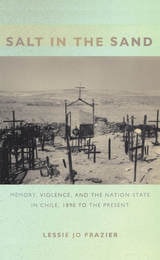
cover of Salt in the Sand: Memory, Violence, and the Nation-State in Chile, 1890 to the Present

Salt in the Sand

Memory, Violence, and the Nation-State in Chile, 1890 to the Present

Lessie Jo Frazier

Duke University Press, 2007

Salt in the Sand is a compelling historical ethnography of the interplay between memory and state violence in the formation of the Chilean nation-state. The historian and anthropologist Lessie Jo Frazier focuses on northern Chile, which figures prominently in the nation’s history as a site of military glory during the period of national conquest, of labor strikes and massacres in the late nineteenth century and early twentieth, and of state detention and violence during World War II and the Cold War. It was also the site of a mass-grave excavation that galvanized the national human rights movement in 1990, during Chile’s transition from dictatorship to democracy. Frazier analyzes the creation of official and alternative memories of specific instances of state violence in northern Chile from 1890 to the present, tracing how the form and content of those memories changed over time. In so doing, she shows how memory works to create political subjectivities mobilized for specific political projects within what she argues is the always-ongoing process of nation-state formation. Frazier’s broad historical perspective on political culture challenges the conventional periodization of modern Chilean history, particularly the idea that the 1973 military coup marked a radical break with the past.

Analyzing multiple memories of state violence, Frazier innovatively shapes social and cultural theory to interpret a range of sources, including local and national government archives, personal papers, popular literature and music, interviews, architectural and ceremonial commemorations, and her ethnographic observations of civic associations, women's and environmental groups, and human rights organizations. A masterful integration of extensive empirical research with sophisticated theoretical analysis, Salt in the Sand is a significant contribution to interdisciplinary scholarship on human rights, democratization, state formation, and national trauma and reconciliation.
[more]
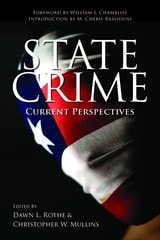
cover of State Crime: Current Perspectives

State Crime

Current Perspectives

Rothe, Dawn

Rutgers University Press, 2010
Current media and political discourse on crime has long ignored crimes committed by States themselves, despite their greater financial and human toll. For the past two decades, scholars have examined how and why States violate their own laws and international law and explored what can be done to reduce or prevent these injustices. Through a collection of essays by leading scholars in the field, State Crime offers a set of cases exemplifying state criminality along with various methods for controlling governmental transgressions. With topics ranging from crimes of aggression to nuclear weapons to the construction and implementation of social controls, this volume is an indispensable resource for those who examine the behavior of States and those who study crime in its varied forms.
[more]
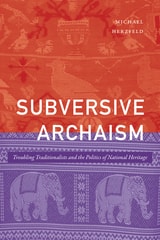
cover of Subversive Archaism: Troubling Traditionalists and the Politics of National Heritage

Subversive Archaism

Troubling Traditionalists and the Politics of National Heritage

Michael Herzfeld

Duke University Press, 2021
In Subversive Archaism, Michael Herzfeld explores how individuals and communities living at the margins of the modern nation-state use nationalist discourses of tradition to challenge state authority under both democratic and authoritarian governments. Through close attention to the claims and experiences of mountain shepherds in Greece and urban slum dwellers in Thailand, Herzfeld shows how these subversive archaists draw on national histories and past polities to claim legitimacy for their defiance of bureaucratic authority. Although vilified by government authorities as remote, primitive, or dangerous—often as preemptive justification for violent repression—these groups are not revolutionaries and do not reject national identity, but they do question the equation of state and nation. Herzfeld explores the political strengths and vulnerabilities of their deployment of heritage and the weaknesses they expose in the bureaucratic and ethnonational state in an era of accelerated globalization.
[more]
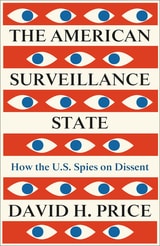
cover of The American Surveillance State: How the U.S. Spies on Dissent

The American Surveillance State

How the U.S. Spies on Dissent

David H. Price

Pluto Press, 2022

New evidence has come to light proving how far the FBI monitored its citizens throughout the Cold War and beyond

When the possibility of wiretapping first became known to Americans they were outraged. Now, in our post-9/11 world, it’s accepted that corporations are vested with human rights, and government agencies and corporations use computers to monitor our private lives. David H. Price pulls back the curtain to reveal how the FBI and other government agencies have always functioned as the secret police of American capitalism up to today, where they luxuriate in a near-limitless NSA surveillance of all.

Price looks through a roster of campaigns by law enforcement, intelligence agencies, and corporations to understand how we got here. Starting with J. Edgar Hoover and the early FBI’s alignment with business, his access to 15,000 pages of never-before-seen FBI files shines a light on the surveillance of Edward Said, Andre Gunder Frank and Alexander Cockburn, Native American communists, and progressive factory owners.

Price uncovers patterns of FBI monitoring and harassing of activists and public figures, providing the vital means for us to understand how these new frightening surveillance operations are weaponized by powerful governmental agencies that remain largely shrouded in secrecy.
[more]
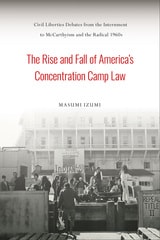
cover of The Rise and Fall of America's Concentration Camp Law: Civil Liberties Debates from the Internment to McCarthyism and the Radical 1960s

The Rise and Fall of America's Concentration Camp Law

Civil Liberties Debates from the Internment to McCarthyism and the Radical 1960s

Masumi Izumi

Temple University Press, 2019

The Emergency Detention Act, Title II of the Internal Security Act of 1950, is the only law in American history to legalize preventive detention. It restricted the freedom of a certain individual or a group of individuals based on actions that may be taken that would threaten the security of a nation or of a particular area. Yet the Act was never enforced before it was repealed in 1971.

Masumi Izumi links the Emergency Detention Act with Japanese American wartime incarceration in her cogent study, The Rise and Fall of America’s Concentration Camp Law. She dissects the entangled discourses of race, national security, and civil liberties between 1941 and 1971 by examining how this historical precedent generated “the concentration camp law” and expanded a ubiquitous regime of surveillance in McCarthyist America. 

Izumi also shows how political radicalism grew as a result of these laws. Japanese Americas were instrumental in forming grassroots social movements that worked to repeal Title II. The Rise and Fall of America’s Concentration Camp Law is a timely study in this age of insecurity where issues of immigration, race, and exclusion persist.
[more]
cover of The Truth and Reconciliation Commission

The Truth and Reconciliation Commission

Mary Ingouville Burton

Ohio University Press, 2017

In 1995, South Africa’s new government set up the Truth and Reconciliation Commission, a lynchpin of the country’s journey forward from apartheid. In contrast to the Nuremberg Trials and other retributive responses to atrocities, the TRC’s emphasis on reconciliation marked a restorative approach to addressing human rights violations and their legacies. The hearings, headed by Bishop Desmond Tutu, began in spring of 1996.

The commission was set up with three purposes: to investigate abuses, to assist victims with rehabilitation, and to consider perpetrators’ requests for amnesty. More than two decades after the first hearings, the TRC’s legacy remains mixed. Many families still do not know what became of their loved ones, and the commission came under legal challenges both from ex-president F. W. de Klerk and the African National Congress. Yet, the TRC fulfilled a vital role in the transition from apartheid to democracy, and has become a model for other countries.

This latest addition to the Ohio Short Histories of Africa series is a trenchant look at the TRC’s entire, stunningly ambitious project. And as a longtime activist for justice in South Africa and a former commissioner of the TRC, Mary Ingouville Burton is uniquely positioned to write this complex story.
[more]
cover of Thought Crime: Ideology and State Power in Interwar Japan

Thought Crime

Ideology and State Power in Interwar Japan

Max M. Ward

Duke University Press, 2019
In Thought Crime Max M. Ward explores the Japanese state's efforts to suppress political radicalism in the 1920s and 1930s. Ward traces the evolution of an antiradical law called the Peace Preservation Law, from its initial application to suppress communism and anticolonial nationalism—what authorities deemed thought crime—to its expansion into an elaborate system to reform and ideologically convert thousands of thought criminals throughout the Japanese Empire. To enforce the law, the government enlisted a number of nonstate actors, who included monks, family members, and community leaders. Throughout, Ward illuminates the complex processes through which the law articulated imperial ideology and how this ideology was transformed and disseminated through the law's application over its twenty-year history. In so doing, he shows how the Peace Preservation Law provides a window into understanding how modern states develop ideological apparatuses to subject their respective populations.
[more]
cover of Understanding the Age of Transitional Justice: Crimes, Courts, Commissions, and Chronicling

Understanding the Age of Transitional Justice

Crimes, Courts, Commissions, and Chronicling

Adler, Nanci

Rutgers University Press, 2018

Since the 1980s, an array of legal and non-legal practices—labeled Transitional Justice—has been developed to support post-repressive, post-authoritarian, and post-conflict societies in dealing with their traumatic past. In Understanding the Age of Transitional Justice, the contributors analyze the processes, products, and efficacy of a number of transitional justice mechanisms and look at how genocide, mass political violence, and historical injustices are being institutionally addressed. They invite readers to speculate on what (else) the transcripts produced by these institutions tell us about the past and the present, calling attention to the influence of implicit history conveyed in the narratives that have gained an audience through international criminal tribunals, trials, and truth commissions. Nanci Adler has gathered leading specialists to scrutinize the responses to and effects of violent pasts that provide new perspectives for understanding and applying transitional justice mechanisms in an effort to stop the recycling of old repressions into new ones.  
[more]