Results by title
7 books match the query 'Political rights'
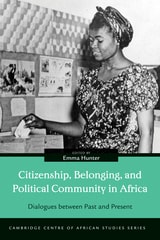
Citizenship, Belonging, and Political Community in Africa
Dialogues between Past and PresentEmma Hunter
Ohio University Press, 2016
Africa, it is often said, is suffering from a crisis of citizenship. At the heart of the contemporary debates this apparent crisis has provoked lie dynamic relations between the present and the past, between political theory and political practice, and between legal categories and lived experience. Yet studies of citizenship in Africa have often tended to foreshorten historical time and privilege the present at the expense of the deeper past.
Citizenship, Belonging, and Political Community in Africa provides a critical reflection on citizenship in Africa by bringing together scholars working with very different case studies and with very different understandings of what is meant by citizenship. By bringing historians and social scientists into dialogue within the same volume, it argues that a revised reading of the past can offer powerful new perspectives on the present, in ways that might also indicate new paths for the future.
The project collects the works of up-and-coming and established scholars from around the globe. Presenting case studies from such wide-ranging countries as Sudan, Mauritius, South Africa, Côte d’Ivoire, and Ethiopia, the essays delve into the many facets of citizenship and agency as they have been expressed in the colonial and postcolonial eras. In so doing, they engage in exciting ways with the watershed book in the field, Mahmood Mamdani’s Citizen and Subject.
Contributors: Samantha Balaton-Chrimes, Frederick Cooper, Solomon M. Gofie, V. Adefemi Isumonah, Cherry Leonardi, John Lonsdale, Eghosa E.Osaghae, Ramola Ramtohul, Aidan Russell, Nicole Ulrich, Chris Vaughan, and Henri-Michel Yéré.
Competing Responsibilities
The Ethics and Politics of Contemporary LifeSusanna Trnka and Catherine Trundle, editors
Duke University Press, 2017
Contributors
Barry D. Adam, Elizabeth Anne Davis, Filippa Lentzos, Jessica Robbins-Ruszkowski, Nikolas Rose, Rosalind Shaw, Cris Shore, Jessica M. Smith, Susanna Trnka, Catherine Trundle, Jarrett Zigon

Dilemmas of Political Change in Mexico
Edited by Kevin J. Middlebrook
University of London Press, 2004
They examine: (1) changes affecting the party system, electoral institutions, and voting behavior; (2) the evolving role of the armed forces, organized labor, big business, and rural producers; (3) the new importance of civil society, the mass media, and cross-border social coalitions; (4) and key issues of political representation and governance, including executive-legislative relations, judicial performance, federalism, the constitutional rights of indigenous peoples, and the political role of Mexicans resident in the United States.

Ethics of Citizenship
Immigration and Group Rights in GermanyWilliam A. Barbieri Jr.
Duke University Press, 1998
Although some of Germany’s foreign workers have gradually attained a degree of social and economic legitimacy, Barbieri explains how they remain effectively excluded from true German citizenship. Describing how this exclusion has occurred and assessing current attitudes toward political membership in Germany, he argues for a just and democratic policy toward the tax-paying, migrant worker minority, one that would combine the extension of the individual rights of citizenship with the establishment of certain group rights. Through a dissection of ongoing public “membership debates” over issues such as suffrage, dual citizenship, and immigration and refugee policy, Barbieri identifies a range of competing responses to the question of who “belongs” in Germany. After critiquing these views, he proposes an alternative ethic of membership rooted in an account of domination and human rights that seeks to balance individual and group rights within the context of a commitment to democracy and equal citizenship.
Indispensable for scholars of German studies, Ethics of Citizenship also raises questions that will attract moral philosophers, constitutional scholars, and those interested in the continuing, global problems associated with migration.

Making Patriots
Walter Berns
University of Chicago Press, 2001
Although Samuel Johnson once remarked that "patriotism is the last refuge of scoundrels," over the course of the history of the United States we have seen our share of heroes: patriots who have willingly put their lives at risk for this country and, especially, its principles. And this is even more remarkable given that the United States is a country founded on the principles of equality and democracy that encourage individuality and autonomy far more readily than public spiritedness and self-sacrifice.
Walter Berns's Making Patriots is a pithy and provocative essay on precisely this paradox. How is patriotism inculcated in a system that, some argue, is founded on self-interest? Expertly and intelligibly guiding the reader through the history and philosophy of patriotism in a republic, from the ancient Greeks through contemporary life, Berns considers the unique nature of patriotism in the United States and its precarious state. And he argues that while both public education and the influence of religion once helped to foster a public-minded citizenry, the very idea of patriotism is currently under attack.
Berns finds the best answers to his questions in the thought and words of Abraham Lincoln, who understood perhaps better than anyone what the principles of democracy meant and what price adhering to them may exact. The graves at Arlington and Gettysburg and Omaha Beach in Normandy bear witness to the fact that self-interested individuals can become patriots, and Making Patriots is a compelling exploration of how this was done and how it might be again.
Sexual Strangers
Gays, Lesbians, and Dilemmas of CitizenshipShane Phelan
Temple University Press, 2001
In Sexual Strangers, Shane Phelan argues that, in the United States, queers are strangers -- not exactly the enemy, since they are not excluded from all rights of citizenship, but not quite members. Rather, they are ambiguous figures who trouble the border between "us" and "them," a border just as central to liberal regimes as to other states. Life on this border structures both the exclusion of sexual minorities and their ambivalence about becoming part of the "mainstream."
Sexual Strangers addresses questions of long-standing importance to minority group politics: the meaning and terms of inclusion, respect, and resistance. Phelan looks at citizenship as including not only equal protection and equal rights to such institutions as marriage and military service, but also political and cultural visibility, as inclusion in the national imaginary. She discusses the continuing stigmatization of bisexuals and transgendered people within lesbian and gay communities as a result of the attempt to flee from strangeness, a flight that inevitably produces new strangers. Her goal is to convince students of politics, both academic and activist, to embrace the rewards of strangeness as a means of achieving inclusive citizenship, rather than a citizenship that defines itself by what it will not accept.
The Capacity Contract
Intellectual Disability and the Question of CitizenshipStacy Clifford Simplican
University of Minnesota Press, 2015
In the first sustained examination of disability through the lens of political theory, The Capacity Contract shows how the exclusion of disabled people has shaped democratic politics. Stacy Clifford Simplican demonstrates how disability buttresses systems of domination based on race, sex, and gender. She exposes how democratic theory and politics have long blocked from political citizenship anyone whose cognitive capacity falls below a threshold level⎯marginalization with real-world repercussions on the implementation of disability rights today.
Simplican’s compelling ethnographic analysis of the self-advocacy movement describes the obstacles it faces. From the outside, the movement must confront stiff budget cuts and dwindling memberships; internally, self-advocates must find ways to demand political standing without reinforcing entrenched stigma against people with profound cognitive disabilities. And yet Simplican’s investigation also offers democratic theorists and disability activists a more emancipatory vision of democracy as it relates to disability⎯one that focuses on enabling people to engage in public and spontaneous action to disrupt exclusion and stigma.
Taking seriously democratic promises of equality and inclusion, The Capacity Contract rejects conceptions of political citizenship that privilege cognitive capacity and, instead, centers such citizenship on action that is accessible to all people.