Results by title
7 books match the query 'Politics in motion pictures'

Activist Film Festivals
Towards a Political SubjectEdited by Sonia Tascón and Tyson Wils
Intellect Books, 2016
This book breaks new ground by bringing scholars from a range of disciplines together with industry professionals to explore the concept of festivals as spaces through an activist lens, as spaces where the sociopolitical identities of communities and individuals are confronted and shaped. Tracing the growth of activist and human rights-focused films from the 1970s to the present, and using case studies from San Francisco, Brazil, Bristol, and elsewhere, the book addresses such contentious topics as whether activist films can achieve humanitarian aims or simply offer “cinema of suffering.” Ultimately, the contributors attack the question of just how effective festivals are at producing politically engaged spectators?

Assayas and Political Seriousness
Brian Price
Northwestern University Press, 2026
A cogent reconsideration of Assayas’s cinematic oeuvre and what it teaches us about the political today
The films of Olivier Assayas are widely celebrated for their complex responses to the many shifts that globalization has introduced in our time. Brian Price contends that they offer a different way of regarding the so-called problem of cultural and political enmeshment that Carl Schmitt and other conservative thinkers fear, including a contention that enmeshment is not a problem at all, in fact, but rather a different mode of social and political organization. Price puts Assayas’s films in dialogue not only with Schmitt’s theory of the political but also with the history of political philosophy after Schmitt, especially in the work of Hannah Arendt, Jacques Derrida, and Chantal Mouffe, all of whom have attempted to reckon with the friend/enemy dynamic at the core of the political.
At the heart of Assayas’s cinematic oeuvre, and of this book, is a reflection on what it means to be politically serious, which, Price shows, cannot be reduced to criteria that can simply be applied or repeated. The boundaries between the political and the varied forms of the social demand a sensitivity to change and the unknown, none of which can be accessed in the states of absolute certainty that are derived from crises that do not repeat in the same ways. The messiness and nuances of modern life are held together by moving images, which insist that we know why we value what we demand and seek to protect.
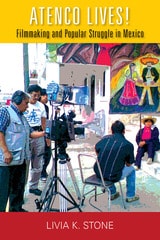
Atenco Lives!
Filmmaking and Popular Struggle in MexicoLivia K. Stone
Vanderbilt University Press, 2019
Stone highlights the importance of how the circulation of the physical videos, and not just their content, promotes the social movement. More broadly she shows how videographers perform their activism, navigating the tensions between neoliberal personhood or ego and an ethos of compañerismo that privileges community. Grounded in the lived experiences of Atenco's activists and allied filmmakers, Atenco Lives! documents the making and circulating of films as an ethical and political practice purposefully used to transform human relationships.
Dream West
Politics and Religion in Cowboy MoviesBy Douglas Brode
University of Texas Press, 2013
While political liberals celebrated the end of “cowboy politics” with the election of Barack Obama to the presidency, political conservatives in the Tea Party and other like-minded groups still vociferously support “cowboy” values such as small government, low taxes, free-market capitalism, and the right to bear arms. Yet, as Douglas Brode argues in this paradigm-shifting book, these supposedly cowboy or “Old West” values hail not so much from the actual American frontier of the nineteenth century as from Hollywood’s portrayal of it in the twentieth century. And a close reading of Western films and TV shows reveals a much more complex picture than the romanticized, simplistic vision espoused by the conservative right.
Examining dozens of Westerns, including Gunfight at the O.K. Corral, Red River, 3:10 to Yuma (old and new), The Wild Ones, High Noon, My Darling Clementine, The Alamo, and No Country for Old Men, Brode demonstrates that the genre (with notable exceptions that he fully covers) was the product of Hollywood liberals who used it to project a progressive agenda on issues such as gun control, environmental protection, respect for non-Christian belief systems, and community cohesion versus rugged individualism. Challenging us to rethink everything we thought we knew about the genre, Brode argues that the Western stands for precisely the opposite of what most people today—whether they love it or hate it—believe to be the essential premise of “the only truly, authentically, and uniquely American narrative form.”
Feminism and the Cinema of Experience
Lori Jo Marso
Duke University Press, 2024
Left of Hollywood
Cinema, Modernism, and the Emergence of U.S. Radical Film CultureBy Chris Robé
University of Texas Press, 2010
In the 1930s as the capitalist system faltered, many in the United States turned to the political Left. Hollywood, so deeply embedded in capitalism, was not immune to this shift. Left of Hollywood offers the first book-length study of Depression-era Left film theory and criticism in the United States. Robé studies the development of this theory and criticism over the course of the 1930s, as artists and intellectuals formed alliances in order to establish an engaged political film movement that aspired toward a popular cinema of social change. Combining extensive archival research with careful close analysis of films, Robé explores the origins of this radical social formation of U.S. Left film culture.
Grounding his arguments in the surrounding contexts and aesthetics of a few films in particular—Sergei Eisenstein's Que Viva Mexico!, Fritz Lang's Fury, William Dieterle's Juarez, and Jean Renoir's La Marseillaise—Robé focuses on how film theorists and critics sought to foster audiences who might push both film culture and larger social practices in more progressive directions. Turning at one point to anti-lynching films, Robé discusses how these movies united black and white film critics, forging an alliance of writers who championed not only critical spectatorship but also the public support of racial equality. Yet, despite a stated interest in forging more egalitarian social relations, gender bias was endemic in Left criticism of the era, and female-centered films were regularly discounted. Thus Robé provides an in-depth examination of this overlooked shortcoming of U.S. Left film criticism and theory.
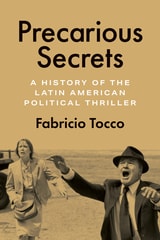
Precarious Secrets
A History of the Latin American Political ThrillerFabricio Tocco
University of Texas Press, 2025
An exploration of the political thriller genre and its context in Latin American politics and entertainment.
For the past five decades, a distinctive type of political thriller has been steadily developing in Latin America. Precarious Secrets is a panoramic overview of the genre in the hands of renowned writers and filmmakers from Argentina, Mexico, Chile, and Brazil, as well as lesser-known Peruvian, Uruguayan and Paraguayan artists for whom the style has been a vehicle for pungent narratives shot through with menace and conspiracy.
Fabricio Tocco explores the genre’s unique role in Latin American entertainment and activism. Precarious Secrets traces the evolutions of the Latin American political thriller from its emergence in the 1970s, through the silence imposed by dictatorships and the genre’s resurgence after the Cold War. The political thriller has dramatized the region’s turbulent past, through assassinations, coups, mass killings, revolutions and the search of desaparecidos by human rights organizations. In the process, Tocco isolates the Latin American political thriller’s particular grammar of secrecy. In the Hollywood thriller, revealing secrets involves high stakes and transformative consequences. In Latin American political thrillers, by contrast, secrets produce only more precarity—moral ambiguity as unsettling as it is unshakeable.