Results by title

7 books match the query 'Poor in literature'

cover of A Question of Class: The Redneck Stereotype in Southern Fiction

A Question of Class

The Redneck Stereotype in Southern Fiction

Duane Carr

University of Wisconsin Press, 1997

“Rednecks” have long been subjects of scorn and ridicule, especially in the South. Carr probes the historical and sociological reasons for the descent of this social class into poverty, their inability to rise above it, and their continuing subjugation to a stereotype developed by others—and all too often accepted by themselves. Carr also records the progress in Southern fiction of this negative stereotype, from antebellum writers who saw rednecks as threats to the social order, to post-Civil War writers who lamented the lost potential of these people and urged sympathy and understanding, to contemporary writers who favor acceptance. Ultimately, this work is an evaluation of individual Southern fiction writers in their capacity to rise above stereotyping.
[more]
cover of Imitations of Life: Fannie Hurst’s Gaslight Sonatas

Imitations of Life

Fannie Hurst’s Gaslight Sonatas

Abe C. Ravitz

Southern Illinois University Press, 2009

In the early 1920s, Fannie Hurst’s enormous popularity made her the highest-paid writer in America. She conquered the literary scene at the same time the silent movie industry began to emerge as a tremendously profitable and popular form of entertainment. Abe C. Ravitz parallels Hurst’s growing acclaim with the evolution of silent films, from which she borrowed ideas and techniques that furthered her career. Ravitz notes that Hurst was amazingly adept at anticipating what the public wanted. Sensing that the national interest was shifting from rural to urban subjects, Hurst set her immigrant tales and her "woiking goil" tales in urban America. In her early stories, she tried to bridge the gap between Old World and New World citizens, each somewhat fearful and suspicious of the other. She wrote of love and ethnicity—bringing the Jewish Mother to prominence—of race relations and prejudice, of the woman alone in her quest for selfhood. Ravitz argues, in fact, that her socially oriented tales and her portraits of women in the city clearly identify her as a forerunner of contemporary feminism.

Ravitz brings to life the popular culture from 1910 through the 1920s, tracing the meteoric rise of Hurst and depicting the colorful cast of characters surrounding her. He reproduces for the first time the Hurst correspondence with Theodore Dreiser, Charles and Kathleen Norris, and Gertrude Atherton. Fellow writers Rex Beach and Vachel Lindsay also play important roles in Ravitz’s portrait of Hurst, as does Zora Neale Hurston, who awakened Hurst’s interest in the Harlem Renaissance and in race relations, as shown in Hurst’s novel Imitation of Life.
[more]
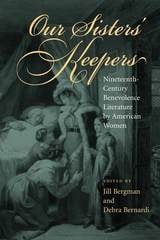
cover of Our Sisters' Keepers: Nineteenth-Century Benevolence Literature by American Women

Our Sisters' Keepers

Nineteenth-Century Benevolence Literature by American Women

Edited by Jill Bergman and Debra Bernardi

University of Alabama Press, 2005

Essays on the roles played by women in forming American attitudes about benevolence and poverty relief

American culture has long had a conflicted relationship with assistance to the poor. Cotton Mather and John Winthrop were staunch proponents of Christian charity as fundamental to colonial American society, while transcendentalists harbored deep skepticism towards benevolence in favor of Emersonian self-reliance and Thoreau’s insistence on an ascetic life. Women in the 19th century, as these essays show, approached issues of benevolence far differently than their male counterparts, consistently promoting assistance to the impoverished, in both their acts and their writings. 
 
These essays address a wide range of subjects: images of the sentimental seamstress figure in women’s fiction; Rebecca Harding Davis’s rewriting of the “industrial” novel; Sarah Orne Jewett’s place in the transcendental tradition of skepticism toward charity, and her subversion of it; the genre of the poorhouse narrative; and the philanthropic work and writings of Hull House founder Jane Addams. 
 
As the editors of Our Sisters’ Keepers argue, the vulnerable and marginal positions occupied by many women in the 19th century fostered an empathetic sensitivity in them to the plight of the poor, and their ability to act and write in advocacy of the impoverished offered a form of empowerment not otherwise available to them. The result was the reformulation of the concept of the American individual.
[more]
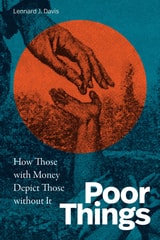
cover of Poor Things: How Those with Money Depict Those without It

Poor Things

How Those with Money Depict Those without It

Lennard J. Davis

Duke University Press, 2024

For generations most of the canonical works that detail the lives of poor people have been created by rich or middle-class writers like Charles Dickens, John Steinbeck, or James Agee. This has resulted in overwhelming depictions of poor people as living abject, violent lives in filthy and degrading conditions. In Poor Things, Lennard J. Davis labels this genre “poornography”: distorted narratives of poverty written by and for the middle and upper classes. Davis shows how poornography creates harmful and dangerous stereotypes that build barriers to social justice and change. To remedy this, Davis argues, poor people should write realistic depictions of themselves, but because of representational inequality they cannot. Given the obstacles to the poor accessing the means of publication, Davis suggests that the work should, at least for now, be done by “transclass” writers who were once poor and who can accurately represent poverty without relying on stereotypes and clichés. Only then can the lived experience of poverty be more fully realized.
[more]
cover of Poverty of the Imagination: Nineteenth-Century Russian Literature about the Po

Poverty of the Imagination

Nineteenth-Century Russian Literature about the Po

David Herman

Northwestern University Press, 2001
The primal scene of all nineteenth-century western thought might involve an observer gazing at someone poor, most commonly on the streets of a great metropolis, and wondering what the spectacle meant in human, moral, political, and metaphysical terms. For Russia, most of whose people hovered near the poverty line throughout history, the scene is one of special significance, presenting a plethora of questions and possibilities for writers who wished to depict the spiritual and material reality of Russian life. How these writers responded, and what their portrayal of poverty reveals and articulates about core values of Russian culture, is the subject of this book, which offers a compelling look into the peculiar convergence in nineteenth-century Russian literature of ideas about the poor and about the processes of art.
[more]
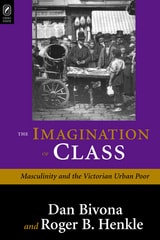
cover of THE IMAGINATION OF CLASS: MASCULINITY AND THE VICTORIAN URBAN POOR

THE IMAGINATION OF CLASS

MASCULINITY AND THE VICTORIAN URBAN POOR

Dan Bivona and Roger B. Henkle

The Ohio State University Press, 2006

A fascinating meld of two scholars’ research and conclusions, The Imagination of Class is a synthetic journey through middle-class Victorian discourse posed by poverty in the midst of plenty—but not that alone. Rather Dan Bivona and Roger B. Henkle argue that the representation of abject poverty in the nineteenth century also displaced anxieties aroused by a variety of challenges to Victorian middle class masculinity. The book’s main argument, in fact, is that the male middle class imagery of urban poverty in the Victorian age presents a complex picture, one in which anxieties about competition, violence, class-based resentment, individuality, and the need to differentiate oneself from the scions of inherited wealth influence mightily the ways in which the urban poor are represented. In the representations themselves, the urban poor are alternately envisioned as sentimentalized (and feminized) victims who stimulate middle class affective response, as the objects of the professionalized discourses of the social sciences (and social services), and as an often hostile social force resistant to the “culturalizing,” taming processes of a maternalist social science.

Through carefully nuanced discussions of a variety of Victorian novelists, journalists, and sociological investigators (some well known, like Dickens, and others less well known, like Masterman and Greenwood), the book offers new insight into the role played by the imagination of the urban poor in the construction of Victorian middle class masculinity. Whereas many scholars have discussed the feminization of the poor, virtually no one has addressed how the poor have served as a site at which middle class men fashioned their own class and gender identity.
[more]
cover of Women, Work, and Representation: Needlewomen in Victorian Art and Literature

Women, Work, and Representation

Needlewomen in Victorian Art and Literature

Lynn M. Alexander

Ohio University Press, 2003

In Victorian England, virtually all women were taught to sew; needlework was allied with images of domestic economy and with traditional female roles of wife and mother- with home rather than factory. The professional seamstress, however, labored long hours for very small wages creating gowns for the upper and middle classes. In her isolation and helplessness, she provided social reformers with a powerful image of working-class suffering that appealed to the sensibilities of the upper classes and helped galvanize public opinion around the need for reform.

Women, Work, and Representation addresses the use of that image in the reform movement, underscoring the shock to the Victorian public when reports revealed that the profession of needlework was extremely hazardous, even deadly.

Author Lynn M. Alexander traces the development of the symbol of the seamstress through a variety of presentations, drawing from the writings of Charles Dickens, Elizabeth Gaskell, Charlotte Elizabeth Tonna, and George W. M. Reynolds, and on visual representations by Richard Redgrave, Thomas Benjamin Kennington, John Everett Millais, John Leech, John Tenniel, and Hubert von Herkomer.

Written to appeal to Victorian scholars, women's studies scholars, and those interested in semiotics and aestheticism, Women, Work, and Representation includes twenty illustrations, most from periodicals of the day, providing new insights into the lives of working women throughout the Victorian era.

[more]