Results by title
6 books match the query 'Popular Imagination'
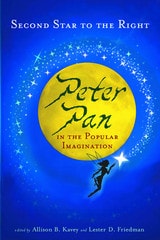
Second Star to the Right
Peter Pan in the Popular ImaginationFriedman, Lester D
Rutgers University Press, 2008
Since 2003 the characters from this story have had a highly visible presence in nearly every genre of popular culture: two major films, a literary sequel to the original adventures, a graphic novel featuring a grown-up Wendy Darling, and an Argentinean novel about a children's book writer inspired by J. M. Barrie. Simultaneously, Barrie surfaced as the subject of two major biographies and a feature film. The engaging essays in Second Star to the Right approach Pan from literary, dramatic, film, television, and sociological perspectives and, in the process, analyze his emergence and preservation in the cultural imagination.
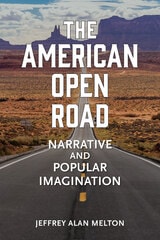
The American Open Road
Narrative and Popular ImaginationJeffrey Alan Melton
University of Alabama Press, 2025
WINNER OF THE ELIZABETH AGEE PRIZE IN AMERICAN LITERATURE
The rearview mirror perspective of a road trip across the American “open road.”
The American Open Road: Narrative and Popular Imagination offers a rich exploration of how the mythos of the open road has shaped, and been shaped by, American culture. Beginning with the post–World War II boom that solidified car culture as central to American life, Melton reflects on how roads, automobiles, and landscapes have been represented in literature, film, and other cultural texts, highlighting the interplay between mobility and narrative.
Drawing on a wide range of cultural texts, from traditional classic road novels and cinematic presentations, to advertisements, poetry, and prose, Melton examines how the open road functions as a symbol of autonomy, reinvention, and resistance. He highlights how road narratives have also exposed deeper tensions in American life—especially around race, gender, and power—and how historically marginalized voices have used the road to reclaim space and tell new stories.
From the romanticism of Route 66 to the political edge of modern road films, The American Open Road offers a thoughtful, engaging analysis of the narratives that continue to define American identity and longing. For readers interested in cultural history, travel literature, or the enduring pull of the highway, this book offers a compelling view from the passenger seat of America’s most iconic journeys.
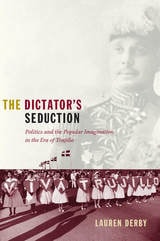
The Dictator's Seduction
Politics and the Popular Imagination in the Era of TrujilloLauren Derby
Duke University Press, 2009
Drawing on previously untapped documents in the Trujillo National Archives and interviews with Dominicans who recall life under the dictator, Derby emphasizes the role that public ritual played in Trujillo’s exercise of power. His regime included the people in affairs of state on a massive scale as never before. Derby pays particular attention to how events and projects were received by the public as she analyzes parades and rallies, the rebuilding of Santo Domingo following a major hurricane, and the staging of a year-long celebration marking the twenty-fifth year of Trujillo’s regime. She looks at representations of Trujillo, exploring how claims that he embodied the popular barrio antihero the tíguere (tiger) stoked a fantasy of upward mobility and how a rumor that he had a personal guardian angel suggested he was uniquely protected from his enemies. The Dictator’s Seduction sheds new light on the cultural contrivances of autocratic power.
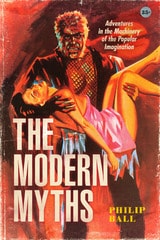
The Modern Myths
Adventures in the Machinery of the Popular ImaginationPhilip Ball
University of Chicago Press, 2021
Myths are usually seen as stories from the depths of time—fun and fantastical, but no longer believed by anyone. Yet, as Philip Ball shows, we are still writing them—and still living them—today. From Robinson Crusoe and Frankenstein to Batman, many stories written in the past few centuries are commonly, perhaps glibly, called “modern myths.” But Ball argues that we should take that idea seriously. Our stories of Dracula, Dr. Jekyll and Mr. Hyde, and Sherlock Holmes are doing the kind of cultural work that the ancient myths once did. Through the medium of narratives that all of us know in their basic outline and which have no clear moral or resolution, these modern myths explore some of our deepest fears, dreams, and anxieties. We keep returning to these tales, reinventing them endlessly for new uses. But what are they really about, and why do we need them? What myths are still taking shape today? And what makes a story become a modern myth?
In The Modern Myths, Ball takes us on a wide-ranging tour of our collective imagination, asking what some of its most popular stories reveal about the nature of being human in the modern age.
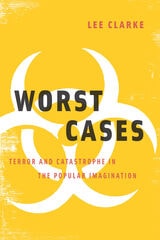
Worst Cases
Terror and Catastrophe in the Popular ImaginationLee Clarke
University of Chicago Press, 2005
We consider the few who live in fear of such scenarios to be alarmist or even paranoid. But Worst Cases shows that such individuals—like Cassandra foreseeing the fall of Troy—are more reasonable and prescient than you might think. In this book, Lee Clarke surveys the full range of possible catastrophes that animate and dominate the popular imagination, from toxic spills and terrorism to plane crashes and pandemics. Along the way, he explores how the ubiquity of worst cases in everyday life has rendered them ordinary and mundane. Fear and dread, Clarke argues, have actually become too rare: only when the public has more substantial information and more credible warnings will it take worst cases as seriously as it should.
A timely and necessary look into how we think about the unthinkable, Worst Cases will be must reading for anyone attuned to our current climate of threat and fear.
Worst Cases
Terror and Catastrophe in the Popular ImaginationLee Clarke
University of Chicago Press, 2005
Al Qaeda detonates a nuclear weapon in Times Square during rush hour, wiping out half of Manhattan and killing 500,000 people. A virulent strain of bird flu jumps to humans in Thailand, sweeps across Asia, and claims more than fifty million lives. A single freight car of chlorine derails on the outskirts of Los Angeles, spilling its contents and killing seven million. An asteroid ten kilometers wide slams into the Atlantic Ocean, unleashing a tsunami that renders life on the planet as we know it extinct.
We consider the few who live in fear of such scenarios to be alarmist or even paranoid. But Worst Cases shows that such individuals—like Cassandra foreseeing the fall of Troy—are more reasonable and prescient than you might think. In this book, Lee Clarke surveys the full range of possible catastrophes that animate and dominate the popular imagination, from toxic spills and terrorism to plane crashes and pandemics. Along the way, he explores how the ubiquity of worst cases in everyday life has rendered them ordinary and mundane. Fear and dread, Clarke argues, have actually become too rare: only when the public has more substantial information and more credible warnings will it take worst cases as seriously as it should.
A timely and necessary look into how we think about the unthinkable, Worst Cases will be must reading for anyone attuned to our current climate of threat and fear.