Results by title

3 books match the query 'Popular Politics'
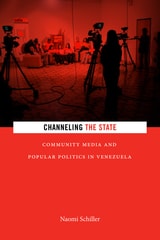
cover of Channeling the State: Community Media and Popular Politics in Venezuela

Channeling the State

Community Media and Popular Politics in Venezuela

Naomi Schiller

Duke University Press, 2018
Venezuela's most prominent community television station, Catia TVe, was launched in 2000 by activists from the barrios of Caracas. Run on the principle that state resources should serve as a weapon of the poor to advance revolutionary social change, the station covered everything from Hugo Chávez’s speeches to barrio residents' complaints about bureaucratic mismanagement. In Channeling the State, Naomi Schiller explores how and why Catia TVe's founders embraced alliances with Venezuelan state officials and institutions. Drawing on long-term ethnographic research among the station's participants, Schiller shows how community television production created unique openings for Caracas's urban poor to embrace the state as a collective process with transformative potential. Rather than an unchangeable entity built for the exercise of elite power, the state emerges in Schiller's analysis as an uneven, variable process and a contentious terrain where institutions are continuously made and remade. In Venezuela under Chávez, media activists from poor communities did not assert their autonomy from the state but rather forged ties with the middle class to question whose state they were constructing and who it represented.
[more]
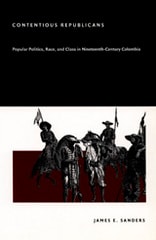
cover of Contentious Republicans: Popular Politics, Race, and Class in Nineteenth-Century Colombia

Contentious Republicans

Popular Politics, Race, and Class in Nineteenth-Century Colombia

James E. Sanders

Duke University Press, 2004

Contentious Republicans explores the mid-nineteenth-century rise of mass electoral democracy in the southwestern region of Colombia, a country many assume has never had a meaningful democracy of any sort. James E. Sanders describes a surprisingly rich republicanism characterized by legal rights and popular participation, and he explains how this vibrant political culture was created largely by competing subaltern groups seeking to claim their rights as citizens and their place in the political sphere. Moving beyond the many studies of nineteenth-century nation building that focus on one segment of society, Contentious Republicans examines the political activism of three distinct social and racial groups: Afro-Colombians, Indians, and white peasant migrants.

Beginning in the late 1840s, subaltern groups entered the political arena to forge alliances, both temporary and enduring, with the elite Liberal and Conservative Parties. In the process, each group formed its own political discourses and reframed republicanism to suit its distinct needs. These popular liberals and popular conservatives bargained for the parties’ support and deployed a broad repertoire of political actions, including voting, demonstrations, petitions, strikes, boycotts, and armed struggle. By the 1880s, though, many wealthy Colombians of both parties blamed popular political engagement for social disorder and economic failure, and they successfully restricted lower-class participation in politics. Sanders suggests that these reactionary developments contributed to the violence and unrest afflicting modern Colombia. Yet in illuminating the country’s legacy of participatory politics in the nineteenth century, he shows that the current situation is neither inevitable nor eternal.
[more]
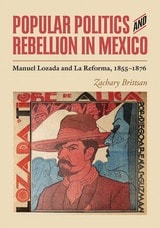
cover of Popular Politics and Rebellion in Mexico: Manuel Lozada and La Reforma, 1855-1876

Popular Politics and Rebellion in Mexico

Manuel Lozada and La Reforma, 1855-1876

Zachary Brittsan

Vanderbilt University Press, 2015

The political conflict during Mexico's Reform era in the mid-nineteenth century was a visceral battle between ideologies and people from every economic and social class. As Popular Politics and Rebellion in Mexico develops the story of this struggle, the role of one key rebel, Manuel Lozada, comes into focus. The willingness of rural peasants to take up arms to defend the Catholic Church and a conservative political agenda explains the bitterness of the War of Reform and the resulting financial and political toll that led to the French Intervention. Exploring the activities of rural Jalisco's residents in this turbulent era and Lozada's unique position in the drama, Brittsan reveals the deep roots of colonial religious and landholding practices, exemplified by Lozada, that stood against the dominant political current represented by Benito Juarez and liberalism.


Popular Politics and Rebellion in Mexico also explores the conditions under which a significant segment of Mexican society aligned itself with conservative interests and French interlopers, revealing this constituency to be more than a collection of reactionary traitors to the nation. To the contrary, armed rebellion--or at least the specter of force--protected local commercial interests in the short run and enhanced the long-term prospects for political autonomy. Manuel Lozada's story adds a necessary layer of complexity to our understanding of the practical and ideological priorities that informed the tumultuous conflicts of the mid-nineteenth century.

[more]