Results by title
7 books match the query 'Population biology'
Adaptation in Metapopulations
How Interaction Changes EvolutionMichael J. Wade
University of Chicago Press, 2016
All organisms live in clusters, but such fractured local populations, or demes, nonetheless maintain connectivity with one another by some amount of gene flow between them. Most such metapopulations occur naturally, like clusters of amphibians in vernal ponds or baboon troops spread across the African veldt. Others have been created as human activities fragment natural landscapes, as in stands of trees separated by roads. As landscape change has accelerated, understanding how these metapopulations function—and specifically how they adapt—has become crucial to ecology and to our very understanding of evolution itself.
With Adaptation in Metapopulations, Michael J. Wade explores a key component of this new understanding of evolution: interaction. Synthesizing decades of work in the lab and in the field in a book both empirically grounded and underpinned by a strong conceptual framework, Wade looks at the role of interaction across scales from gene selection to selection at the level of individuals, kin, and groups. In so doing, he integrates molecular and organismal biology to reveal the true complexities of evolutionary dynamics from genes to metapopulations.
With Adaptation in Metapopulations, Michael J. Wade explores a key component of this new understanding of evolution: interaction. Synthesizing decades of work in the lab and in the field in a book both empirically grounded and underpinned by a strong conceptual framework, Wade looks at the role of interaction across scales from gene selection to selection at the level of individuals, kin, and groups. In so doing, he integrates molecular and organismal biology to reveal the true complexities of evolutionary dynamics from genes to metapopulations.
[more]
Ecological Explosions
The History of Biological Invasions and Invasion ScienceDaniel Simberloff
University of Chicago Press, 2025
A leading biologist offers a comprehensive and accessible history of invasive species science, from its earliest antecedents through its current research foci and controversies.
From the arrival of the naval shipworm in the Black Sea in the first millennium BC to the escape of the Burmese python in Florida in 1992, humans have moved species to new locations, deliberately or inadvertently, for thousands of years. Agricultural and environmental impacts of some invasions were evident early, although whether observers recognized that the cause was an introduced species is uncertain. The history of invasion biology truly begins in the sixteenth through eighteenth centuries, when explorers noticed European species on various distant islands and in North America. In the nineteenth century, biogeographers, studying species distributions across the globe, introduced the first native and non-native species categorizations, and prominent researchers like Charles Darwin began to describe the impacts of introduced species. In the nineteenth and twentieth centuries, as humans moved increasing numbers of species across the globe, the advent of modern ecology deepened our understanding of the scope of the problem.
In Ecological Explosions, invasive species expert Daniel Simberloff provides a thorough overview of the development of invasion science, from early research—including from the perspectives of leading scientists like Aldo Leopold—to the field’s future. Simberloff explores the work of pioneering ecologists like Charles Elton, antecedents of what became today’s invasion biology, before discussing the field’s true emergence in the 1980s, its explosive methodological and theoretical expansion, its integration with other disciplines, and its increasing visibility, not only within the biological literature but also in government policies across the world in the 1990s. Finally, he investigates current controversies, such as the debate over whether the entire science is xenophobic, and asks how ecosystems might adapt to a rapidly globalizing world and ever-increasing numbers of introduced species—including the joro spider, lionfish, spotted lanternfly, common reed, and Asian carp.
[more]
Metacommunities
Spatial Dynamics and Ecological CommunitiesEdited by Marcel Holyoak, Mathew A. Leibold, and Robert D. Holt
University of Chicago Press, 2005
Until recently community ecology—a science devoted to understanding the patterns and processes of species distribution and abundance—focused mainly on specific and often limited scales of a single community. Since the 1970s, for example, metapopulation dynamics—studies of interacting groups of populations connected through movement—concentrated on the processes of population turnover, extinction, and establishment of new populations.
Metacommunities takes the hallmarks of metapopulation theory to the next level by considering a group of communities, each of which may contain numerous populations, connected by species interactions within communities and the movement of individuals between communities. In examining communities open to dispersal, the book unites a broad range of ecological theories, presenting some of the first empirical investigations and revealing the value of the metacommunity approach.
The collection of empirical, theoretical, and synthetic chapters in Metacommunities seeks to understand how communities work in fragmented landscapes. Encouraging community ecologists to rethink some of the leading theories of population and community dynamics, Metacommunities urges ecologists to expand the spatiotemporal scales of their research.
[more]
Modeling Nature
Sharon E. Kingsland
University of Chicago Press, 1995
The first history of population ecology traces two generations of science and scientists from the opening of the twentieth century through 1970. Kingsland chronicles the careers of key figures and the field's theoretical, empirical, and institutional development, with special attention to tensions between the descriptive studies of field biologists and later mathematical models. This second edition includes a new afterword that brings the book up to date, with special attention to the rise of "the new natural history" and debates about ecology's future as a large-scale scientific enterprise.
[more]
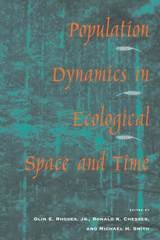
Population Dynamics in Ecological Space and Time
Olin E. Rhodes Jr., Ronald K. Chesser, and Michael H. Smith
University of Chicago Press, 1996
As profound threats to ecosystems increase worldwide, ecologists must move beyond studying single communities at a single point in time. All of the dynamic, interconnected spatial and temporal processes that determine the distribution and abundance of species must be understood in order to develop new conservation and management strategies.
This volume is the first to integrate mathematical and biological approaches to these crucial topics. The editors include not only a wide variety of theoretical approaches, but also a broad range of experimental and field studies, with chapters written by renowned experts in community ecology, ecological modeling, population genetics, and conservation biology.
In addition to providing new insights into well-known topics such as migration, the authors also introduce some less familiar subjects, including bacterial population genetics and ecotoxicology. For anyone interested in the study, management, and conservation of populations, this book will prove to be a valuable resource.
[more]
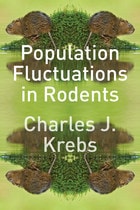
Population Fluctuations in Rodents
Charles J. Krebs
University of Chicago Press, 2013
How did rodent outbreaks in Germany help to end World War I? What caused the destructive outbreak of rodents in Oregon and California in the late 1950s, the large population outbreak of lemmings in Scandinavia in 2010, and the great abundance of field mice in Scotland in the spring of 2011? Population fluctuations, or outbreaks, of rodents constitute one of the classic problems of animal ecology, and in Population Fluctuations in Rodents, Charles J. Krebs sifts through the last eighty years of research to draw out exactly what we know about rodent outbreaks and what should be the agenda for future research.
Krebs has synthesized the research in this area, focusing mainly on the voles and lemmings of the Northern Hemisphere—his primary area of expertise—but also referring to the literature on rats and mice. He covers the patterns of changes in reproduction and mortality and the mechanisms that cause these changes—including predation, disease, food shortage, and social behavior—and discusses how landscapes can affect population changes, methodically presenting the hypotheses related to each topic before determining whether or not the data supports them. He ends on an expansive note, by turning his gaze outward and discussing how the research on rodent populations can apply to other terrestrial mammals. Geared toward advanced undergraduate students, graduate students, and practicing ecologists interested in rodent population studies, this book will also appeal to researchers seeking to manage rodent populations and to understand outbreaks in both natural and urban settings—or, conversely, to protect endangered species.
[more]
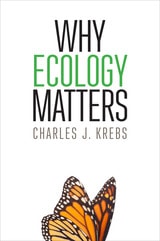
Why Ecology Matters
Charles J. Krebs
University of Chicago Press, 2016
Global temperatures and seawater levels rise; the world’s smallest porpoise species looms at the edge of extinction; and a tiny emerald beetle from Japan flourishes in North America—but why does it matter? Who cares? With this concise, accessible, and up-to-date book, Charles J. Krebs answers critics and enlightens students and environmental advocates alike, revealing not why phenomena like these deserve our attention, but why they demand it.
Highlighting key principles in ecology—from species extinction to the sun’s role in powering ecosystems—each chapter introduces a general question, illustrates that question with real-world examples, and links it to pressing ecological issues in which humans play a central role, such as the spread of invasive species, climate change, overfishing, and biodiversity conservation. While other introductions to ecology are rooted in complex theory, math, or practice and relegate discussions of human environmental impacts and their societal implications to sidebars and appendices, Why Ecology Matters interweaves these important discussions throughout. It is a book rooted in our contemporary world, delving into ecological issues that are perennial, timeless, but could not be more timely.
Highlighting key principles in ecology—from species extinction to the sun’s role in powering ecosystems—each chapter introduces a general question, illustrates that question with real-world examples, and links it to pressing ecological issues in which humans play a central role, such as the spread of invasive species, climate change, overfishing, and biodiversity conservation. While other introductions to ecology are rooted in complex theory, math, or practice and relegate discussions of human environmental impacts and their societal implications to sidebars and appendices, Why Ecology Matters interweaves these important discussions throughout. It is a book rooted in our contemporary world, delving into ecological issues that are perennial, timeless, but could not be more timely.
[more]