Results by title

2 books match the query 'Porfirian Mexico'

cover of Americans in the Treasure House: Travel to Porfirian Mexico and the Cultural Politics of Empire

Americans in the Treasure House

Travel to Porfirian Mexico and the Cultural Politics of Empire

By Jason Ruiz

University of Texas Press, 2014

When railroads connected the United States and Mexico in 1884 and overland travel between the two countries became easier and cheaper, Americans developed an intense curiosity about Mexico, its people, and its opportunities for business and pleasure. Indeed, so many Americans visited Mexico during the Porfiriato (the long dictatorship of Porfirio Díaz, 1876–1911) that observers on both sides of the border called the hordes of tourists and business speculators a “foreign invasion,” an apt phrase for a historical moment when the United States was expanding its territory and influence.

Americans in the Treasure House examines travel to Mexico during the Porfiriato, concentrating on the role of travelers in shaping ideas of Mexico as a logical place for Americans to extend their economic and cultural influence in the hemisphere. Analyzing a wealth of evidence ranging from travelogues and literary representations to picture postcards and snapshots, Jason Ruiz demonstrates that American travelers constructed Mexico as a nation at the cusp of modernity, but one requiring foreign intervention to reach its full potential. He shows how they rationalized this supposed need for intervention in a variety of ways, including by representing Mexico as a nation that deviated too dramatically from American ideals of progress, whiteness, and sexual self-control to become a modern “sister republic” on its own. Most importantly, Ruiz relates the rapid rise in travel and travel discourse to complex questions about national identity, state power, and economic relations across the U.S.–Mexico border.
[more]
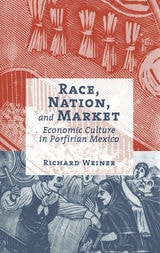
cover of Race, Nation, and Market: Economic Culture in Porfirian Mexico

Race, Nation, and Market

Economic Culture in Porfirian Mexico

Richard Weiner

University of Arizona Press, 2004

Prior to the Revolution of 1910, economic ideals were a dominant mode of political and social discourse in Mexico. Scholars have focused considerable attention on the expansion of the market economy during this period—particularly its political, economic, and social importance. Richard Weiner now enhances our understanding of the emergence of modern Mexico by exploring the market's immense symbolic significance. Race, Nation, and Market traces the intellectual strands of economic thought during the late Porfiriato. Even in the face of Díaz's political reign, the market became the dominant theme in national discourse as contemporaries of all political persuasions underscored its social and cultural effects. This work documents the ways in which liberals, radicals, and conservatives employed market rhetoric to establish their political identities and map out their courses of action, and it shows how the market became an emblem linked to the identity of each group. Weiner explains how the dominant political interests—the científicos, the Mexican Liberal Party, and the social Catholics—each conceived economic issues, and he compares how they rhetorically used their conceptions of the market to promote their political objectives. Some worshiped it as a deity that created social peace, political harmony, and material abundance, while others demonized it as a source of social destruction. Weiner delineates their approaches and reveals how distinct notions of race, gender, community, and nationality informed economic culture and contradicted a laissez-faire conception of society and economy. By focusing on these rhetorical contests, Race, Nation, and Market offers a new perspective on social mobilization in late nineteenth-century Mexico as it also explores the related field of Porfirian economic culture and thought, about which little thus far has been written. In the face of today's controversy over globalization, it offers a unique historical perspective on the market's long-standing significance to political activism.
[more]