Results by title
15 books match the query 'Portland'
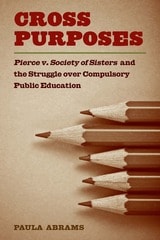
Cross Purposes
Pierce v. Society of Sisters and the Struggle over Compulsory Public EducationPaula Abrams
University of Michigan Press, 2009
"A definitive study of an extremely important, though curiously neglected, Supreme Court decision, Pierce v. Society of Sisters."
---Robert O'Neil, Professor of Law Emeritus, University of Virginia School of Law
---Richard W. Garnett, Professor of Law and Associate Dean, Notre Dame Law School
"A well-written, well-researched blend of law, politics, and history."
---Joan DelFattore, Professor of English and Legal Studies, University of Delaware
In 1922, the people of Oregon passed legislation requiring all children to attend public schools. For the nativists and progressives who had campaigned for the Oregon School Bill, it marked the first victory in a national campaign to homogenize education---and ultimately the populace. Private schools, both secular and religious, vowed to challenge the law. The Catholic Church, the largest provider of private education in the country and the primary target of the Ku Klux Klan campaign, stepped forward to lead the fight all the way to the U.S. Supreme Court.
In Pierce v. Society of Sisters (1925), the court declared the Oregon School Bill unconstitutional and ruled that parents have the right to determine how their children should be educated. Since then, Pierce has provided a precedent in many cases pitting parents against the state.
Paula Abrams is Professor of Constitutional Law at Lewis & Clark Law School.
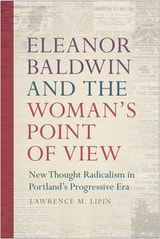
Eleanor Baldwin and the Woman's Point of View
New Thought Radicalism in Portland’s Progressive EraLawrence M. Lipin
Oregon State University Press, 2017
A century before the Occupy movement and the Women’s March, Baldwin spoke truth to power. Imbued with a New Thought spirituality that presumed progressive thought could directly affect material reality, she wrote to move history forward. And yet, the trajectory of history proved as hard to forecast then as now. While her personal story seems to embody a modern progressivism, blending abolition with labor reform and anti-banker activism—positions from which she never wavered—her path grew more complicated as times changed in the aftermath of World War I, when she would advocate on behalf of both the Bolsheviks and the Ku Klux Klan.
In this deeply researched and nuanced account of Eleanor Baldwin’s intellectual journey, historian Larry Lipin reveals how even the most dedicated radical can be overcome by unforeseen events. Eleanor Baldwin and the Woman’s Point of View restores a missing chapter in Portland’s Progressive Era history and rescues this passionate, intriguing, and quixotic character from undeserved obscurity.

Finding Amy
A True Story of Murder in MaineJoseph K. Loughlin and Kate Clark Flora
University Press of New England, 2011
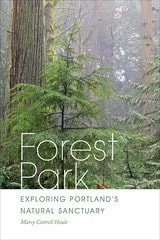
Forest Park
Exploring Portland's Natural SanctuaryMarcy Cottrell Houle
Oregon State University Press, 2023
Situated in the rugged hills west of downtown Portland, Forest Park is the nation’s premier urban natural sanctuary. It supports essential habitat for hundreds of native plants and animals, including species at risk, and is one of the largest city parks in the world. While extending critical ecosystem services to the region, it offers miles of outstanding hiking trails, all within minutes of the downtown core.
Forest Park: Exploring Portland’s Natural Sanctuary showcases this treasure in new light, offering a compendium of the most up-to-date and comprehensive information available. Twenty-one hikes covering 75 miles bring a full awareness of the park’s outstanding attributes. Hikes are grouped by theme to encourage people to explore Forest Park’s watersheds; geology; lichens and mosses; vegetation; amphibians and reptiles; pollinators; native wildlife; and wildlife corridors. Beautiful photographs and full-color maps accompany each trail description.
Forest Park is a shining example of the Pacific Northwest western hemlock community--an ecosystem unique among all temperate forests of the world. It is also an exciting model for a future Urban Biodiversity Reserve, a concept under development recognizing the park’s scientific, natural, and cultural qualities. Forest Park: Exploring Portland’s Natural Sanctuary will help all visitors discover the beauty and wonders of this extraordinary natural resource.
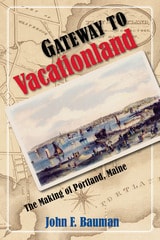
Gateway to Vacationland
The Making of Portland, MaineJohn F. Bauman
University of Massachusetts Press, 2012
Situated on a peninsula jutting into picturesque Casco Bay, Portland has long been admired for its geographical setting—the “beautiful city by the sea,” as native son Henry Wadsworth Longfellow called it. At the same time, Portland's deep, ice-free port has made it an ideal site for the development of coastal commerce and industry. Much of the city's history, John F. Bauman shows, has been defined by the effort to reconcile the competing interests generated by these attributes—to balance the imperatives of economic growth with a desire to preserve Portland's natural beauty.
Caught in the crossfire of British and French imperial ambitions throughout the colonial era, Portland emerged as a prosperous shipbuilding center and locus of trade in the decades following the American Revolution. During the nineteenth century it became a busy railroad hub and winter port for Canadian grain until a devastating fire in 1866 reduced much of the city to ruins. Civic leaders responded by reinventing Portland as a tourist destination, building new hotels, parks, and promenades, and proclaiming it the “Gateway to Vacationland.”
After losing its grain trade in the 1920s and suffering through the Great Depression, Portland withered in the years following World War II as it wrestled with the problems of deindustrialization, suburbanization, and an aging downtown. Efforts at urban renewal met with limited success until the 1980s, when a concerted plan of historic preservation and the restoration of the Old Port not only revived the tourist trade but eventually established Portland as one of America's “most livable cities.”
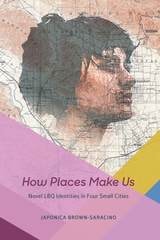
How Places Make Us
Novel LBQ Identities in Four Small CitiesJaponica Brown-Saracino
University of Chicago Press, 2017
Taking us into communities in Ithaca, New York; San Luis Obispo, California; Greenfield, Massachusetts; and Portland, Maine; Brown-Saracino shows how LBQ migrants craft a unique sense of self that corresponds to their new homes. How Places Make Us demonstrates that sexual identities are responsive to city ecology. Despite the fact that the LBQ residents share many demographic and cultural traits, their approaches to sexual identity politics and to ties with other LBQ individuals and heterosexual residents vary markedly by where they live. Subtly distinct local ecologies shape what it feels like to be a sexual minority, including the degree to which one feels accepted, how many other LBQ individuals one encounters in daily life, and how often a city declares its embrace of difference. In short, city ecology shapes how one “does” LBQ in a specific place. Ultimately, Brown-Saracino shows that there isn’t one general way of approaching sexual identity because humans are not only social but fundamentally local creatures. Even in a globalized world, the most personal of questions—who am I?—is in fact answered collectively by the city in which we live.
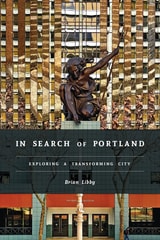
In Search of Portland
Exploring a Transforming CityBrian Libby
Oregon State University Press, 2026
“A good walking tour is not just about individual stops but the total experience of moving along a city’s streets, taking in a variety of neighborhoods, buildings, shops, parks, public art, and bridges: a chance to be the grand marshal in your own parade,” writes Brian Libby in the introduction of In Search of Portland. Starting from his 1997 home, the Empire Apartments at Southwest Eleventh Avenue and Jefferson Street, Libby shares one hundred fascinating points of interest through personal reflection, interviews, and anecdotal history.
The six excursions exploring Portland’s downtown, Old Town, and Pearl District not only focus on the city’s important landmarks and hidden gems but showcase an evolving city’s resilience and heart. Alongside his own experiences, Libby reveals how luminaries like Humphrey Bogart, Mark Rothko, Gus Van Sant, Vera Katz, and Bill Walton appreciated the City of Roses. From Pioneer Courthouse Square to the Crystal Ballroom, each location in the book celebrates the spirit of place in addition to its architecture.
More than a book about buildings, In Search of Portland reveals the stories behind the built landscape, the people, and the history that have created modern Portland.
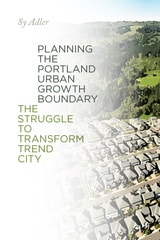
Planning the Portland Urban Growth Boundary
The Struggle to Transform Trend CitySy Adler
Oregon State University Press, 2022
In this companion volume to his 2012 book Oregon Plans: The Making of an Unquiet Land-Use Revolution, Sy Adler offers readers a deep analysis of planning Portland’s Urban Growth Boundary. Required by one of Oregon’s nineteen statewide planning goals, a boundary in the Portland metropolitan area was intended to separate urban land and land that would be urbanized from commercially productive farmland. After adopting the goals, approving the Portland growth boundary in 1979 was the most significant decision the Oregon Land Conservation and Development Commission has ever made, and, more broadly, is a significant milestone in American land-use planning.
Planning the Portland Urban Growth Boundary primarily covers the 1970s. Innovative regional planning institutions were established in response to concerns about sprawl, but planners working for those institutions had to confront the reality that various plans being developed and implemented by city and county governments in metro Portland would instead allow sprawl to continue. Regional planners labeled these as “Trend City” plans, and sought to transform them during the 1970s and thereafter.
Adler discusses the dynamics of these partially successful efforts and the conflicts that characterized the development of the Portland UGB during the 1970s—between different levels of government, and between public, private, and civic sector advocates. When the regional UGB is periodically reviewed, these conflicts continue, as debates about values and technical issues related to forecasting future amounts of population, economic activity, and the availability of land for urban development over a twenty-year period roil the boundary planning process.
Planning the Portland Urban Growth Boundary is an authoritative history and an indispensable resource for anyone actively involved in urban and regional planning—from neighborhood associations and elected officials to organizations working on land use and development issues throughout the state.
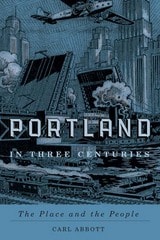
Portland in Three Centuries
The Place and the PeopleCarl Abbott
Oregon State University Press, 2011
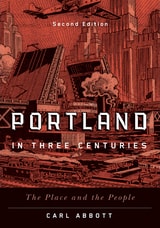
Portland in Three Centuries
The Place and the PeopleCarl Abbott
Oregon State University Press, 2022
Incorporating social history and contemporary scholarship in his narrative, Abbott examines current metropolitan character and issues, giving close attention to historical background. He explores the context of opportunities and problems that have helped to shape the rich mosaic that is Portland.
This revised and updated second edition includes greater attention to the Indigenous peoples of the Portland region, Portland’s communities of color, and the challenges of recent years that have thrust Portland into the national spotlight.
A highly readable character study of a city, and enhanced by more than sixty historic and contemporary images, Portland in Three Centuries will appeal to readers interested in Portland, in Oregon, and in Pacific Northwest history.
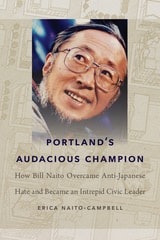
Portland's Audacious Champion
How Bill Naito Overcame Anti-Japanese Hate and Became an Intrepid Civic LeaderErica Naito-Campbell
Oregon State University Press, 2024
William “Bill” Sumio Naito (1925–1996) was a remarkable and visionary individual—the Portland-born son of Japanese immigrants who became one of the city’s most significant business and civic leaders. Every day thousands of people drive on Naito Parkway alongside Portland’s Waterfront Park, yet little has been written about the man for whom it was named.
In this first biography, Erica Naito-Campbell, Bill’s granddaughter, shows how his story is also the story of Portland, the city he loved. Naito’s life, from the Great Depression and World War II through Portland’s rebirth in the 1970s and its profound growth, tracked most of the major events in the city and was the catalyst for many of them. Through hard-earned success in importing and real estate with his brother Sam, Naito came to wield considerable power in the city, and his leadership led to much of what we consider iconic Portland today: the “Portland Oregon” sign near the Burnside Bridge, the annual Christmas tree in Pioneer Courthouse Square, and Harbor Drive’s conversion to Waterfront Park.
Naito’s name became synonymous with civic leadership, whether it was growing Portland’s urban tree canopy, revitalizing its downtown, or preserving historic buildings. But less is known about his difficult childhood—with a father who worked twelve-hour days and a mother whose treatment of him was harsh at best—and the racism he endured during World War II. After the expulsion of Japanese Americans following Pearl Harbor and his military service in Occupied Japan, Naito overcame great emotional turmoil to return to Portland and become one of its greatest change-makers.
Erica Naito-Campbell uses anecdotes, rich details, and previously unknown stories about Bill Naito to bring Portland’s history to life—while acknowledging that the cost of his success was a family rife with resentments and envy. Her book reveals the emotional wounds that drove Naito to become one of Portland’s most inspiring civic leaders, a pivotal player in the city’s journey from a moribund downtown to a national model for livability, urban renewal, and historic preservation.
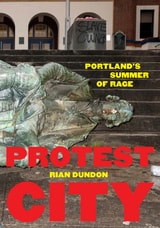
Protest City
Portland's Summer of RageRian Dundon
Oregon State University Press, 2023
In the months leading up to the 2020 presidential election, Portland made national news with nightly social justice protests, often met with violent response by counter protestors and law enforcement. Though frequently regarded as a progressive hub, Portland has a long history of racial inequality and oppression, and the city’s entrenched divisions gained new attention during the Trump years. The photos in Protest City present a visceral visual record of this significant moment in Portland’s history.
Rian Dundon, who has been photographing the rise of extreme politics on the West Coast since 2016, lived only a short walk from the protests that erupted after the murder of George Floyd. For one hundred days, Dundon enmeshed himself in the demonstrations with an unobtrusive point-and-shoot camera. The result is a graphic portrayal of how social movements become politicized, how spectacle serves as a subtext to change in the digital age, and how modern protests blur distinctions among performance, ritual, and surveillance. As he follows the progress of Portland’s conflicts, Dundon draws connections to Oregon’s legacy as a stronghold of white supremacist extremism and interrogates the role of whiteness in racial justice movements.
Most of the photographs in the book were taken between May and October 2020, but the collection also includes photos from protests in late 2020 and 2021 around various related issues, including the Red House eviction blockade, rightwing demonstrations on January 6 and 17, and the one-year anniversary of George Floyd’s murder. Dundon’s striking photos recreate the immediacy and impact of the protests, while essays by historian Carmen Thompson and journalist Donnell Alexander contextualize the uprising’s sociopolitical background. A chronology and author’s note are also featured.
The publisher and author would like to thank the Magnum Foundation, Documentary Arts, and the Economic Hardship Reporting Project for their generous support of this publication. Additional funding has been provided by Furthermore: a program of the J. M. Kaplan Fund.

Rare and Used
Adventures of a Book Scout's ApprenticeDaniel Dietz
Oregon State University Press, 2026
Coming home to Oregon to reconnect with his aging parents, Daniel Dietz discovers the rhythms and relationships of a changing book world. As the internet pushes bibliophiles away from used bookstores and toward digital commerce, Dietz’s stepfather Michael, now nearing eighty, clings to the precarious trade of scouring thrift stores and library sales for rare books to sell. He explores the stacks, from garage sales in Eugene’s Whiteaker neighborhood to Portland’s Powell’s City of Books, for overlooked first editions and valuable rare books from the past.
With humor and tenderness, Rare and Used introduces us to Michael and to a dedicated and zealous community of book people, each with a grail book that they seek above all others. For Dietz, it’s Beat poet Diane di Prima’s debut collection This Kind of Bird Flies Backward—a book once owned by his stepfather. In his quest for the book, Dietz grapples with larger questions about possession, inheritance, and what we can hold onto. A tribute to books and booksellers as well as to family and place, Rare and Used explores what it means to return home to a community that shaped you.
This Is Not For You
An Activist's Journey of Resistance and ResilienceRichard Brown
Oregon State University Press, 2021
The book finds Brown approaching his eightieth birthday and reflecting on his life. As he recalls his childhood in 1940s Harlem, his radicalization in the newly desegregated Air Force, and his decades of activism in one of America’s whitest cities, he questions how much longer he’ll do this work, and he wonders who, if anyone, will take his place.
This is a book about how and why to become an engaged, activist citizen, and how activists can stay grounded, no matter how deeply they immerse themselves in the work. It also offers an intimate, firsthand look at policing: what policing is and could be, how civilians can have a say, and how police can and should be responsive to and inclusive of civilian voices. This Is Not For You speaks on every page about being Black in America: about Black pride; Black history, art, and culture; and the experience of resisting white supremacy. It also stands as a much-needed counternarrative to Portlandia, telling a different story about the city and who has shaped it.
Over fifty percent of royalties earned on this book will be donated to organizations working on behalf of Black Portlanders.
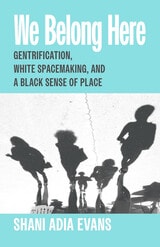
We Belong Here
Gentrification, White Spacemaking, and a Black Sense of PlaceShani Adia Evans
University of Chicago Press, 2025
In We Belong Here, sociologist Shani Adia Evans offers an intimate look at gentrification from the inside, documenting the reactions of Albina residents as the racial demographics of their neighborhood shift. As White culture becomes centered in Northeast, Black residents recount their experiences with what Evans refers to as “White watching,” the questioning look on the faces of White people they encounter, which conveys an exclusionary message: “What are you doing here?” This, Evans shows, is a prime example of what she calls “White spacemaking”: the establishment of White space—spaces in which Whiteness is assumed to be the norm and non-Whites are treated with suspicion—in formerly non-White neighborhoods. Evans also documents Black residents’ efforts to create and maintain places for Black belonging in White-dominated Portland. While gentrification typically describes socioeconomic changes that may have racial implications, White spacemaking allows us to understand racism as a primary mechanism of neighborhood change. We Belong Here illuminates why gentrification and White spacemaking should be examined as intersecting, but not interchangeable, processes of neighborhood change.