Results by title
7 books match the query 'Posner, Richard A.'
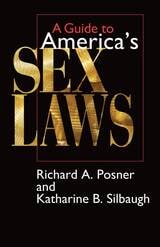
A Guide to America's Sex Laws
Richard A. Posner and Katharine B. Silbaugh
University of Chicago Press, 1996
"It takes only a few minutes with A Guide to [America's] Sex to realize that the nation's laws governing what two consenting adults can do with one another are an odd jumble."—Eric Fidler, San Diego Commerce
"Especially noteworthy is how laws governing various sexual activities vary from state to state."—Library Journal
"Fascinating and often surprising facts are concisely documented and conveniently organized in A Guide."—Carlin Meyer, New York Law Journal
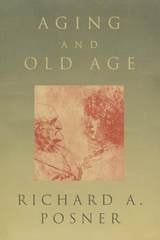
Aging and Old Age
Richard A. Posner
University of Chicago Press, 1995
Aging and Old Age offers fresh insight into a wide range of social and political issues relating to the elderly, such as health care, crime, social security, and discrimination. From the dread of death to the inordinate law-abidingness of the old, from their loquacity to their penny-pinching, Posner paints a surprisingly rich, revealing, and unsentimental portrait of the millions of elderly people in the United States. He explores issues such as age discrimination in employment, creativity and leadership as functions of age, and the changing social status of the elderly. Why are old people, presumably with less to lose, more unwilling to take risks than young people? Why don't the elderly in the United States command the respect and affection they once did and still do in other countries? How does aging affect driving and criminal records? And how does aging relate to creativity across different careers?
Antitrust Law, Second Edition
Richard A. Posner
University of Chicago Press, 2001
Antitrust Law was fundamental to redefining the field of antitrust law and it remains the definitive textbook for those teaching or learning the subject, Richard Posner's book has played a major role in transforming the field of antitrust law into a body of economically rational principles largely in accord with the ideas set forth in the first edition. Today's antitrust professionals may disagree on specific practices and rules, but most litigators, prosecutors, judges, and scholars agree that the primary goal of antitrust laws should be to promote economic welfare, and that economic theory should be used to determine how well business practices conform to that goal.
In this thoroughly revised edition, Posner explains the economic approach to new generations of lawyers and students.
"The antitrust laws are here to stay," Posner writes, "and the practical question is how to administer them better-more rationally, more accurately, more expeditiously, more efficiently." This fully revised classic will continue to be the standard work in the field.
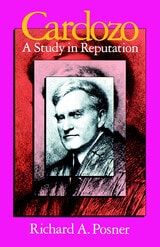
Cardozo
A Study in ReputationRichard A. Posner
University of Chicago Press, 1993
"The present compact and unflaggingly interesting volume . . . is a full-bodied scholarly biography. . . .It is illuminating in itself, and will serve as a significant contribution."—Paul A. Freund, New York Times Book Review
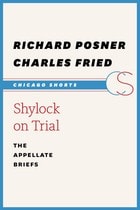
Shylock on Trial
The Appellate BriefsRichard A. Posner and Charles Fried
University of Chicago Press, 2013
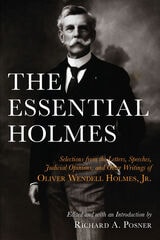
The Essential Holmes
Selections from the Letters, Speeches, Judicial Opinions, and Other Writings of Oliver Wendell Holmes, Jr.Oliver Wendell Holmes
University of Chicago Press, 1992
"A first-rate prose stylist, [Holmes] was perhaps the most quotable of all judges, as this ably edited volume shows."—Washington Post Book World
"Brilliantly edited, lucidly organized, and equipped with a compelling introduction by Judge Posner, [this book] is one of the finest single-volume samplers of any author's work I have seen. . . . Posner has fully captured the acrid tang of him in this masterly anthology."—Terry Teachout, National Review
"Excellent. . . . A worthwhile contribution to current American political/legal discussions."—Library Journal
"The best source for the reader who wants a first serious acquaintance with Holmes."—Thomas C. Grey, New York Review of Books
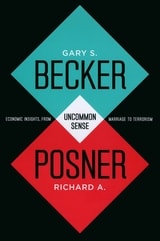
Uncommon Sense
Economic Insights, from Marriage to TerrorismGary S. Becker and Richard A. Posner
University of Chicago Press, 2009
On December 5, 2004, the still-developing blogosphere took one of its biggest steps toward mainstream credibility, as Nobel Prize–winning economist Gary S. Becker and renowned jurist and legal scholar Richard A. Posner announced the formation of the Becker-Posner Blog.
In no time, the blog had established a wide readership and reputation as a reliable source of lively, thought-provoking commentary on current events, its pithy and profound weekly essays highlighting the value of economic reasoning when applied to unexpected topics. Uncommon Sense gathers the most important and innovative entries from the blog, arranged by topic, along with updates and even reconsiderations when subsequent events have shed new light on a question. Whether it’s Posner making the economic case for the legalization of gay marriage, Becker arguing in favor of the sale of human organs for transplant, or even the pair of scholars vigorously disagreeing about the utility of collective punishment, the writing is always clear, the interplay energetic, and the resulting discussion deeply informed and intellectually substantial.
To have a single thinker of the stature of a Becker or Posner addressing questions of this nature would make for fascinating reading; to have both, writing and responding to each other, is an exceptionally rare treat. With Uncommon Sense, they invite the adventurous reader to join them on a whirlwind intellectual journey. All they ask is that you leave your preconceptions behind.