Results by title
3 books match the query 'Post - Soviet Russia'

Coming of Age in Post-Soviet Russia
Fran Markowitz
University of Illinois Press, 2000
Anthropologist Fran Markowitz interviewed more than one hundred Russian teenagers to discover how adolescents have been coping with their country's seismic transitions. Her findings present a substantive challenge to near-axiomatic theories of human development that regard cultural stability as indispensable to the successful navigation of adolescence.
Markowitz's fieldwork leads to the surprising conclusion that the disruptions brought by glasnost, perestroika, and the fragmentation of the USSR exerted a greater impact on Western political hopes and on many of Russia's adults than on young people's perceptions of their lives. In their remarks on topics ranging from being Russian to religion, sex, music, and military service, the teenagers convey a flexible and optimistic approach to the future and a sense of security deriving from strong family, school, and neighborhood ties. Their perspectives suggest that culture change and social instability may be seen as positive forces, allowing for expressive opportunities, the establishment of individualized identities, and creative, pragmatic planning.
Markowitz's fieldwork leads to the surprising conclusion that the disruptions brought by glasnost, perestroika, and the fragmentation of the USSR exerted a greater impact on Western political hopes and on many of Russia's adults than on young people's perceptions of their lives. In their remarks on topics ranging from being Russian to religion, sex, music, and military service, the teenagers convey a flexible and optimistic approach to the future and a sense of security deriving from strong family, school, and neighborhood ties. Their perspectives suggest that culture change and social instability may be seen as positive forces, allowing for expressive opportunities, the establishment of individualized identities, and creative, pragmatic planning.
[more]
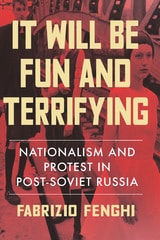
It Will Be Fun and Terrifying
Nationalism and Protest in Post-Soviet RussiaFabrizio Fenghi
University of Wisconsin Press, 2021
The National Bolshevik Party, founded in the mid-1990s by Eduard Limonov and Aleksandr Dugin, began as an attempt to combine radically different ideologies. In the years that followed, Limonov, Dugin, and the movements they led underwent dramatic shifts. The two leaders eventually became political adversaries, with Dugin and his organizations strongly supporting Putin’s regime while Limonov and his groups became part of the liberal opposition.
To illuminate the role of these right-wing ideas in contemporary Russian society, Fabrizio Fenghi examines the public pronouncements and aesthetics of this influential movement. He analyzes a diverse range of media, including novels, art exhibitions, performances, seminars, punk rock concerts, and even protest actions. His interviews with key figures reveal an attempt to create an alternative intellectual class, or a “counter-intelligensia.” This volume shows how certain forms of art can transform into political action through the creation of new languages, institutions, and modes of collective participation.
To illuminate the role of these right-wing ideas in contemporary Russian society, Fabrizio Fenghi examines the public pronouncements and aesthetics of this influential movement. He analyzes a diverse range of media, including novels, art exhibitions, performances, seminars, punk rock concerts, and even protest actions. His interviews with key figures reveal an attempt to create an alternative intellectual class, or a “counter-intelligensia.” This volume shows how certain forms of art can transform into political action through the creation of new languages, institutions, and modes of collective participation.
[more]
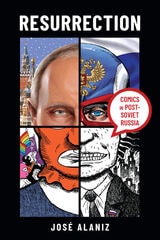
Resurrection
Comics in Post-Soviet RussiaJosé Alaniz
The Ohio State University Press, 2022
Winner, 2023 Eisner Award for Best Comics-Related Book
Resurrection: Comics in Post-Soviet Russia traces the “kopecks to rubles” journey of Russian comics at the turn of the century. As the follow-up to José Alaniz’s groundbreaking Komiks: Comic Art in Russia (2010), Resurrection authoritatively and exhaustively details the Russian comic landscape of the last three decades: beginning after the 1991 fall of the Soviet Union and encompassing the fourth Putin administration, the COVID-19 crisis, and beyond. Bolstering his analysis with interviews with some of the major figures in Russia’s comics industry, Alaniz particularly focuses on the representation of masculinity, disability, historical trauma, and superheroes, as well as on the recent rise of fandom, alternative micropresses, and nonfiction graphic narrative. Resurrection is a sweeping discussion of the metamorphosis of contemporary Russian comic art from its rebirth to its entry into mainstream culture.
Resurrection: Comics in Post-Soviet Russia traces the “kopecks to rubles” journey of Russian comics at the turn of the century. As the follow-up to José Alaniz’s groundbreaking Komiks: Comic Art in Russia (2010), Resurrection authoritatively and exhaustively details the Russian comic landscape of the last three decades: beginning after the 1991 fall of the Soviet Union and encompassing the fourth Putin administration, the COVID-19 crisis, and beyond. Bolstering his analysis with interviews with some of the major figures in Russia’s comics industry, Alaniz particularly focuses on the representation of masculinity, disability, historical trauma, and superheroes, as well as on the recent rise of fandom, alternative micropresses, and nonfiction graphic narrative. Resurrection is a sweeping discussion of the metamorphosis of contemporary Russian comic art from its rebirth to its entry into mainstream culture.
[more]