Results by title
10 books match the query 'Post-racialism'
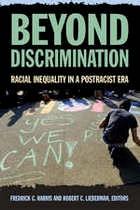
Beyond Discrimination
Racial Inequality in a Post-Racist EraFredrick C. Harris
Russell Sage Foundation, 2013
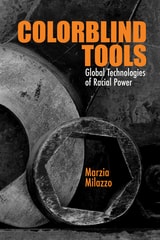
Colorblind Tools
Global Technologies of Racial PowerMarzia Milazzo
Northwestern University Press, 2023
Winner of the 2023 Association for Ethnic Studies Outstanding Book Award
A study of anti-Blackness and white supremacy across four continents demonstrates that colorblindness is neither new nor a subtype of racist ideology, but a constitutive technology of racism
In Colorblind Tools, Marzia Milazzo offers a transnational account of anti-Blackness and white supremacy that pushes against the dominant emphasis on historical change pervading current racial theory. This emphasis on change, she contends, misses critical lessons from the past.
Bringing together a capacious archive of texts on race produced in Brazil, Cuba, Mexico, Panama, the United States, and South Africa from multiple disciplines and genres, Milazzo uncovers transnational continuities in structural racism and white supremacist discourse from the inception of colonial modernity to the present. In the process, she traces the global workings of what she calls colorblind tools: technologies and strategies that at once camouflage and reproduce white domination. Whether examining Rijno van der Riet’s defense of slavery in the Cape Colony, discourses of racial mixture in Latin American eugenics and their reverberations in contemporary scholarship, the pitfalls of white “antiracism,” or Chicana indigenist aesthetics, Milazzo illustrates how white people collectively disavow racism to maintain power across national boundaries, and how anti-Black and colonial logics can be reproduced even in some decolonial literatures. Milazzo’s groundbreaking study proves that colorblindness is not new, nor is it a subtype of racist ideology or a hallmark of our era. It is a constitutive technology of racism—a tool the master cannot do without.
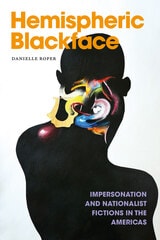
Hemispheric Blackface
Impersonation and Nationalist Fictions in the AmericasDanielle Roper
Duke University Press, 2025
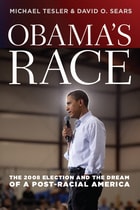
Obama's Race
The 2008 Election and the Dream of a Post-Racial AmericaMichael Tesler and David O. Sears
University of Chicago Press, 2010
Barack Obama’s presidential victory naturally led people to believe that the United States might finally be moving into a post-racial era. Obama’s Race—and its eye-opening account of the role played by race in the election—paints a dramatically different picture.
The authors argue that the 2008 election was more polarized by racial attitudes than any other presidential election on record—and perhaps more significantly, that there were two sides to this racialization: resentful opposition to and racially liberal support for Obama. As Obama’s campaign was given a boost in the primaries from racial liberals that extended well beyond that usually offered to ideologically similar white candidates, Hillary Clinton lost much of her longstanding support and instead became the preferred candidate of Democratic racial conservatives. Time and again, voters’ racial predispositions trumped their ideological preferences as John McCain—seldom described as conservative in matters of race—became the darling of racial conservatives from both parties. Hard-hitting and sure to be controversial, Obama’s Race will be both praised and criticized—but certainly not ignored.
Race among Friends
Exploring Race at a Suburban SchoolModica, Marianne
Rutgers University Press, 2015
This intriguing volume focuses on a “racially friendly” suburban charter school called Excellence Academy, highlighting the ways that students and teachers think about race and act out racial identity. Modica finds that even in an environment where students of all racial backgrounds work and play together harmoniously, race affects the daily experiences of students and teachers in profound but unexamined ways. Some teachers, she notes, feared that talking about race in the classroom would open them to charges of racism, so they avoided the topic. And rather than generate honest and constructive conversations about race, student friendships opened the door for insensitive racial comments by whites, resentment and silence by blacks, and racially biased administrative practices. In the end, the school’s friendly environment did not promote—and may have hindered—serious discussion of race and racial inequity.
The desire to ignore race in favor of a “colorblind society,” Modica writes, has become an entrenched part of American culture. But as Race Among Friends shows, when race becomes a taboo subject, it has serious ramifications for students and teachers of all ethnic origins.
Racism Postrace
Roopali Mukherjee, Sarah Banet-Weiser, and Herman Gray, editors
Duke University Press, 2019
Contributors. Inna Arzumanova, Sarah Banet-Weiser, Aymer Jean Christian, Kevin Fellezs, Roderick A. Ferguson, Herman Gray, Eva C. Hageman, Daniel Martinez HoSang, Victoria E. Johnson, Joseph Lowndes, Roopali Mukherjee, Safiya Umoja Noble, Radhika Parameswaran, Sarah T. Roberts, Catherine R. Squires, Brandi Thompson Summers, Karen Tongson, Cynthia A. Young
Rhetorics of Whiteness
Postracial Hauntings in Popular Culture, Social Media, and EducationEdited by Tammie M. Kennedy, Joyce Irene Middleton, Krista Ratcliffe, with a foreword by Lilia D. Monzó and Peter McLaren
Southern Illinois University Press, 2017
With the election of our first black president, many Americans began to argue that we had finally ended racism, claiming that we now live in a postracial era. Yet near-daily news reports regularly invoke white as a demographic category and recount instances of racialized violence as well as an increased sensitivity to expressions of racial unrest. Clearly, American society isn’t as color-blind as people would like to believe. In Rhetorics of Whiteness: Postracial Hauntings in Popular Culture, Social Media, and Education, contributors reveal how identifications with racialized whiteness continue to manifest themselves in American culture.
The sixteen essays that comprise this collection not only render visible how racialized whiteness infiltrates new twenty-first-century discourses and material spaces but also offer critical tactics for disrupting this normative whiteness. Specifically, contributors examine popular culture (novels, films, TV), social media (YouTube, eHarmony, Facebook), education (state law, the textbook industry, dual credit programs), pedagogy (tactics for teaching via narratives, emotional literacy, and mindfulness) as well as cultural theories (concepts of racialized space, anti-dialogicism, and color blindness). Offering new approaches to understanding racialized whiteness, this volume emphasizes the importance of a rhetorical lens for employing whiteness studies’ theories and methods to identify, analyze, interpret, and interrupt representations of whiteness.
Although whiteness studies has been waning as an active research field for the past decade, the contributors to Rhetorics of Whiteness assert that it hasn’t lost its relevancy because racialized whiteness and issues of systemic racism persist in American society and culture today. Few whiteness studies texts have been published in rhetoric and composition in the past decade, so this collection should quickly become mandatory reading. By focusing on common, yet often overlooked, contemporary examples of how racialized whiteness haunts U.S. society, Rhetorics of Whiteness serves as a valuable text for scholars in the field as well as anyone else interested in the topic.
Signifying Without Specifying
Racial Discourse in the Age of ObamaLi, Stephanie
Rutgers University Press, 2011
On the campaign trail, Barack Obama faced a difficult task—rallying African American voters while resisting his opponents’ attempts to frame him as “too black” to govern the nation as a whole. Obama’s solution was to employ what Toni Morrison calls “race-specific, race-free language,” avoiding open discussions of racial issues while using terms and references that carried a specific cultural resonance for African American voters.
Stephanie Li argues that American politicians and writers are using a new kind of language to speak about race. Challenging the notion that we have moved into a “post-racial” era, she suggests that we are in an uneasy moment where American public discourse demands that race be seen, but not heard. Analyzing contemporary political speech with nuanced readings of works by such authors as Toni Morrison, Jhumpa Lahiri, and Colson Whitehead, Li investigates how Americans of color have negotiated these tensions, inventing new ways to signal racial affiliations without violating taboos against open discussions of race.
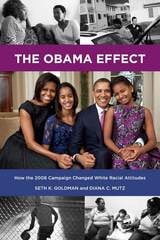
The Obama Effect
How the 2008 Campaign Changed White Racial AttitudesSeth K. Goldman
Russell Sage Foundation, 2014
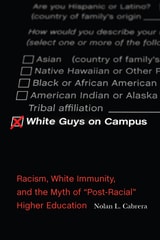
White Guys on Campus
Racism, White Immunity, and the Myth of "Post-Racial" Higher EducationCabrera, Nolan L
Rutgers University Press, 2019
On April 22, 2015, Boston University professor Saida Grundy set off a Twitter storm with her provocative question: “Why is white America so reluctant to identify white college males as a problem population?” White Guys on Campus is a critical examination of race in higher education, centering Whiteness, in an effort to unveil the frequently unconscious habits of racism among White male undergraduates. Nolan L. Cabrera moves beyond the “few bad apples” frame of contemporary racism, and explores the structures, policies, ideologies, and experiences that allow racism to flourish. This book details many of the contours of contemporary, systemic racism, while engaging the possibility of White students to participate in anti-racism. Ultimately, White Guys on Campus calls upon institutions of higher education to be sites of social transformation instead of reinforcing systemic racism, while creating a platform to engage and challenge the public discourse of “post- racialism.”