Results by title
4 books match the query 'Postcolonialism and music'
Creolized Aurality
Guadeloupean Gwoka and Postcolonial PoliticsJérôme Camal
University of Chicago Press, 2019
In the Caribbean island of Guadeloupe, the complex interplay between anticolonial resistance and accommodation resounds in its music. Guadeloupean gwoka music—a secular, drum-based tradition—captures the entangled histories of French colonization, movements against it, and the uneasy process of the island’s decolonization as an overseas territory of France. In Creolized Aurality, Jérôme Camal demonstrates that musical sounds and practices express the multiple—and often seemingly contradictory—cultural belongings and political longings that characterize postcoloniality. While gwoka has been associated with anti-colonial activism since the 1960s, in more recent years it has provided a platform for a cohort of younger musicians to express pan-Caribbean and diasporic solidarities. This generation of musicians even worked through the French state to gain UNESCO heritage status for their art. These gwoka practices, Camal argues, are “creolized auralities”—expressions of a culture both of and against French coloniality and postcoloniality.
[more]

Flip the Script
European Hip Hop and the Politics of PostcolonialityJ. Griffith Rollefson
University of Chicago Press, 2017
Hip hop has long been a vehicle for protest in the United States, used by its primarily African American creators to address issues of prejudice, repression, and exclusion. But the music is now a worldwide phenomenon, and outside the United States it has been taken up by those facing similar struggles. Flip the Script offers a close look at the role of hip hop in Europe, where it has become a politically powerful and commercially successful form of expression for the children and grandchildren of immigrants from former colonies.
Through analysis of recorded music and other media, as well as interviews and fieldwork with hip hop communities, J. Griffith Rollefson shows how this music created by black Americans is deployed by Senegalese Parisians, Turkish Berliners, and South Asian Londoners to both differentiate themselves from and relate themselves to the dominant culture. By listening closely to the ways these postcolonial citizens in Europe express their solidarity with African Americans through music, Rollefson shows, we can literally hear the hybrid realities of a global double consciousness.
Through analysis of recorded music and other media, as well as interviews and fieldwork with hip hop communities, J. Griffith Rollefson shows how this music created by black Americans is deployed by Senegalese Parisians, Turkish Berliners, and South Asian Londoners to both differentiate themselves from and relate themselves to the dominant culture. By listening closely to the ways these postcolonial citizens in Europe express their solidarity with African Americans through music, Rollefson shows, we can literally hear the hybrid realities of a global double consciousness.
[more]
Macau and Catholic Sacred Music Across the Sino-Western Divide
Jen-yen Chen
University of Michigan Press, 2026
For three centuries, the former Portuguese colony of Macau served as the gateway into mainland China and the locale for the development of an Asian Catholic culture that encompassed distinctive musical practices and styles. Macau and Catholic Music Across the Sino-Western Divide draws extensively upon historical documents in Chinese and Portuguese for a polylingual approach to Catholic sacred music. Jen-yen Chen follows this music from the sixteenth century through the twentieth by reading literary accounts of sound, primary source documents, and musical notation to examine the impacts of linguistic, political, and cultural divides and the ways sounds have traveled across these divides. Chen covers Chinese responses to Western sounds in Macau and southern China, illuminating the strategies for the use of sounds and musicking adopted by Jesuit missionaries; and the complexities of identity formation negotiated by Macau Catholics who confront exceptionalist historical discourses of Chinese or Portuguese “greatness.”
Drawing from sound studies and musicological methods, Chen argues that Chinese descriptions of Catholic sounds in Macau, including the ringing of church bells, the playing of the organ, and choral singing, illuminate spatial, sonic, and ideological mobilities that reconfigure Chinese and European identities. Macau and Catholic Music Across the Sino-Western Divide also extends to contemporary times to explore how present day members of Macau’s Catholic community position themselves in relation to the historical narratives often told about their city, cultivating a rich individuality of identity that refuses conformity to fixed notions of Asianness or Westernness.
Drawing from sound studies and musicological methods, Chen argues that Chinese descriptions of Catholic sounds in Macau, including the ringing of church bells, the playing of the organ, and choral singing, illuminate spatial, sonic, and ideological mobilities that reconfigure Chinese and European identities. Macau and Catholic Music Across the Sino-Western Divide also extends to contemporary times to explore how present day members of Macau’s Catholic community position themselves in relation to the historical narratives often told about their city, cultivating a rich individuality of identity that refuses conformity to fixed notions of Asianness or Westernness.
[more]
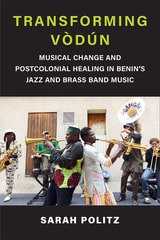
Transforming Vòdún
Musical Change and Postcolonial Healing in Benin's Jazz and Brass Band MusicSarah Politz
University of Michigan Press, 2023
Transforming Vòdún examines how musicians from the West African Republic of Benin transform Benin’s cultural traditions, especially the ancestral spiritual practice of vòdún and its musical repertoires, as part of the process of healing postcolonial trauma through music and ritual. Based on fieldwork in Benin, France, and New York City, Sarah Politz uses historical ethnography, music analysis, and participant observation to examine three case studies of brass band and jazz musicians from Benin. The multi-sited nature of this study highlights the importance of mobility, and diasporic connections in musicians’ professional lives, while grounding these connections in the particularities of the African continent, its histories, its people, and its present.
[more]